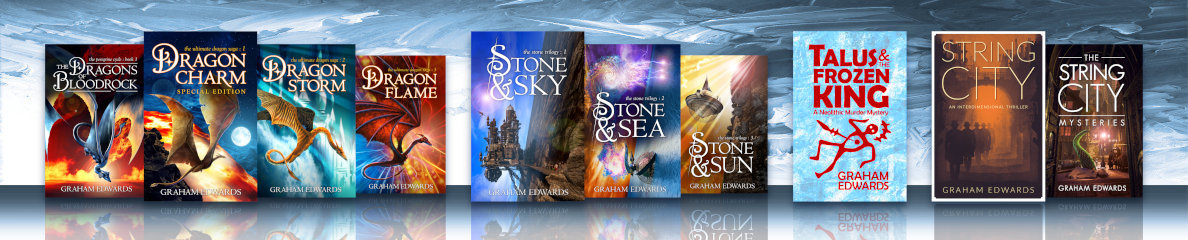

I occasionally visit local primary schools to talk about creative writing and my experiences in the publishing industry. Halfway through telling the children about my first novel Dragoncharm, I bring out the original typescript and drop it on the table. At 798 pages it makes quite a bang (and raises plenty of surprised giggles). It’s a good icebreaker.
When I reveal that the first draft handwritten manuscript was even bigger, they gasp. Of course, my humble offering is nothing compared to some. If you don’t believe me, find yourself a picture of Neal Stephenson’s Baroque Cycle manuscript. If you dropped that bad boy it would fall through the floor!
Apart from creating a bit of theatre, dropping the pages sets me up to make a particular observation – namely that seeing your work in print after slaving over a manuscript can be a bit weird. You pick up the book and think, “This isn’t what I wrote – what I wrote weighs the same as a small child and can be reduced to chaos by high winds.”
Of course, when you write – as I do these days – mostly on a laptop, it flips to the opposite extreme. “What I wrote” is now a scrollable string of virtual words I can carry around on a USB stick so small I have to be sure not wear the trousers with the hole in the pocket. Yes, I print it out (it always reads differently on the page) but the principle holds true: compared to the original, the paperback version feels like something from another planet.
When your work’s published online it’s a little different. In many ways the text looks much the same as it does on your laptop. On the other hand, I still don’t feel too comfortable reading on screen, so I’ll most likely print it out anyway!
So when I’m asked, “Do you read your own books?” the answer is, “Yes, I do.” Not out of vanity but because, however familiar the text may be (and however sick of it I may have grown!), it always looks different in its final form. Reading the final printed page gives me a chance to (a) get an idea of how my audience will perceive it and (b) appraise it with a fresh eye. Okay, that’s sometimes no more fresh than a month-old kipper, but it’s as close as I’m going to get. The only alternative is to bury the thing for years and unearth it only when it’s started to turn green and move about of its own accord.
I sometimes do that too.
 Graham Edwards – Author & Journalist