If you’ve got as many questions as I have about the craft of creative writing, you’ll know how important it is to try out new things. The more you learn, the more it seems there is to learn. Every day, as they say, is a school day.
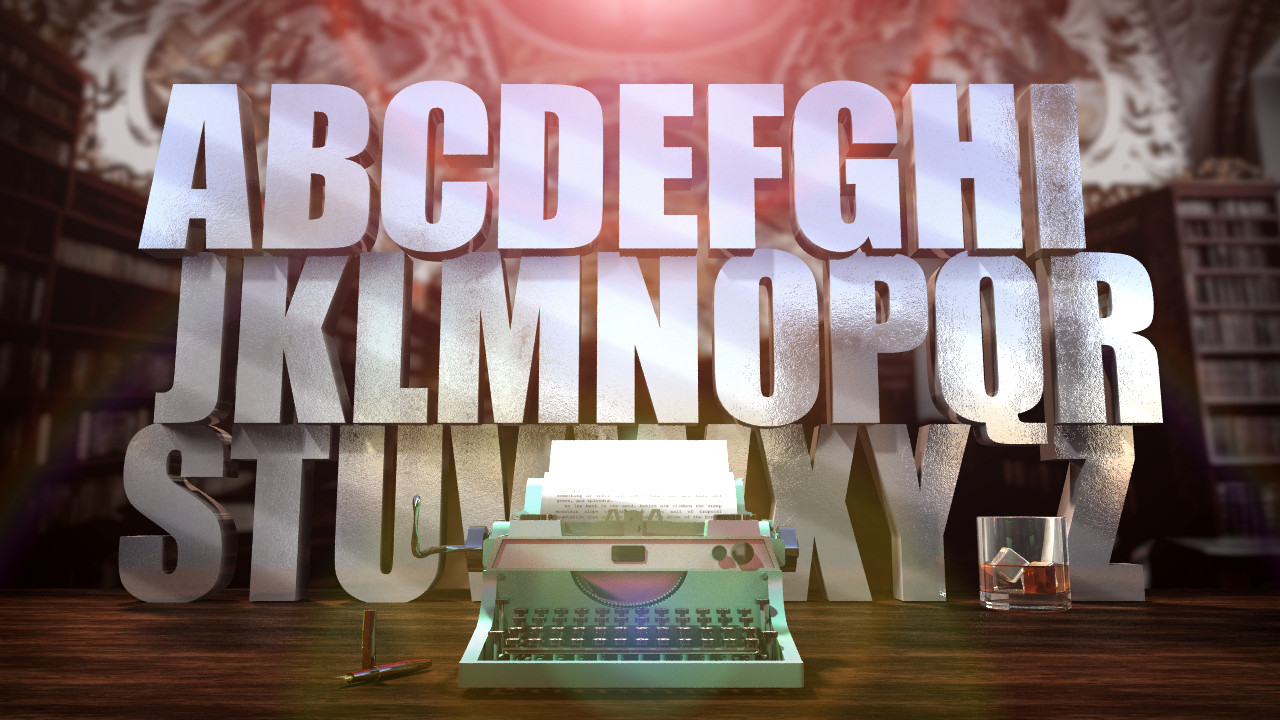
That’s what this A-Z is all about. It’s not a dictionary of answers, more a lexicon of suggestions. Some of the ideas are my own, some are based on things I’ve picked up along the way, borrowed from people far smarter than myself. It’s not a list of rules (in any case, rules are made to be broken). But it might just give you a jolt when you need it.
A is for Adjectives and Adverbs
The best thing you can do with adjectives and adverbs is ditch them. Instead of writing he ran quickly, try he sprinted. Instead of telling me the building was tall, try telling me the building towered. Continue like this and observe how concise and precise your writing becomes. Very often, the fewest words deliver the maximum effect. Less is more.
B is for But
When writing an outline for a story, add the word but into every single sentence. Jack crosses the rope bridge BUT the rain has made it slippery. He makes it to the other side BUT drops his pack in the river halfway across. He climbs down to the bank BUT the crocodiles are closing in. Instant drama.
C is for Characters
Before writing from a character’s point of view, inhabit their persona for a whole day. Be a method actor. Speak as they speak. Walk as they walk. Think as they think. If they’re alive in your head, there’s a good chance they’ll come alive on the page.
D is for Dialogue
Avoid fancy attributions like he blurted or he chuckled or he bellowed. Instead, limit yourself to the catchall he said. If your dialogue’s any good, and if you’ve established the right context, your reader will know exactly what tone of voice your character is using without you having to ram it down their throat. While you’re at it, throw caution to the wind and cut out the attribution altogether. If the dialogue is really fizzing, you don’t need anything else at all.
E is for Engine
All good stories need an engine. Something that keeps them driving forward. Your engine might be a quest, or a deadline, or a mystery to solve. It might be something else altogether. Pour all your energy into keeping that engine ticking. Better still, keep it roaring. Make sure every single scene adds fuel to the fire. Rev that engine until it’s ready to explode. Then try revving it some more.
F is for Folklore
Folklore is stories that survive not just for years, but for generations. Folklore has power. Folklore has resonance. Dust off those old myths and legends – not the Disney versions, but the down-and-dirty originals. Find something in them that gives your modern prose a timeless heart.
G is for Genre
Fantasy. Crime. Horror. Romance. Historical. The list goes on. If you think you’re restricted to only one genre, maybe it’s time to try another. Maybe the techniques you thought applied only to one genre apply to another. Maybe they apply to them all. If you don’t experiment, how will you ever know?
H is for Hook
Also known as the elevator pitch. This is how it goes. Imagine you’re standing in an elevator with a prospective publisher. You’ve got fifteen seconds to pitch the idea for your new novel before the doors open and the golden opportunity is gone forever. Can you condense all those crazy ideas into a short, compelling hook, something you can blurt out in a single breath? Give it a try – it’s harder than you think.
I is for Ignore
There are plenty of people out there offering advice to creative writers. Some of it’s good. Some of it’s bad. When you find a piece of advice that speaks to you, go ahead and follow it. Then, try ignoring it. You’ll soon learn to separate the wheat from the chaff. Of course, you can always ignore what I just said.
J is for Jekyll and Hyde
Everyone has a dark side. Unleash yours and see how it affects your writing. Put the laptop away and instead write with scratchy black ink on tattered parchment. Curse. Be angry. Drool. Your mild-mannered Dr Jekyll might be surprised by what the unrestrained Mr Hyde has to say.
K is for Knots
You’ve heard of plot threads? Well, plot knots are those nasty places where all the strands of your story get tangled hopelessly together. When this happens, put on your editor’s hat. Comb your way through the text. Streamline. Simplify. When you have to, grab the nearest pair of scissors and cut, cut, cut.
L is for Lyrics
At their best, song lyrics are short-form fiction packed with meaning. Because they’re all wrapped up in music, they also spark emotional reactions that are entirely personal to you. Take the lyrics from one of those old songs that keeps echoing around your head. Does it suggest a story to you? Yes? What are you waiting for? Write the damn thing down.
M is for Monsters
Monsters stalk. Monsters bite. Without monsters, your story has no conflict. I’m not talking about vampires or zombies – although they might suit you well enough. I’m talking about human failings and human fears. Misfortune and misunderstanding. Jealousy and guilt. Despair. All these things have teeth. Put them in your story and see if they bite.
N is for Night Terrors
Night is when the monsters come out. The thing is, the monsters are you. If you doubt me, think about the last time you lay awake in the small hours, surrounded by shadows, thinking awful things. Regrets about the day you’ve just had, fears about the day yet to come. Terror that the bogeyman’s gonna get ya. Channel that sense of dark foreboding. What springs from it may not necessarily be a horror story, but it will be soaked in the kind of visceral emotion you cannot access any other way.
O is for Ordnance
Consider your readers as targets. Take your sniper’s rifle and pick them off with unsettling revelations about the characters you’ve caused them to love. Turn your plot into a minefield and force your readers to pick their way gingerly through its twists and turns, fearful of what might go off next. Just when they think they’ve reached safe ground, open up with the heavy artillery and blow them to pieces.
P is for Panic
Panic is an essential part of creativity. Every writer who has faced the yawning abyss of the empty page knows this. The empty page tells you that you’re out of ideas, that you’ve lost what little talent you had, that you’re all washed up. Every artist experiences this, whatever medium they’re working in. Embrace the panic. Make it your bedfellow. Without the panic, neither prose nor poetry will come. The panic is part of you, whether you like it or not.
Q is for Quite
This is a warning. The word quite has no place in your writing, neither textually nor conceptually. Don’t write something that’s quite good, write something that’s extraordinary. Don’t be quite emotional, rip your reader’s heart to shreds. Don’t be quite committed to your craft, live and breathe everything everything it demands of you.
R is for Revolutionary
Everything’s been done. No story is unique. But you are. So, write in a way that only you can write. Tell your story in a way that only you can tell it. Rebel. Refuse to conform. Find your voice and use it. Start the revolution.
S is for Superhero
As a writer, your job is to observe the strange behaviour of the human beings that surround you and report back on what you’ve seen. For that, you’re going to need X-ray vision. Sometimes you will face the deadly Kryptonite that is the rejection letter. However, when the words ripple from your heart to surround you like a magical billowing cape, you’ll remember that you can fly.
T is for Tools in the Twilight Zone
It’s vital that you understand the craft of the writer. Use your tools to sharpen your spelling and polish your grammar. Make the words work for you. Carve that prose, then hone it. At the same time, always remember there’s one place that will always remain beyond the reach of any Earthly toolbox. I’m talking about the strange and hidden realm where the ideas come from in the first place. Rod Serling knew it well. It’s called the Twilight Zone.
U is for Unknown
Every creative project is a voyage into the unknown. Whenever you begin writing, throw away your compass and charts. Unlash the rudder and let the winds take you where they will. Be prepared for storms, shallows, pirates, sea serpents and whirlpools. Set your eye on the horizon and take your reader far beyond it. Be adventurous. Pathfind. Explore.
V is for Vital
You can never be sure you’ve got your reader’s full attention. Why should they be interested in your story when there’s something better on the TV, when they’re approaching their stop on the train, when they’re hungry, when they’re just plain tired? Make your story vital. Make it essential to your readers that they keep reading, whatever the cost. Make it critical that they find out what happens next. Force your reader to turn off the television, make them miss their stop, starve them, keep them up all night.
W is for Words
Love the words. It’s as simple as that. As a writer, words are your currency and your lifeblood. Learn their tricks. Learn the tricks other writers play with them. Learn their many meanings, then invent some of your own. See how words change when they rub up against each other. Watch them dance. Worship them, because they’re all you’ve got. Luckily, words are also all you need.
X is for X
Write as if you’re searching for a missing truth. The answer to the unsolvable equation. That elusive factor that makes sense of the world and all that happens in it. The ineffable. The sublime. The still point of the turning world. X. Nobody’s found it yet. Maybe you’ll be the one.
Y is for Yes
Every time you ask yourself, “Have I really got time to write today?” Every time you ask yourself, “Is what I’m doing any good?” Every time you ask yourself, “Can I do it?” The answer is, “Yes.”
Z is for Zombie Attack
When the zombie apocalypse finally comes, take heart from the sure knowledge that never in the history of the world has there been a single documented case of the undead killing and eating a creative writer. As a creative writer, your survival amid the burning wreckage of civilisation is completely assured.
So, cast all fear aside. Take those twenty-six little letters and assemble them into the words you need to tell the story that wants to burst out of your head. Do what you were built to do.
Write.
 Graham Edwards
Reblogged this on Kaffee und Kuchen.