There’s a rhythm to life at Cinefex. No sooner do you get your teeth stuck into a new assignment than the previous one comes knocking at the door again.
The new assignment in question is my article for our February issue. The movie I’m covering won’t be released until next year but my copy deadline is early December, so right now I’m trekking through my interviews and trying to bludgeon the material into some kind of order. If you’re wondering what the movie is, sorry, mum’s the word.
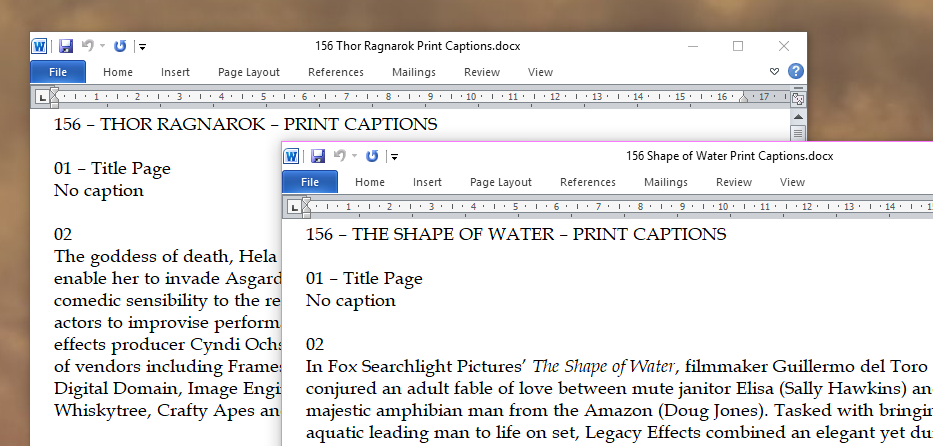
The previous assignment – two assignments, actually – is back because it’s time to write the picture captions for the print edition of Cinefex 156. That might not sound like a big deal, until you understand that Cinefex captions doesn’t just describe what’s going on in the pictures. In fact, they’re almost a mini-assignment in themselves. The idea is that, by browsing the captions in sequence, the casual reader gets a highly condensed overview of the main article.
Print Captions
My first job when writing the print captions is to study the collection of amazing images that our publisher, Gregg Shay, has selected for the article. Typically these include film stills, behind the scenes photographs and visual effects before-and-afters, all approved by the studio for publication.
Next, I’ll try to give the image context in terms of the film’s narrative, and write copy that explains the picture contents. If space allows, I’ll provide extra contextual detail that helps to illuminate things further. All this means lifting content from the final draft article, editing and rewording to present the information in fresh, compressed form. I have just 100 words to play with for each caption, so it’s a meticulous process where every syllable counts, and some captions cover more than one picture. My print edition article on The Shape of Water has 19 pictures and 11 captions; Thor: Ragnarok has 24 pictures and 19 captions. For the captions of both articles together, I’ve written about 2,500 words.
Occasionally, Gregg will throw something at me that demands additional research. Maybe there’s a photo of a bunch of sculptors in a creature shop, with no indication of their names (when people appear in the photos, we always try to credit them). Even when I do recognise faces, I always double-check – the camera does sometimes lie you know. Or maybe there’s a gorgeous-looking visual effects shot that didn’t specifically get discussed during the interview, or that was mentioned only in passing. This doesn’t happen very often, but when it does it prompts a hasty call or email to the supervisor concerned, something along the lines of: “Help! I have to write something intelligent about this shot and I have no idea what I’m looking at!”
iPad Captions
The captions for the iPad edition of Cinefex serve exactly the same purpose as those for the print edition. A lot of the time, I can simply duplicate the print captions, but there are two important differences that mean it’s not always that straightforward.
Firstly, we publish a lot more pictures in the iPad edition. The print versions of my Thor: Ragnarok and The Shape of Water articles contain 24 and 19 images respectively. On the iPad, those numbers go up to 48 and 40. That’s around double the content.
Secondly, I have to obey some slightly funky iPad formatting rules. When our publisher Gregg Shay does the layout, he assigns a code to each caption. There are nine different codes, each corresponding to a different page design. Using a specific typeface, point size and line length, I need to make sure my text conforms to the maximum space allowed by each code. This can be anywhere between 4 and 8.5 lines.
Writing the iPad captions is therefore a mix of copying and pasting from the print edition, editing the print captions down to make sure the new versions conform to the required line length, and writing completely new captions for pictures I’ve never seen before. It’s not as big a job as doing the print captions, but it has its own unique quirks. The most entertaining of these is trying to cut an already lean 100-word caption down to half its length, without losing any of the essential meaning.
 Graham Edwards – Author & Journalist