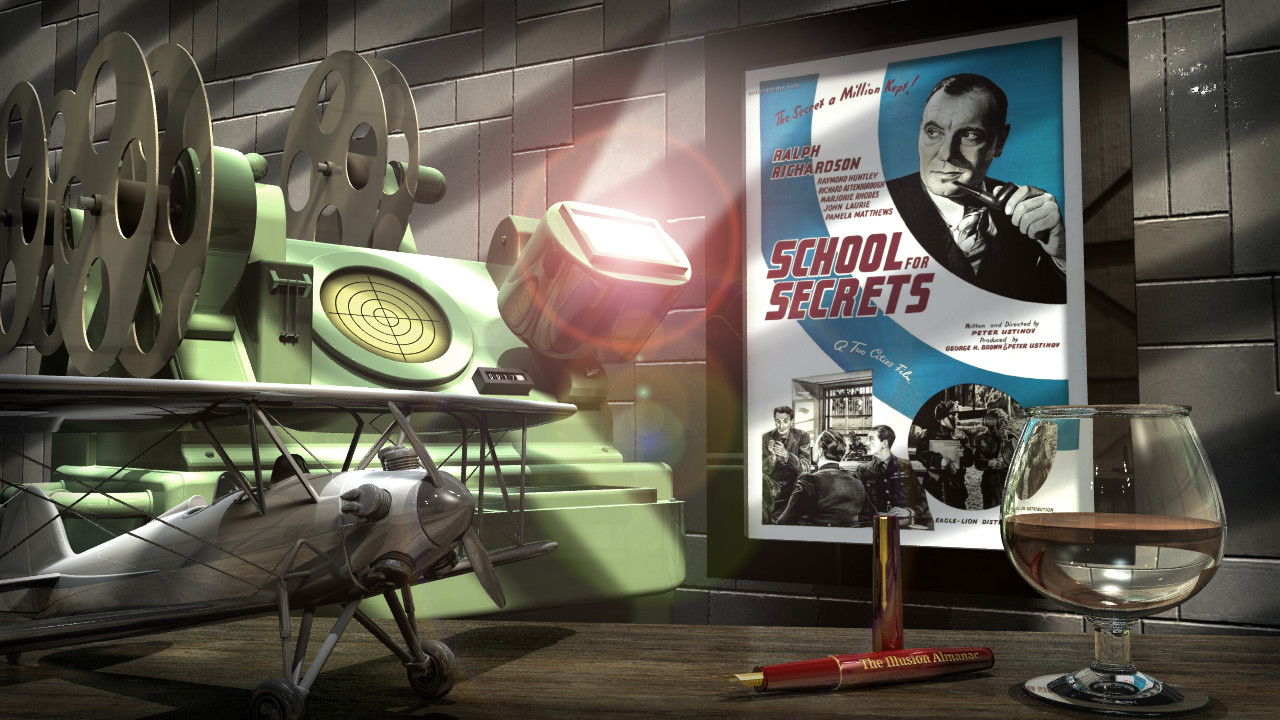
Back in the 1940s, British studios were busy producing all manner of films featuring wartime aerial combat. Many of these were propaganda pieces, while others were more conventional melodramas. The 1946 movie “School for Secrets” — also known as “Secret Flight” — was a bit of both.
Written and directed by Peter Ustinov, the film tells the story of the British scientists who developed radar during World War II. To create scenes showing planes in flight, cinematographer Harry Waxman and art director John Howell devised a range of miniature effects.
Into the Clouds
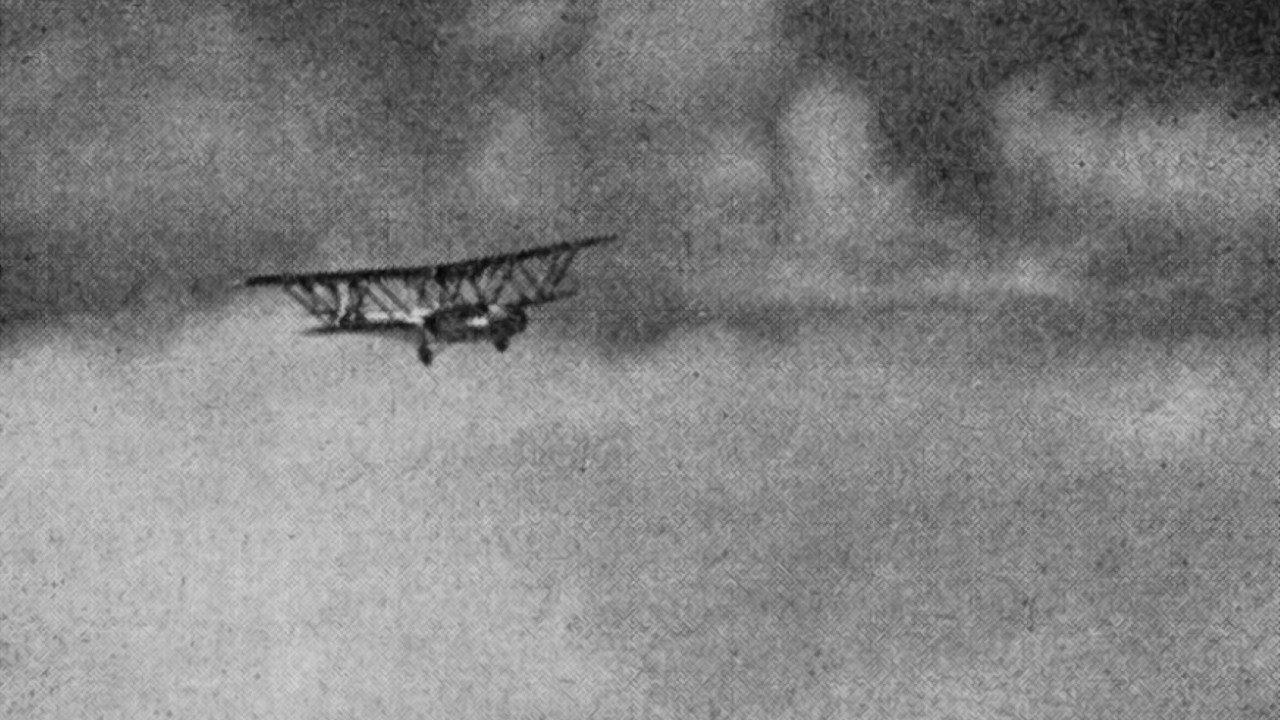
In the opening sequence of “School for Secrets,” a Handley Page HP42 passenger biplane sinks into a sea of clouds. Out of shot, it flies into a mountainside and crashes in flames.
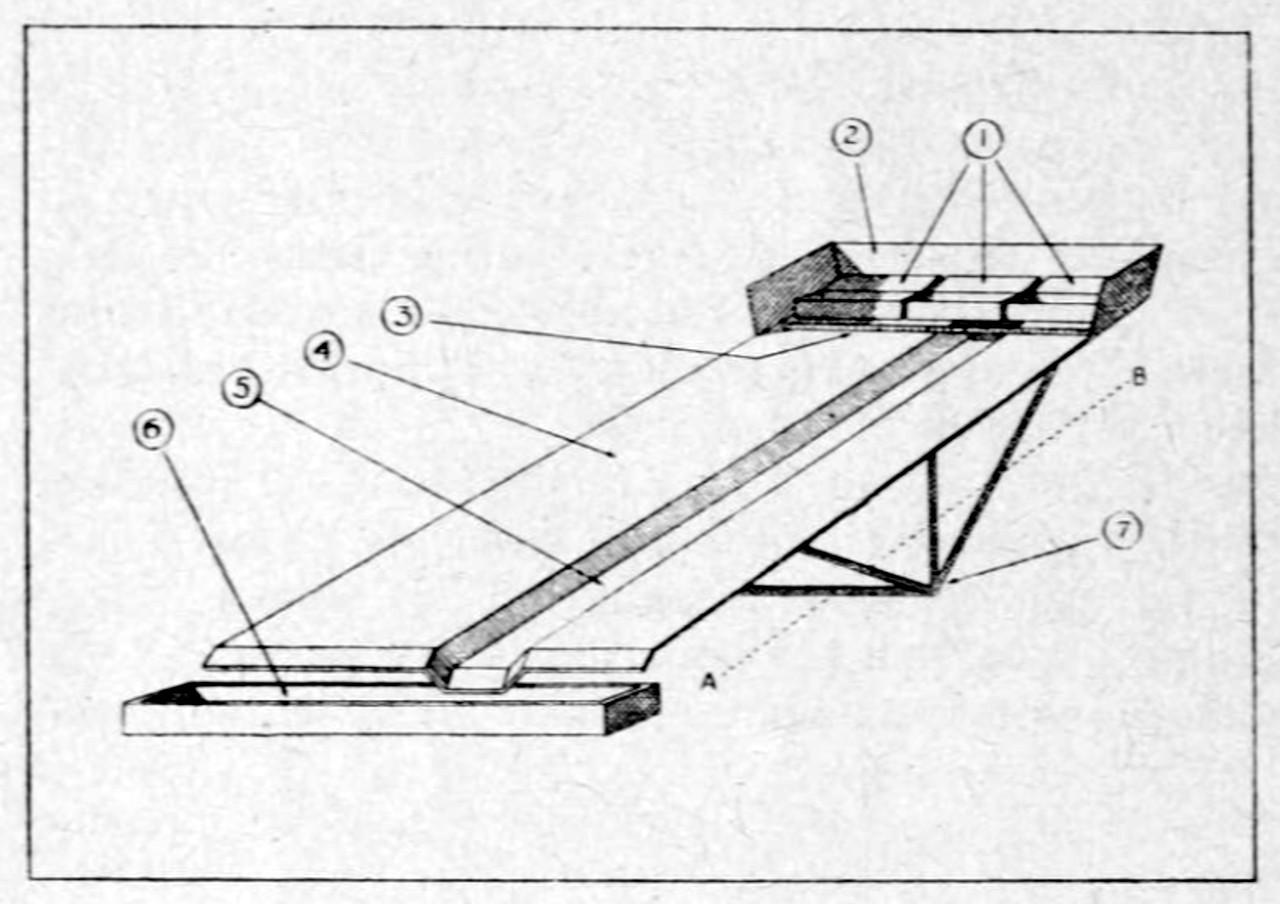
Waxman and Howell created the three dimensional cloud layer by pouring Dricold, a commercially available solid CO2 product, down a large sloping ramp. Wooden baffles placed at intervals along the ramp introduced turbulence into the vapour.
“Across the full width of the ramp at the top, metal tanks measuring 6 feet x 1 foot x 6 inches deep were placed, each tank containing about four inches of water and being fitted with heating units. Each tank was also fitted with a hinged wooden lid which opened right back into the horizontal position. ‘Dricold’ was broken up into small pieces and loaded on to the lids of the tanks so that it could be tipped into the water across the full width of the ramp when the water reached the required temperature. We found that 130°F gave us the best results.”
Harry Waxman, The Journal of the British Kinematograph Society, May/June 1947
Since dry ice vapour is easily disturbed, there was a limit to how far the ramp could be tilted before the clouds broke up completely. Unfortunately, the action required the clouds to travel faster than this limited tilt would allow. The solution was to run cold water down the ramp.
“Our clouds were now resting on a moving surface of cold water to which they seemed to adhere whilst being carried forward with a minimum of disturbance. A trough running up the full length of the ramp was provided to allow sufficient depth of cloud for the model aircraft completely to sink into.”
With the camera tilted to the same angle as the ramp, the clouds appeared to be moving horizontally. A model aircraft ran along horizontal wires, which guided it gradually into the cloud layer. Beyond the ramp was a white screen on which cloudscapes were projected, each moving at a slightly different speed to create parallax. The billowing edge of the dry ice clouds blended naturally into this projected backdrop.
Nightfighting
Later in the film, an RAF Bristol Beaufighter nightfighter shoots down a Luftwaffe Junkers 88 bomber. Shots from the Beaufighter pilot’s point of view were photographed on a full-scale cockpit set, against a back projection screen showing the enemy aircraft speeding over clouds.
Waxman and Howell assembled the back projection plates from three separately-photographed elements. The first was a wide view of the bomber in flight, complete with exploding engine. The second was the tracer bullets from the nightfighter that cause the explosion, and the third was the puff of smoke that immediately precedes it.
For the first element, the team photographed a Junkers 88 miniature flying on wires over dry ice clouds, revisiting the techniques they’d used for the opening sequence. On cue, a remote detonator triggered an explosive charge in the miniature bomber’s port engine. Happily, the model’s motorised propellers introduced a realistic ‘flutter’ into the ensuing flames and smoke.
Next came the tracer element, which required ten dotted lines of burning shells to converge on the engine nacelle. To ensure the trajectories lined up perfectly with the miniature plane, the team first extracted a single frame from the miniature footage, then punched a tiny pinhole through the target engine. This frame was fitted into the gate of a camera mounted some 50 feet above the stage floor, pointing straight down. Looking through the viewfinder, they were able to mark a point on the floor that aligned perfectly with the engine.
“Behind the camera and slightly below the lens — to maintain the correct relative viewpoint — a length of 4- by 2-inch timber about 12 feet long was fixed in a horizontal position. On this batten were marked the relative positions of the ten machine guns with which the Beaufighter was fitted. From each of these positions in turn a thin piano wire was run down to the marked point on the studio floor. Down these wires was then run a series of small trollies, each carrying a flashlamp bulb.”
With the stage in darkness, the flashbulbs were photographed running down the first wire, with the camera operating at six or seven frames per second. The film was then rewound and the wire moved along to the next position on the batten. Ten exposures later, the full set of tracer lines had been captured.
The final element was the puff of smoke. With the camera again mounted high and pointing straight down, the team fired a black smoke bomb through a hole in a large white board. The same registration frame technique ensured that the source of the smoke matched the position of the engine nacelle. The smoke rose naturally towards the camera, which was running at about eight frames per second.
All three elements were combined in an optical printer to produce the finished back projection plates.
Today, most visual effects artists would use fluid simulations to generate realistic clouds and explosions. The aircraft would probably be digital, although miniatures are still used from time to time.
But the underlying principle is the same. The action must read clearly on screen, and deliver the requisite drama. Every shot tells a story, in and of itself. That’s as true today as it was 80 years ago.
 Graham Edwards
One thought on “Nightfighter Special Effects of 1946”