
In February 1926, First National Pictures released its 10-reel silent epic “The Lost World.” Adapted from the novel by Sir Arthur Conan Doyle and directed by Harry O. Hoyt, it told of an expedition to a remote Amazonian plateau led by the hot-tempered Professor Challenger (Wallace Beery). On the plateau, the team of explorers discover prehistoric creatures that have survived there since the dawn of time.
The film, whose stop-motion animated dinosaurs came to life under the technical direction of Willis O’Brien, was an instant hit with audiences and critics alike. George Gerhard of the New York Evening World called it “an entirely new departure in the cinema art. It is a marvel of ingenuity, bringing to the screen, as it does, gigantic prehistoric animals, extinct for millions of years, in such manner that the spectator absolutely lives the story from beginning to end. How the animals were made to appear so lifelike is an absolute mystery.”
“The Lost World” enjoyed its world premiere on 2 February, 1925, at the Tremont Temple Theatre in Boston. The event was accompanied by a massive publicity campaign engineered by Mark Kellogg, First National’s director of advertising, and Allan S. Glenn, supervisor of exploitation.
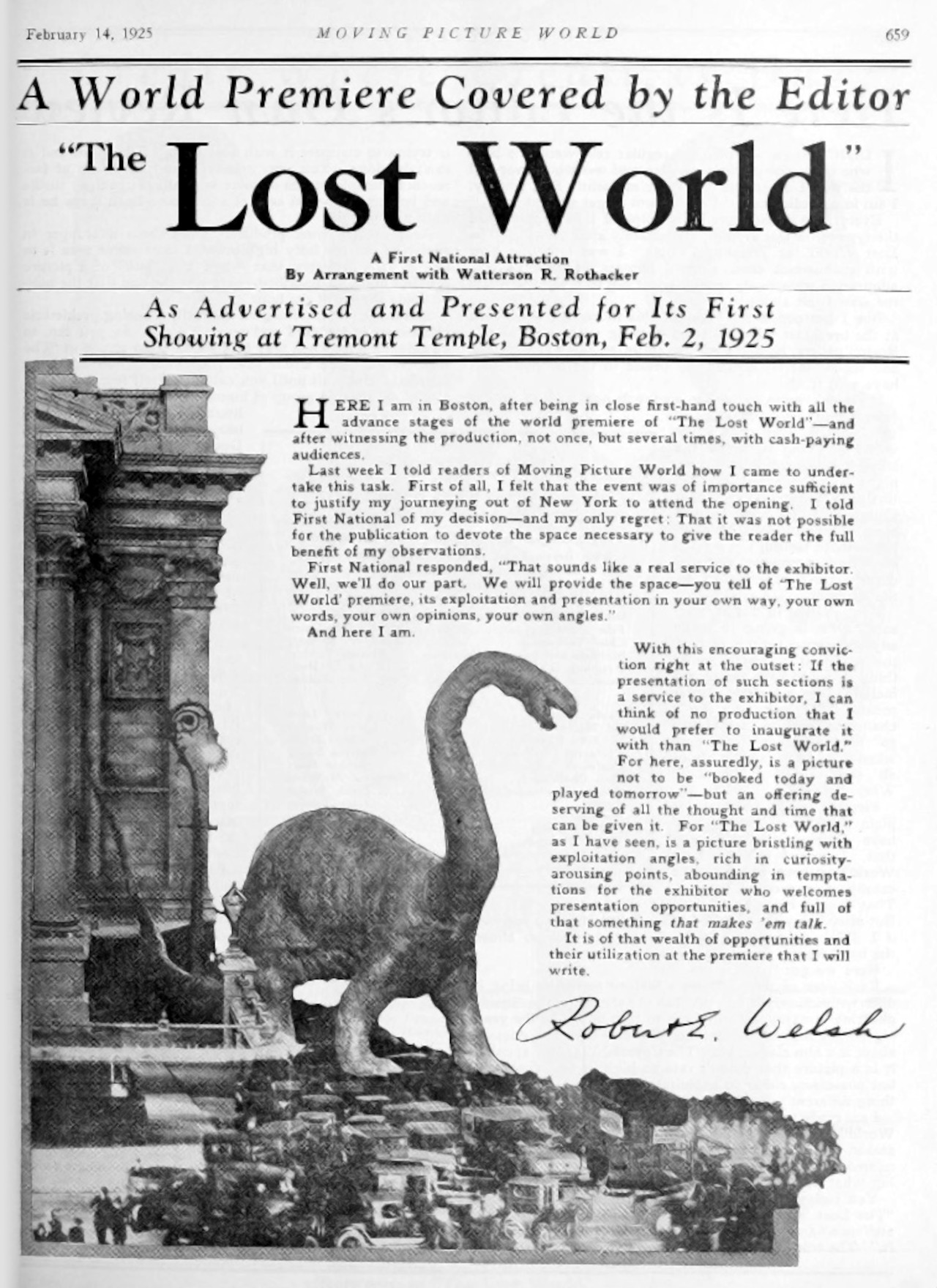
On the run-up to the premiere, newspapers including the Boston Globe and Boston Advertiser serialised the original novel, and published themed crosswords.
“The puzzles were circular in form, presenting something the appearance of the globe, so that even in shape the puzzles tied up with the title of the picture. The title of the picture, the names of the stars and of the prehistoric monsters brought to life in the film were contained either in the definitions of the words or in the words themselves. This puzzle stunt was in Boston for the entire week in advance of the showing.”
The Associated First National Franchise, Feb-Mar 1925
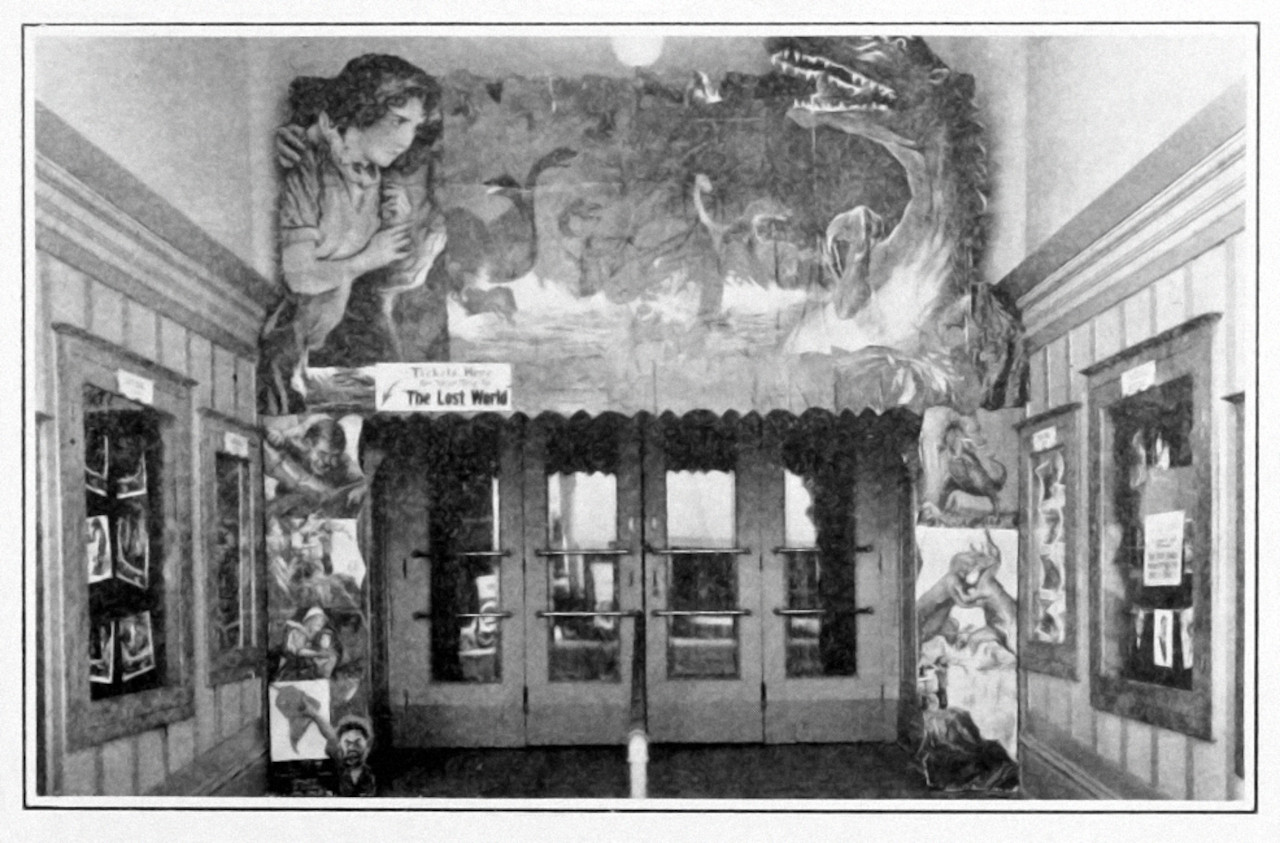
For the premiere itself, Colby Harriman, former technical director of the theatre department of Famous Players Lasky Corporation, outfitted the Tremont with an “atmospheric prologue.” The Boston Globe described this pre-show experience as “a brilliantly conceived combination of hangings and lighting effects.”
“The title of the presentation ‘The Spirit of Evolution’ fittingly summed up the work displayed, which was a synchronization of lighting and music, using the special scenic base for the interpretation of the theme. No people were used in the prologue. Three motifs comprised the action, representing a deserted cave of primitive type; a jungle wilderness; and the finale with the flaming forest, and ultimate confusion, a riot of colors. All changes were wrought by a manipulation of the lights.”
Exhibitors Herald 28 Feb 1925

Now let’s fast-forward a whole year. At the beginning of 1926, “The Lost World” was still showing widely across the United States, and would continue to draw audiences for the rest of year. Keen to capitalise on the film’s continuing popularity, theatre managers came up with their own forms of promotional “ballyhoo.”

Some managers even went on the road to lure in the punters. According to an edition of Moving Picture World from 13 Mar, 1926, Warren Irvin of the Imperial Theatre in Charlotte, North Carolina, “used a bannered street car for a full week and one day sent a steam piano through the town on a bannered truck.”

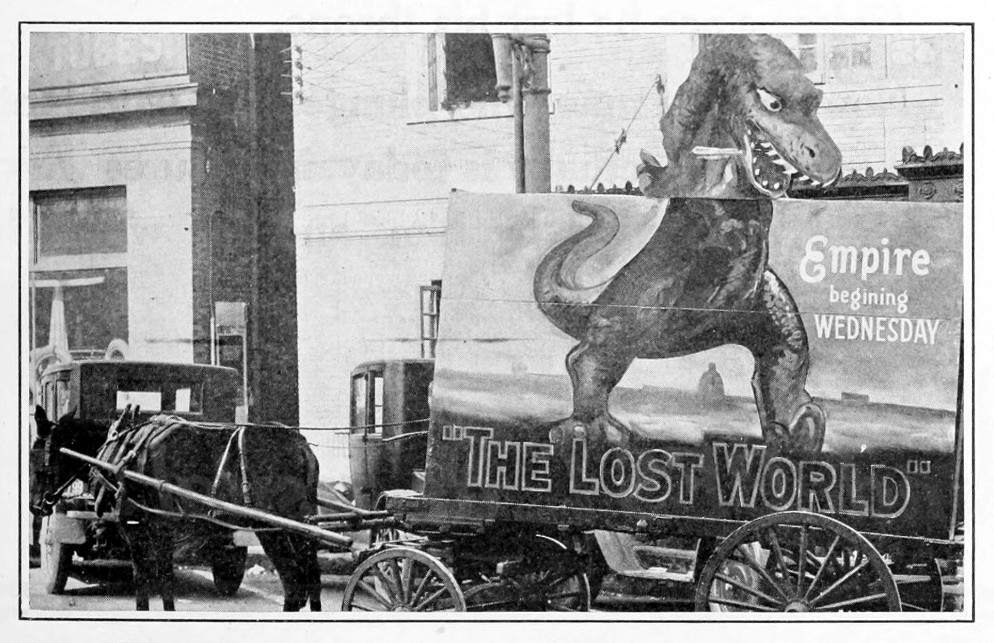
Nowadays, when going to the movies probably means a trip to a multiplex owned by an international chain, it’s hard to imagine theatre owners caring so deeply about the films they’re showing. Back in 1926, things were very different. Most movie theatres were privately owned, and managers had to rent their movies from the distributors. As quaint as all this old-school ballyhoo looks now, it was done for sound commercial reasons.
To maximise profits … and put bums on seats!
 Graham Edwards – Author & Journalist