

Buried treasure. You can find it anywhere. A forgotten corner of a dusty cupboard. A waterlogged ditch in a muddy field. Or the pages of an century-old family photo album.
I inherited the album in question some years ago. It languished on a shelf with its companions until, one day, I began the monumental task of scanning the entire collection to create a lasting digital record. The task – still ongoing – has proved to be incredibly rewarding, especially with the album I labelled Vintage Edwards-2.
Vintage Edwards-2 contains a variety of snapshots taken by my grandfather through the late 1920s and early 1930s. One batch records a day out at Parc Howard in Llanelli, South Wales, close to where my grandfather lived with his family in Felinfoel. Another chronicles a seaside holiday in Weston-super-Mare in 1928, and includes shots of the grand pier with its 2,000-seat theatre, just two years before it burned down in 1930. A third batch captures the atmosphere of the 1929 Eisteddfod Proclamation, with further shots of the Welsh cultural festival itself, held the following year in Llanelli.

The photos really are my idea of treasure. Not only do they illuminate my own family history, but they also recall a forgotten pre-war era when cars had running boards, everyone wore hats and everything was tinted a nostalgic shade of sepia.
So where does Amy Johnson come in to all this?
I’ll tell you. Tucked in there among the family snapshots are two photos I’d always struggled to identify. The first shows a big old biplane called Seafarer sitting alongside another, smaller aircraft. The second shows an unidentified woman wearing a long skirt strolling in front of a plane. Both photos appear to have been taken on a beach. I remember browsing this album in my younger years and mentally tagging these snapshots “Some Old Airshow,” before moving on to the amusing pictures of my dad as a little kid in short trousers.

When I came to digitise Vintage Edwards-2, I became increasingly obsessed by this photographic odd couple. Although they’re unlabelled, context suggested they date from the early 1930s. Did they have airshows back then? I didn’t know. Maybe they were a record of a day trip to the seaside. However, while I could understand my grandfather being taken by that rather splendid aeroplane, why on Earth did he photograph some random woman just walking around?
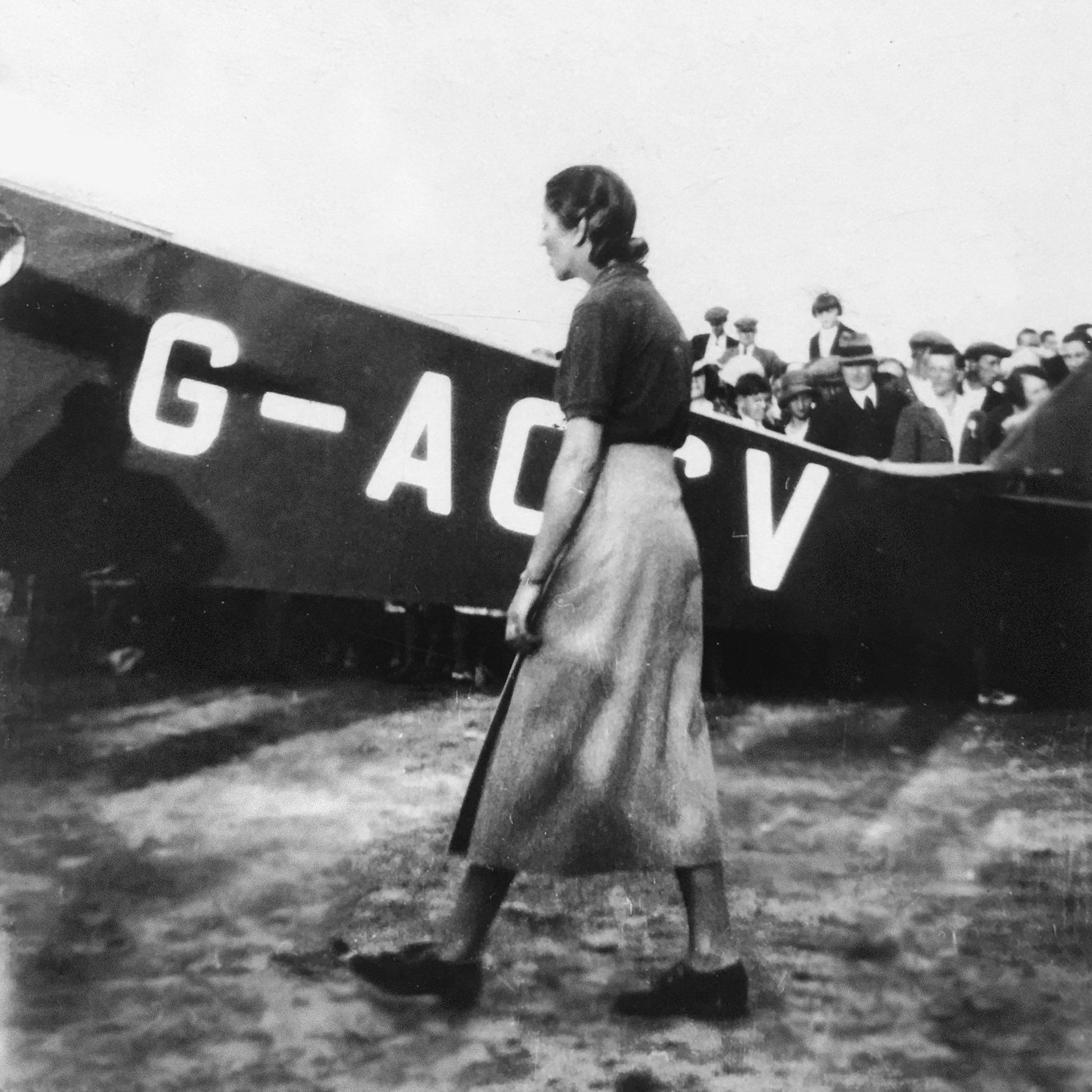
The more I stared at the photo of the woman, the more I puzzled over it. Why had my grandfather taken the picture? Back then, in the days before smartphones, photography was an expensive business. The equipment was cumbersome and everything had to be processed and printed by hand. You didn’t waste a single frame of film. Every picture was precious.
This train of thought led to my eureka moment. Never mind why he’d taken the photo. I already knew the answer to that. He’d taken it because the moment it recorded was precious to him. Which led me inevitably to the question I should be asking.
Who was the woman in the photograph?
Feeling like a bloodhound following an elusive scent, I began searching online. I had in the back of my mind that the woman might have been famous. Maybe she was an aviator, one of those pioneering pilots like Amelia Earhart. But there wasn’t much detail in the photo, and her face was turned a little away from my grandfather’s camera. How was I ever going to identify her?
Fortunately I also had the photo of the two planes. A quick internet search for “Seafarer aircraft” yielded a number of articles about the very biplane my grandfather had snapped. These same articles told me the pilot of this historic flying machine was the famous English aviator Amy Johnson.
Suddenly everything began to align. Seafarer’s registration code was G-ACCV – the same code that’s visible (if a trifle obscured) on the plane behind the mystery woman. Could it really be Amy Johnson herself? The hair looked right. If only she was looking at the camera.
The clincher came in the form of a British Movietone newsreel from 1933, which shows Amy Johnson standing in front of Seafarer with her husband Jim Mollison. In the footage she’s wearing the exact same outfit as the woman in my grandfather’s photograph. All my doubts evaporated. It was definitely her.
More research completed the jigsaw. On 3 July, 1933, Amy Johnson and Jim Mollison arrived at Pendine Sands, the same beach on the south coast of Wales where, in the 1920s, Sir Malcolm Campbell had set several world land speed records. Their plan was to pilot their new De Havilland 84 Dragon Seafarer from Pendine to New York and thus become the first husband-and-wife team to fly across the Atlantic.
Amy and her husband spent the best part of three weeks waiting for favourable weather. During that time, crowds of up to 10,000 people filled the beach in the hope of seeing the couple, who were major international celebrities. Stalls sprang up, a funfair arrived, and Pendine Sands took on an exuberant carnival atmosphere.
The crowds continued to throng the beach until high seas forced the Mollisons to fly Seafarer to Cardiff Airport for safety. They brought her back to Pendine Sands early on the morning of Saturday 22 July, finally taking off on their epic journey around noon. The following day they made landfall at Bridgeport, Stratford, Connecticut … but not as they’d intended. Short of fuel, Seafarer crashed unceremoniously to the ground, injuring her pilots. After a brief stay in hospital, Amy Johnson and her husband finally reached New York City, where enjoyed the razzmattazz of a tickertape parade.

Pendine Sands is around 30 miles from Llanelli, just right for a day trip. I don’t know precisely when my grandfather made the journey, nor do I know if he took the family – they don’t feature in the photos. Since Amy’s outfit matches what she’s wearing in the newsreel, I wonder if he was there on the same day as the British Movietone team. I’ve identified the small plane parked beside Seafarer is a De Havilland Puss Moth air taxi from London – maybe that’s how the camera crew got to Wales?
These questions will probably never be answered. Never mind. I’ve answered the one burning question by identifying the mystery woman in my grandfather’s photograph as the legendary English aviator Amy Johnson who, in 1930, put her stamp on history by becoming the first woman to fly solo from London to Australia. That’s good enough for me.
As for the photos themselves, well, they’ll remain safe in their original album. I’m delighted to report that a set of digital copies now forms part of the spectacular Amy Johnson Collection at Sewerby Hall Museum in Yorkshire. My thanks to Dr. David Marchant, Museums Registrar and Keeper of Archaeology, for making this happen.
Photographs by Martin Edwards
 Graham Edwards