The following is an extract from my article on Kong: Skull Island, published in Cinefex 152, April 2017
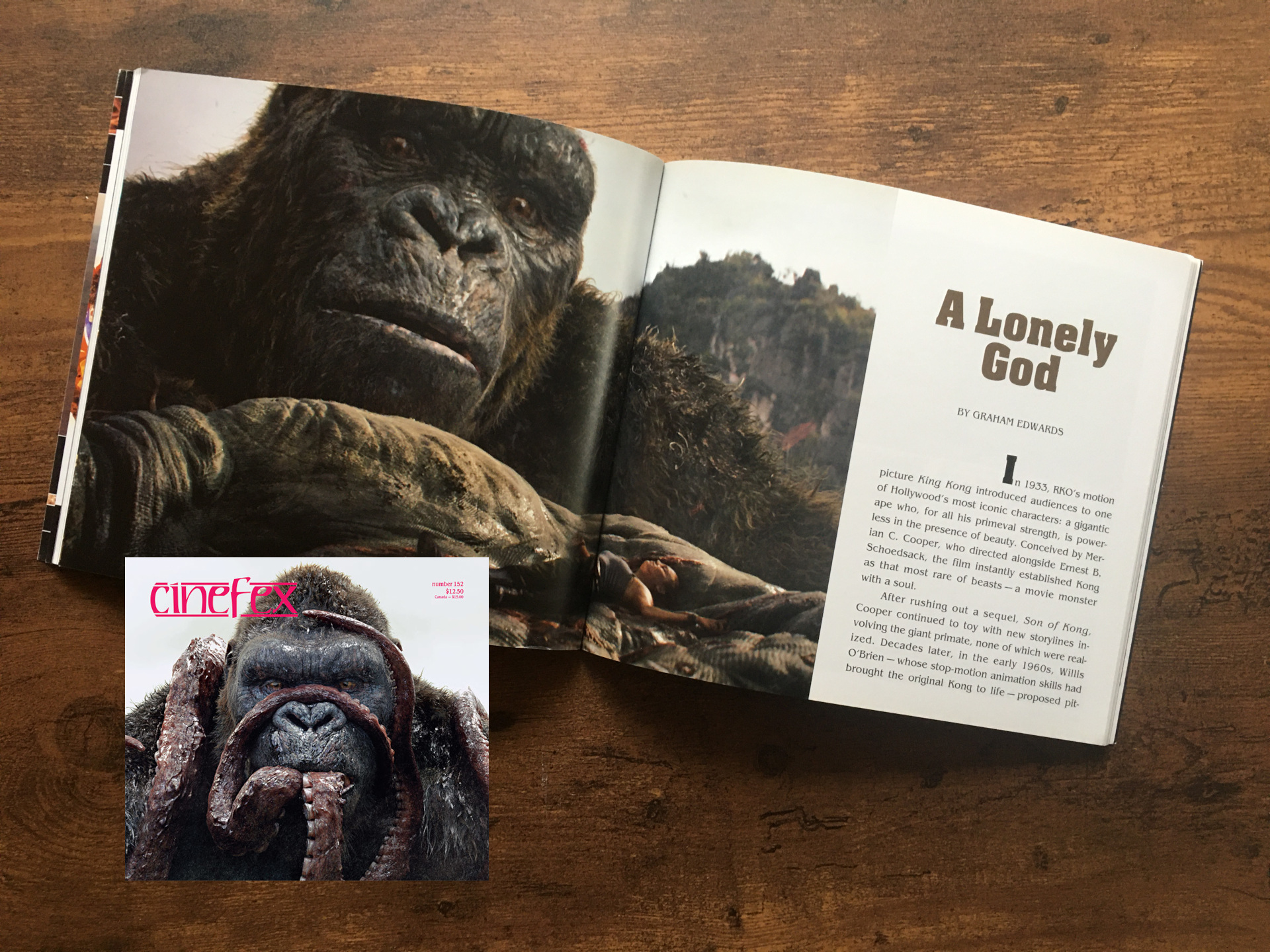
In 1933, RKO’s motion picture King Kong introduced audiences to one of Hollywood’s most iconic characters: a gigantic ape who, for all his primeval strength, is powerless in the presence of beauty. Conceived by Merian C. Cooper, who directed alongside Ernest B. Schoedsack, the film instantly established Kong as that most rare of beasts — a movie monster with a soul.
After rushing out a sequel, Son of Kong, Cooper continued to toy with new storylines involving the giant primate. During the early 1960s, Willis O’Brien — whose stop-motion animation skills had brought the original Kong to life — proposed pitting the big ape against adversaries such as Frankenstein’s monster and the Abominable Snowman. Then, in 1963, producer John Beck, the Toho company of Japan, and Universal Pictures released King Kong vs Godzilla, in which the dueling monsters were portrayed by performers in suits — a move that drove a horrified Cooper to attempt legal action asserting his ownership of the character. Dino De Laurentiis introduced Kong to the modern world with his 1976 production King Kong, while Peter Jackson returned to the original film’s period setting with his sumptuous 2005 remake.
In the summer of 2014, Legendary Pictures announced a new feature centered around Kong, entitled Skull Island. Set in 1917, the film would be a prequel to Cooper’s original. In October 2015, Legendary announced the film’s move from Universal Pictures to Warner Bros. Pictures, where it would become part of the growing franchise spawned by the studio’s 2014 production of Godzilla, with plans eventually to pit Kong against the titanic reptile, just as Toho had done. At the helm of Kong: Skull Island would be Jordan Vogt-Roberts, fresh from his feature directorial debut — the coming-of-age woodland adventure The Kings of Summer.
“When Legendary said to me, ‘What do you think about doing a new Kong movie?’” said Jordan Vogt-Roberts, “my first response was, ‘Cool,’ and my second response was: ‘Why does that need to exist? We live in an age of so many sequels and reboots that, unless something truly has a reason for being, what’s the point?’”
Acknowledging the director’s reservations — especially about the story’s period setting — the producers encouraged him to present his own concept. Vogt-Roberts responded with a pitch inspired by films set in the Vietnam War era. “I just loved the aesthetic genre mashup of choppers and napalm and monsters,” Vogt-Roberts recalled. “I thought they were going to laugh me out of the room, because it was an insane idea. Instead they said, ‘Yes.’”
For the director, the 1970s represented an era during which it was still plausible that lost islands might lie awaiting discovery in remote oceans. Equally appealing were the period’s social and political trends. “I was obsessed thematically,” Vogt-Roberts remarked, “with the crazy dark mirror that the late ‘60s and early ‘70s holds up to right now. You’re talking about race riots, political scandals, sexual revolution, people fighting for basic human rights, oil, wars that we’re losing, political unrest, distrust of the government. Then, I loved the idea of taking all these wounded characters and sending them to a place that should be cathartic and beautiful and serene and amazing, and them very quickly realizing that they don’t belong there.”
With screenwriters Dan Gilroy and Max Borenstein rewriting the script, Vogt-Roberts used concept visuals to help steer the new storyline, working with production designer Stefan Dechant and concept artists including Crash McCreery, who had created artwork for the early prequel iteration. The director also recruited designers from the videogame industry. “There’s just this incredible explosion of creativity in that field,” observed Vogt-Roberts. “Some of it can feel too heightened and unrealistic, but it doesn’t necessarily involve the same traditional movie design work that you’d normally see. I put together a book with a bunch of stills and mood imagery, then I would talk to Stefan and we would throw things to these concept artists to play with. It became this long, evolving conversation, sitting down and spitballing ideas just as if we were in a writing room trying to break the story.”
Inspired by natural wonders from around the world, Vogt-Roberts envisioned Skull Island as a ‘bastard island’ where wildly different terrains existed cheek by jowl. A location scouting trip took in Iceland, Hawaii, Thailand and Cambodia before the director finally fell in love with the heavily eroded ‘karst’ landscape of northern Vietnam, where towering limestone mountains thrust upwards from waterlogged swamps.
Principal photography commenced on Kong: Skull Island in October 2015, by which time Vietnam had become the single visual touchstone for the island’s look and feel. For logistical reasons, however, many key scenes were staged on location in Hawaii, with visual effects earmarked to give environments the required Asian ambience. “Jordan was nervous about going into the same Hawaiian locations that every movie has been to,” said Stefan Dechant. “I mean, there are parts of the Kualoa Ranch that are just owned by Gallimimus! But the jungles are easy to get in and out of, and there’s quite a bit of variety there. So I told Jordan to see Hawaii as our natural soundstage, and Vietnam as the location that would tie it all together.” Production also shot at Village Roadshow Studios in Oxenford, Australia, and on the nearby Gold Coast. A separate round of reshoots took place in the fall of 2016 on a stage in Los Angeles.
Overall visual effects producer and co-producer Tom C. Peitzman — who had championed the project throughout its development — assigned the bulk of Kong: Skull Island’s visual effects sequences, including every shot featuring Kong himself, to Industrial Light & Magic. ILM divided 752 shots between its San Francisco, Vancouver and Singapore studios, and allocated 102 shots to Hybride Technologies and 81 to Rodeo FX. At Legendary, Peitzman oversaw a small in-house department and worked with The Third Floor to deliver previs for key action sequences. Halon Entertainment provided previs support, handled postvis and delivered additional visual effects shots.
At ILM, executive visual effects producer Jill Brooks worked with associate visual effects producers Laura Moore, Russell Lum and Cabral Rock to manage the workflow. The comparatively low shot count belied the complexity of the work. “We had the three hardest things,” said Jill Brooks, “which were fur, fire and water. We had 14-hour renders per frame on some of these shots and we really had to plan because of that. It’s not like we didn’t have enough processors — it was just the sheer amount of time it took.”
Stephen Rosenbaum was overall visual effects supervisor through principal photography. When Rosenbaum moved on early in post-production, ILM’s Jeff White took over his role, with Robert Weaver serving as co-visual effects supervisor and Jeff Capogreco as associate visual effects supervisor in Singapore.
ILM received its first development shots in January 2016, which it worked on through the spring as artists continued to craft the final look of Kong and his Skull Island home. With final turnovers rolling in from April onwards, visual effects ramped up through to final delivery on December 9, 2016. Daily review sessions saw Jeff White working alongside Jordan Vogt-Roberts at the film’s production office in Los Angeles, where a Teradici remote workstation gave them instant access to ILM’s network. “We could pull shots up on the fly if we wanted to show them a different take,” Brooks explained, “or if a new version dropped while we were in the review. Jeff was with Jordan all the time, showing him stuff right as it finished. The instant feedback was what we needed, because it was a compact schedule.”
Of all the challenges facing the artists at ILM, one towered over everything: Kong. Early on, the visual effects team prepared by gathering as much gorilla reference as they could — only to discover that the director had something else in mind. “For me, a big part of it was going back to Kong being a movie monster,” said Jordan Vogt-Roberts. “In the 1933 film, he is a Monster with a capital ‘M.’ I love the fact that he clearly wasn’t just a big gorilla, and that he had slightly Hanna-Barbera cartoony qualities to him.” The director identified two key qualities that set the new Kong apart: an unpredictable tendency to enter a berserker rage, contrasting with an almost mythical ability to inspire religious awe. “I see our Kong as this lumbering, lonely god.”
Concept designs for Kong incorporated the bipedal stance, heavy brow and bright eyes of the stop-motion puppet constructed by Marcel Delgado for Merian C. Cooper’s 1933 film; Kong’s hair is the brown of the puppet’s rabbit-fur pelt. “The 1933 Kong had this kind of spooked, scary look to him,” said animation supervisor Scott Benza, “and we incorporated that into our Kong. Instead of doing a traditional squinted-eye, brow-down type of roar, we went with a wide-eyed roar, which makes him look enraged.”
ILM’s ape differs significantly from his 1933 counterpart in one crucial respect: his size. Depending on the scene, the original Kong was scaled at either 18 or 24 feet tall, although camera angles routinely made him seem bigger. The lonely god of Kong: Skull Island surveys his kingdom from a height of around 100 feet.
“Jordan had decided early on that he was going to be huge,” said Jeff White. “We knew that was going to present some real challenges, especially on a film that’s shot anamorphic. To sit Kong within a 2.40:1 frame he’s got to be pretty far away. Every inch of Kong had to be covered with really incredible detail in the model, the texture maps and the hair groom.”
A team that included ILM art director Aaron McBride and model supervisors Krishnamurti Costa and Lana Lan spent around a year developing the look of the supersized Kong and his associated library of facial expressions. Creature technical director Chris Havreberg layered a monolithic muscle system over an articulated skeleton, wrapped successively in flexible fascia and fat layers, with an outermost skin detailed by texture painter Alison Farmer and texture supervisor Martin Murphy. Over 100 unique blend shapes drove the movements of Kong’s facial features. “We don’t rig our faces in the sense that you can grab a cheek and move it around,” commented Scott Benza. “That will sometimes lead to the character going off-model. Instead, we build in a shape library so everybody gets the same set of shapes to work from. For example, the same wrinkles happen around the eyes for every animator.”
Hair groomers Ryan Gillis and Gaelle Morand developed the look of the giant ape’s fur, using ILM’s proprietary tool Haircraft. Respecting the director’s dislike of clean-looking CG hair, the team incorporated plenty of tousling and clumping, while effects technical director Alexis Hall dirtied it up with twigs, leaves and mud. “Gorillas do a pretty good job keeping themselves clean,” Jeff White noted, “so we looked at other animals to find some nasty, gnarly groom styles.” Secondary grooms incorporated injuries sustained by Kong throughout the film, from a wound on his arm to extensive burns across his body.
ILM produced animation tests designed to explore the giant ape’s immense physicality. Animators initially favored a performance capture approach; however, the director preferred the look of the department’s keyframe animation studies. In the end, over 90 percent of Kong shots were entirely keyframe animated, with performance capture limited to a one-day session in which Jordan Vogt-Roberts directed Terry Notary as Kong at House of Moves, Los Angeles. “If you’re not applying motion capture to something of similar size,” explained Scott Benza, “there’s a look to it that feels smaller scale than what Jordan wanted. We ended up using some performance capture, but none of it was untouched by animators. We just used it as inspiration.”
The animation department scoured the internet for video reference on which to base certain aspects of Kong’s performance. Animators also decamped to ILM’s performance room to record video of themselves acting out scenes. “The cool thing about video reference,” Benza said, “is you can do these really hard splices between different sections that you like, and it’s up to the artist to blend them into a single performance.”
Directed to keep Kong in an upright stance, animators had to resist the urge to move him around on all-fours. “He has these big hands and really long arms,” commented Benza, “so it looks really natural for him to go down to a quadruped stance — and we weren’t doing that in this film. But there are some mannerisms that gorillas do, and certain types of behavior, that made sense for this character.” While it provided the inspiration for Kong’s basic posture, the 1933 film helped little with the subtleties of the great ape’s performance. “The technology was amazing for the time, but it was hard for us to pull any kind of nuance from that version.”
Animators explored ways to maximize the sense of scale, keeping Kong’s movements believably slow and ponderous in wide shots, and increasing their speed for closeups. Age-old animation techniques proved vital in selling Kong’s immense size. “It’s important to do a lot of follow-through,” Benza remarked. “If you’re going to have him jump down from any kind of height you have to absorb that impact with a huge compression in his body, and take a beat before he gets up — you can’t have him just springing back up into action. Luckily, the director was flexible, so a lot of times he would turn over shots that were two seconds, and we would tell him we needed three or four seconds for this particular moment to convey Kong’s sense of scale.”
Text copyright © Cinefex 2017. Reprinted here with permission.
 Graham Edwards