The following is an extract from my article on Black Panther, published in Cinefex 158, April 2018
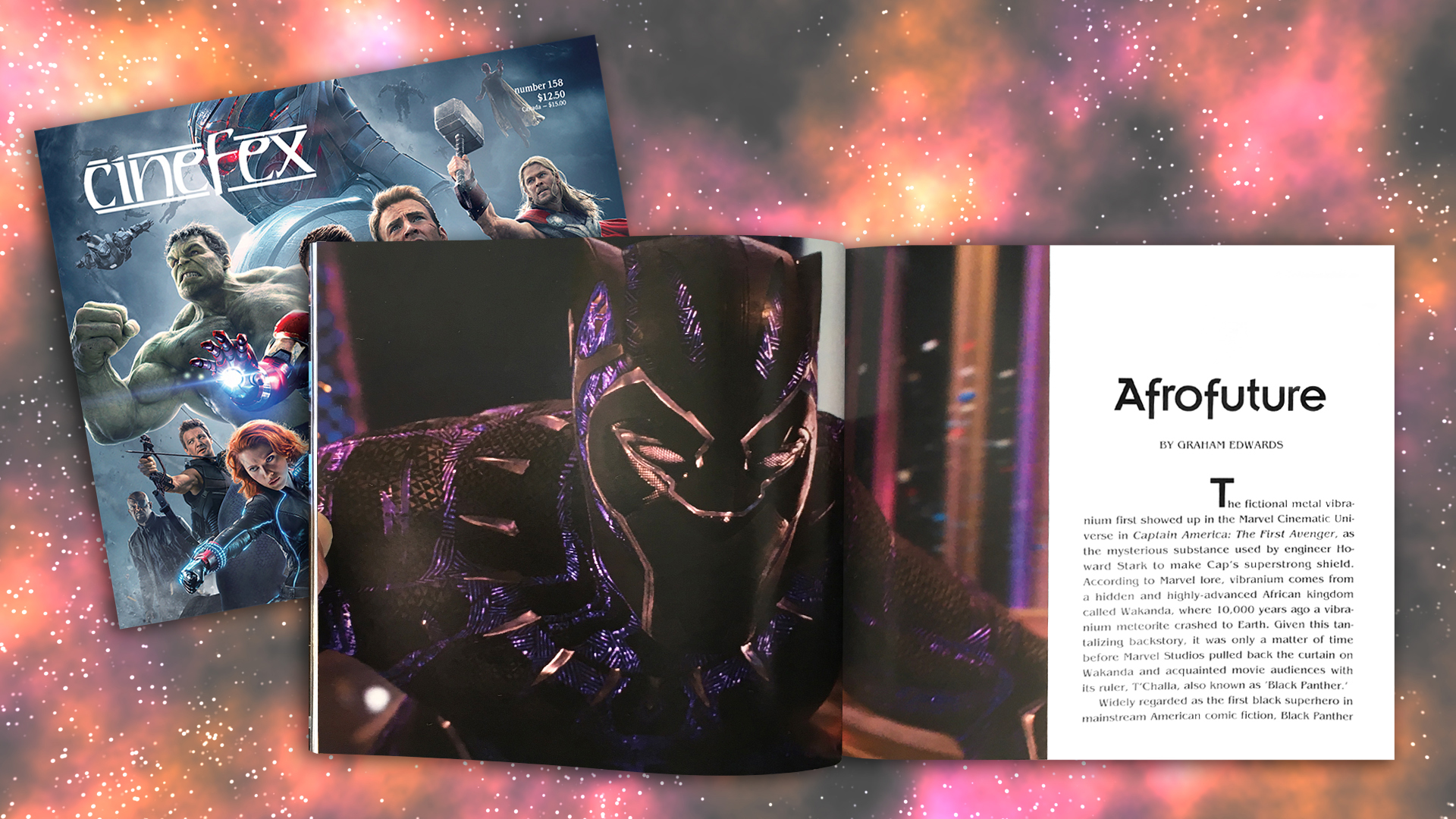
The fictional metal vibranium first showed up in the Marvel Cinematic Universe in Captain America: The First Avenger, as the mysterious substance used by engineer Howard Stark to make Cap’s superstrong shield. According to Marvel lore, vibranium comes from a hidden and highly-advanced African kingdom called Wakanda, where 10,000 years ago a vibranium meteorite crashed to Earth. Given this tantalizing backstory, it was only a matter of time before Marvel Studios pulled back the curtain on Wakanda and acquainted movie audiences with its ruler, T’Challa, also known as ‘Black Panther.’
Widely regarded as the first black superhero in mainstream American comic fiction, Black Panther hit the comic book scene in July 1966. Five decades later, Chadwick Boseman suited up for Black Panther’s movie debut in Captain America: Civil War, in which the African prince seeks vengeance following the assassination of his father, T’Chaka (John Kani).
Boseman reprised the role in the character’s first solo screen outing Black Panther, which sees T’Challa taking up the throne, only to be challenged by the mercenary Erik Killmonger (Michael B. Jordan), who believes that Wakanda should use its vibranium reserves to assert itself in the world. Aided by Okoye (Danai Gurira) of the Dora Milaje security service and ‘War Dog’ spy Nakia (Lupita Nyong’o) — and donning a next-generation Black Panther suit created by his gifted younger sister Shuri (Letitia Wright) — T’Challa rallies the tribes of Wakanda in an attempt to stop not just a revolution, but global disaster.
Early in 2016, Marvel Studios confirmed that Black Panther would be directed by Ryan Coogler, tackling his third feature following the critically acclaimed Fruitvale Station and Creed. Springboarding off the original comic books created by Stan Lee and Jack Kirby, and more recent editions written by Ta-Nehisi Coates and illustrated by Brian Stelfreeze, the director also tapped into a science fiction subgenre called ‘Afrofuturism’ — a term coined by cultural commentator Mark Dery in his 1993 essay Black To The Future. “You can’t really talk about Wakanda without talking about Afrofuturism,” said Ryan Coogler. “We embraced that idea early on. Afrofuturism is about embracing the future through dreams of how far technology can go — but without letting go of the past. You allow African culture to be present at the same time.”
Coogler traveled extensively in Africa during preproduction, feeding reference material back to production designer Hannah Beachler. “Ryan was putting together this tapestry of the people, the environments, the food, the music — everything,” Beachler related. “Then, the Afro-punk festival was on in Atlanta when we were working there; Ryan went to it and a lot of that found its way into the film. It was a huge part of the design because it’s about what black and African culture has done for itself, not influenced by anything else.” A concept emerged of a nation with no counterpart in Earth’s history — an African country that has never been colonized.
Seeking a logical real-world location for Wakanda, the creative team identified a region of central Africa near Uganda’s Impenetrable Forest. “I looked at all the waterways that go through this land,” commented Beachler. “Where are the mountain ranges? Where do all these tribes live, and how does that affect what each tribe is? I started at the macro level and then just kept zooming in.” Beachler ultimately produced a ‘Wakanda Bible’ containing hundreds of pages packed with concept art, backstory and explorations of the country’s mythology.
Plate material captured on the African continent allowed the film to be shot almost entirely in Atlanta. Visual effects either composited backgrounds photographed in Africa or crafted fully digital environments, supporting an extensive practical set build. Visual effects supervisor Geoffrey Baumann and visual effects producer Lisa Beroud led an international team of vendors, backed up by capital T, Exceptional Minds and in-house team, Mammal. By the time Black Panther premiered on January 29, 2018, every shot in the film had passed through their hands.
The jewel in Wakanda’s crown is the nation’s capital — the Golden City. Here, diverse tribes live in a thriving metropolis whose buildings are alive with pattern and color. In consultation with city planners and architects, Hannah Beachler laid out an urban grid with six distinctively-styled districts. Industrial Light & Magic constructed the city and its surrounding landscape in digital form, and handled all the sequences that take place there.
“This is not the first future city that we’ve seen in films,” Ryan Coogler noted. “So our whole thing was: ‘How do we make this our own?’” Unpaved roads and building surfaces rich in artistic detail combined to create an African ambience. When turning a street corner in the Golden City, a visitor is as likely to stumble on a historic monument as a futuristic tower block. “I went to a technology conference while we were in prep, looking for ideas of how the technology would affect the architecture of the city. At the same time, we spoke about it being an ancient city, so you see traditional structures right next to innovative structures. It’s no different from if you were in Rome — you see the ruins of the Colosseum a stone’s throw from a modern building.”
Work on the CG city began early, with ILM CG and environment supervisor Dan Mayer taking up residence in the visual effects production office during principal photography. “We wanted to get a head start because we knew it would be a huge task,” said ILM visual effects supervisor Craig Hammack. “As Dan was building up the 3D asset, Geoff, Ryan and Hannah would come by and weigh in on that initial design. We worked out the things that typically you run into when you convert concept art to a 3D world — scales that are cheated, things that you want to be highlighted. It was quite a thought process. We had to decide what was important for our shots and for the story, because you can easily get lost in details that are never seen on the screen.”
“We wanted to create a city that you’d want to visit — a place seeming to be only a plane trip away,” Geoffrey Baumann added. “A city that has evolved, over time, as the cityscapes we see today, but one also with construction and materials based in a traditional African culture. So, you see cylindrical shapes rather than rectangular ones, as well as vibrant colors and patterns, and more earth-based materials.”
ILM fashioned individual structures as modular units, working primarily in Autodesk Maya, to create a library of buildings that could be assembled into city blocks. The architecture of Timbuktu provided inspiration, as did Ryan Coogler’s directive to mix old and new. Thus, close examination of a sleek Wakandan skyscraper might reveal walls of traditional mud brick.
Custom asset management tools allowed artists to focus on each district independently, with the complete city — which measured three miles wide and over five miles long — coming together only at render time. The team procedurally arranged some 57,000 buildings, then customized the layout to suit individual shot composition. Further dressing introduced street furniture, signage and vehicles, plus crowds of up to 20,000 digital Wakandans. “Adding details inevitably took us past our memory threshold,” Craig Hammack commented. “So we spent a lot of time on memory optimizations, like sharing material types so that each building would get multiple variations. We broke up the city into multiple deep composite passes, which were merged together in compositing. Our final wide shots had nearly 200,000,000 individual items in the scene.”
Environment artists located over 12 million trees inside the city, and planted nearly 140,000 trees and bushes in the countryside around it. Hammack accompanied a reference and plate shoot in Uganda, acquiring material that informed the landscape, which was laid out mostly in Autodesk 3DSMax. “It had to feel like a city built up out of the jungle as opposed to a city with trees placed around,” said Hammack. “We built on tools and organic assets we’d developed for Tomorrowland and Kong: Skull Island,which allowed us to combine architectural elements with a natural landscape.”
Approaching the Golden City in his Royal Talon Fighter, T’Challa flies through a holographic shield that conceals Wakanda from the rest of the world. ILM crafted a high-tech wipe between the camouflaged environment seen by outsiders and the hidden land beyond. The shield began life as a gridwork of hexagons derived from mountain geometry. Artists procedurally layered up iterations of this grid, using noise patterns to generate variations. Multiple passes preserved details during the high-speed camera movement, and offered flexibility in compositing.
ILM also fashioned shots of the dreamlike Ancestral Plain, where T’Challa communes with his father’s spirit. Extracting Chadwick Boseman and John Kani from plates shot on a small set, artists placed the actors into a CG savannah dotted with acacia trees and overlooked by a saturated sky. Artists populated the Ancestral Plain with CG panthers, with ILM’s proprietary Zeno software producing realistic flesh and fur simulations. Back in Wakanda, the same rigging system underpinned the anatomy of rhinoceroses kept as battle animals. For shots of T’Challa feeding a rhino with an apple, a horse stood in for the enormous ungulate.
High in the mountains of Wakanda lies the home of the Jabari, a gorilla-worshipping tribe. “At one point, we had the Jabari in the jungle,” Hannah Beachler revealed. “Then we went to the Sentinel Mountains in South Africa, where there was the biggest snowstorm! It was so awesome and beautiful to be in the reserve and see giraffes walking by, with these snowy mountains in the background. So Ryan said, ‘Let’s put the Jabari there.’”
Rise introduced the Jabari city in a series of fully digital establishing shots. Artists initially worked from concept art of metal-and-glass skyscrapers perched on a vertiginous mountainside; a later redesign forced a change of direction. “We went from high-rise buildings to wooden architecture,” said Rise CG supervisor Oliver Schulz. “We integrated it more into the mountain and had gorilla statues and rope bridges between canyons. Because it’s a warrior clan, we put little spikes everywhere.” Photogrammetry of Uganda’s Rwenzori Mountains formed the basis for the craggy environment. Buildings and landscape were so interdependent that procedural instancing was not an option, so artists laid out the city by hand. “It was a constant back and forth between building the architecture and adjusting the mountain to make it look more dangerous.”
“Although they have torches and everything is made out of wood,” noted Rise visual effects supervisor Jonathan Weber, “the Jabari are a very tech-savvy people. That was the tricky part for us — we had these little wooden houses that look like they are from some ancient people, but they had to look modern, as well.”
Rise composited its digital cityscape into live-action of the Jabari throne room, photographed on a large set backed by bluescreen. Because camera movements were minimal, Rise worked them up as digital matte paintings, relying on distant fires and falling snow to inject life. Artists extended throne room hallways beyond the practical build.
A sacred healing hut stands on the city’s outskirts. For a scene in which healers resurrect T’Challa, artists at Rise rotomated the hands of actors interacting with artificial snow used on set, and the effects department generated simulations with which to replace it. “Marvel realized that in other sequences the snow was behaving differently,” Weber commented, “so they wanted it to be perfect, as always.” For a 160-frame close-up of snow being brushed across T’Challa’s face, the team matchmoved a digi-double to provide a collision object for the snow simulation. Re-projecting the plate of the actor onto underlying geometry assisted with compositing, but otherwise the live-action was retained.
While the Jabari carve gorilla effigies, many of the Wakandan tribes celebrate their tribal roots using body adornment. Makeup department head Joel Harlow employed prosthetics to equip three tribal elders with lip plates similar to those worn by Omo River valley dwellers in Ethiopia. Makeup effects artist Lenny McDonald devised a vacuformed dental piece that attached to the performer’s lower palate. “It had a little wire coming off it, with a magnet on the end,” Harlow explained. “The wire forced the lip down naturally and then the plate — which was lightweight plastic — would clip into that magnet.” Each dental piece supported a row of acrylic teeth that was missing either two or four incisors. With the actor’s lower lip concealed behind the device, artists encircled the plastic plate with silicone prosthetics simulating the character’s radically stretched lower lip. These were blended into the skin around the jawline, while a separate upper lip appliance simulated secondary stretching above the mouth. Each makeup took around two and a half hours to apply.
Harlow used transfer prosthetics to decorate other characters with scarification patterns — none more elaborate than those sported by Erik Killmonger, who adds one scar to his body each time he takes a life. “It’s a personal ritual that has its base in tradition,” remarked Harlow. “We initially had this very beautiful scarification pattern, but it was too ornate for this character’s motivations. We ended up with something very rough and brutal.” Makeup effects artist Joey Orosco sculpted the raised scars. Artists took overlapping silicone molds from these and filled them with self-adhesive Prosaid cream. During application, these transfers were applied individually to Michael B. Jordan’s body; when peeled away, the molds left the scars adhering to the actor’s skin. “Michael’s a big guy — very muscular, very tall, so it was a lot of surface area to cover!”
High technology is as important to Wakanda as tribal heritage. Acting as a technology consultant, Perception researched cutting-edge scientific trends. “There’s been some really interesting ideas coming from the Massachusetts Institute of Technology in the tangible media department,” said Perception chief creative director John LePore. “They’re looking at taking pixels and making them physical elements. Other exciting tests have been going on using ultrasonic sound waves to make things like styrofoam particles levitate into very specific positions.” Perception’s research also embraced cymatics — a ‘modal vibration phenomenon’ by which sound waves can be translated into physical form by coating a vibrating surface with fluids or particulates.
From this conceptual melting pot grew the idea of ‘vibranium sand’ — a material which, when ultrasonically stimulated, can sculpt itself into any 3D form. “To us, this was the hologram for Wakanda,” LePore stated. “Except it is a physical element — you can touch it, hold it, feel it crumble in your hands. This grounds it to reality, and also to the setting of Africa. It’s a technology we’ve never really seen before, and feels so much more advanced than just shapes that are projected out of blue glowing light.”
“We explored the different ways this technology could function using 3D animation and Houdini sims,” added Perception art director Russ Gautier. “We even built an actual sandbox here in the office — which was horrifically messy! We covered action figures in sand and tried to figure out how you interact with a sand interface.” The team gave vibranium sand the ability to mimic real-world surface textures by emitting light or receiving projections.
Text copyright © Cinefex 2018. Reprinted here with permission.
 Graham Edwards