
The following is an extract from my article on X-Men: Apocalypse, published in Cinefex 147, June 2016
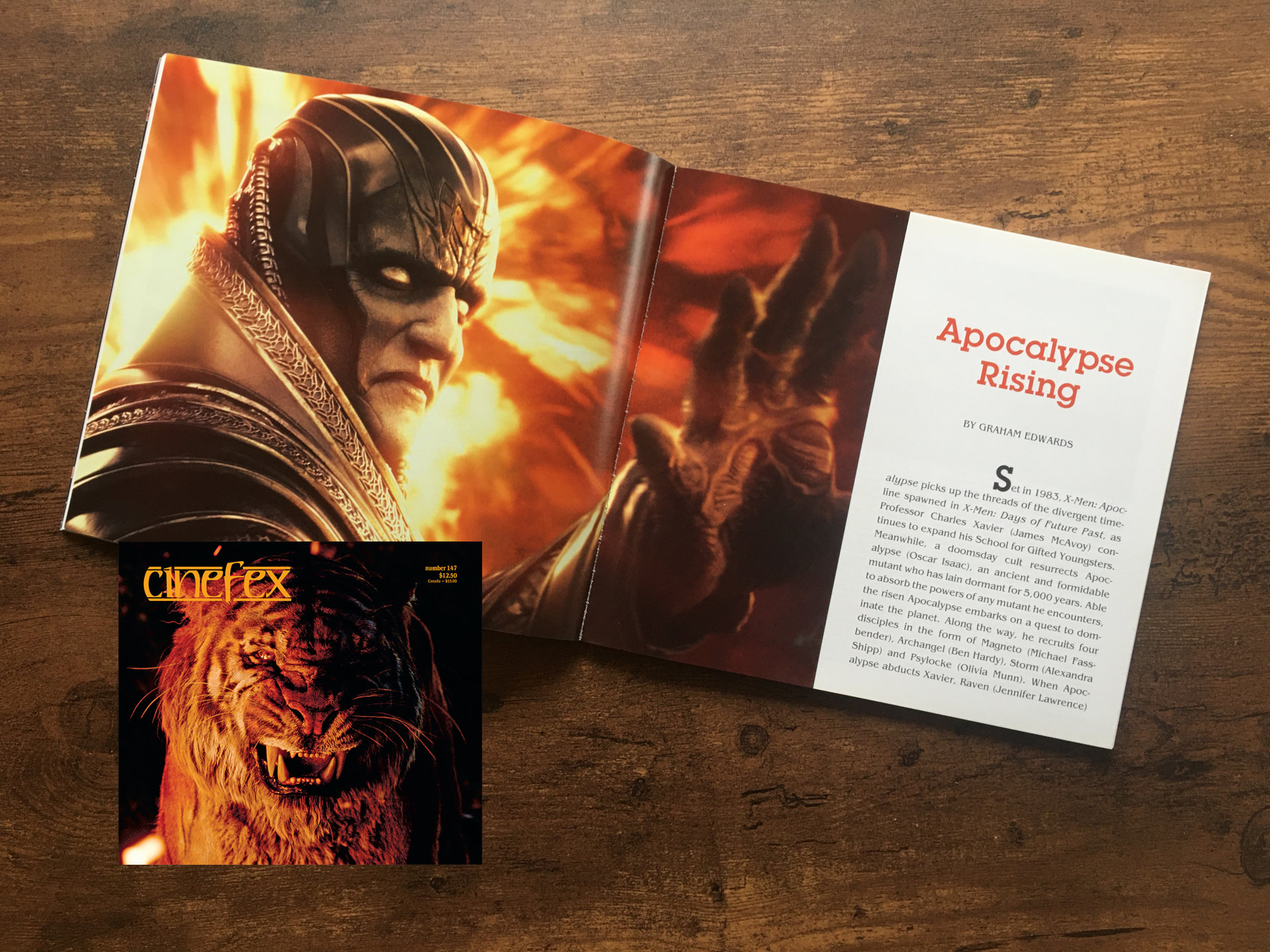
Set in 1983, X-Men: Apocalypse picks up the threads of the divergent timeline spawned in X-Men: Days of Future Past, as Professor Charles Xavier (James McAvoy) continues to expand his School for Gifted Youngsters. Meanwhile, a doomsday cult resurrects Apocalypse (Oscar Isaac), an ancient and formidable mutant who has lain dormant for 5,000 years. Able to absorb the powers of any mutant he encounters, the risen Apocalypse embarks on a quest to dominate the planet. Along the way, he recruits four disciples in the form of Magneto (Michael Fassbender), Archangel (Ben Hardy), Storm (Alexandra Shipp), and Psylocke (Olivia Munn). When Apocalypse abducts Xavier, Raven (Jennifer Lawrence) assembles a team of X-Men to rescue the professor and rid the world of the tyrannical overlord.
For his fourth excursion into the X-Men universe of 20th Century Fox and Marvel Entertainment, director Bryan Singer renewed his partnership with screenwriter Simon Kinberg to develop a storyline centered around a powerful supervillain. Other X-Men returnees ready to pit Professor X’s mutant protégés against a seemingly invincible enemy included producers Lauren Shuler Donner and Hutch Parker, visual effects producer Blondel Aidoo, visual effects designer John Dykstra, and visual effects supervisor Matt Sloan.
Dykstra insisted that the visual effects of X-Men: Apocalypse be grounded in reality. “It’s my curse,” Dykstra commented, “that I try to adhere to the physics of the world. Any time I can include verisimilitude, even if an event is totally impossible, it helps makes the illusion more complete.”
Seizing Dykstra’s gauntlet of physical plausibility was MPC, which divided some 1,075 shots between two teams operating across its Montreal, London and Bangalore sites. Digital Domain and Rising Sun Pictures each handled major sequences; additional vendors included Cinesite, Raynault VFX, Mels VFX, Hydraulx, Lola VFX, and Exceptional Minds, supported by an in-house team. Legacy Effects, Ironhead Studio and Adrien Morot fashioned a range of mutant makeup effects and specialty costumes.
Principal photography centered on soundstages at Mels Studios, Montreal, with Singer’s first unit shooting in native stereo with RED Epic Dragon Cameras. A second unit led by Brian Smrz shot in mono for later post-conversion. Visual effects facilities managed workflows based on both formats, outputting fully-CG sequences for the most part in stereo.
As a major new character — not to mention a villain with literally earth-shattering powers — Apocalypse demanded early attention from the design department. Costume designer Louise Mingenbach and concept artist Keith Christensen conceived a look for Apocalypse that amalgamated Ancient Egyptian iconography with sleek metallic forms. Legacy Effects executed the approved concept as a specialty suit integrated with prosthetic makeup.
Ian Joyner and Kourtney Coats digitally sculpted the costume. “We used scans of Oscar Isaac,” said Legacy Effects supervisor John Rosengrant, “but we also did an old school lifecast, because it gives you the texture you need when you’re doing a prosthetic that’s going to blend off onto skin. Once we had everything sculpted, we broke the costume down so all the pieces would interlock nicely.”
Legacy used rapid-prototyping to output individual suit components. Artists hand-finished each piece, before taking molds and making lightweight urethane casts. A metallic paint scheme added an aged patina, leaving Legacy’s lead costumer, Marilyn Chaney, to enrich the suit with printed fabrics provided by Mingenbach.
Grouping their components into sub-assemblies, the Legacy team perfected a 20-minute suiting-up routine. The headpiece assembly featured biomechanical dreadlocks, internally threaded with elastic cords and locked down beneath the flared collar. Separate assemblies encased Isaac’s neck, chest, back, waist, and limbs.
Brian Sipe sculpted a full-face prosthetic makeup for Apocalypse, implemented as a set of silicone appliances that blended seamlessly into the helmet. Makeup application took around two hours each day. Legacy artists tweaked the character’s skin tone to create a more menacing aspect. “The first incarnation was more of a pale gray,” Rosengrant noted. “We kind of blued him and darkened him down. That evened out the contrast with the darker, more intricate details in his face.”
Going up against Apocalypse is a strike team led by Raven. Mingenbach devised the militaristic look of the squad’s tactical suits, as well as a set of new-style X-Men outfits revealed at the end of the film. Ironhead Studio created both wardrobes, for multiple characters, in both hero and stunt versions. “First, we did miniature clay mockups,” said Ironhead founder José Fernandez. “We scanned those, resculpted them digitally, then molded and cast them. With the tactical suits, there’s a lot of soft goods that we just stitched, old school.” Ironhead used similar techniques to fabricate costumes for Magneto, Archangel, Storm, and Psylocke.
The 1983 setting allowed the production to wind back the clock on a number of familiar mutant characters, including Nightcrawler (Kodi Smit-McPhee). Working in Adobe Photoshop and Pixologic ZBrush on a Wacom Cintiq tablet, makeup effects supervisor Adrien Morot developed concepts for the blue-skinned teleport based on makeup created by Gordon Smith for Alan Cumming in X-Men 2. “I took pictures of Kodi,” said Morot, “and kind of plopped on Gordon’s makeup, adapting it to Kodi’s more youthful face.” Morot introduced feline features by rearranging facial scarification patterns, slanting the eyes, and modifying the pointed ears to resemble those of a lynx.
Morot formulated a dark skin tone distinct from the blue colors already assigned to Apocalypse and Mystique. “I didn’t want Nightcrawler to look ‘makeuppy,’” Morot remarked. “With such an opaque layer of makeup covering Kodi’s skin, things could have quickly got out of hand and looked unnatural. We did a ton of research, and ended up with a mix of colors and products from M·A·C Cosmetics. It was really successful — even in different lighting conditions, it always looked like skin.” Morot’s team spent approximately two hours daily transforming Smit-McPhee into Nightcrawler, simulating facial scars with Pros-Aide transfers, and applying silicone prosthetic ears, three-digit silicone gloves, and two-digit feet. Contact lenses completed the feline look.
Makeup effects artist Pierre Parry developed a practical Nightcrawler tail to deliver natural movement on set, inspired by a YouTube video demonstrating a tail comprised of K’nex construction toy parts, hooked together with elastic. Morot’s team cast the six foot-long ‘kinetic tail’ in lightweight urethane. Internal springs held an articulated metal skeleton in constant tension. Attached to a harness beneath Smit-McPhee’s costume, the tail responded to subtle movements of the actor’s body. “When we showed it to Bryan,” recalled Morot, “he was like, ‘Holy crap!’ There were no guys with wires — it just moved on its own. Eventually, Kodi learned to walk a certain way so that it moved like a snake behind him.”
For two of the film’s already established mutant characters, Legacy revisited the makeups they had developed for X-Men: Days of Future Past. “Beast is pretty much what we’ve been doing all along with Nicholas Hoult,” commented John Rosengrant, “although we remade his muscle suit to be a bit easier for him to wear, and made a couple of little prosthetic appliance tweaks on his face. With Mystique, it wasn’t broke so we didn’t try to fix it. Jennifer was happy with our team, and we got the application time down to about two and a half hours — ridiculously quick.”
X-Men Apocalypse begins with a prologue set in Ancient Egypt, during which worshipful acolytes carry a ceremonial galleon inside a looming pyramid. On the boat lies the withered body of an old man — the human vessel currently used by despotic ruler Apocalypse to house his immortal soul. A full-scale galleon, built from cedar wood under the direction of production designer Grant Major, was suspended from an overhead wire to lighten the load for the 22 extras assigned to carry it. Digital Domain nestled live-action of the ship into a fully digital Ancient Egypt environment.
The pyramid houses a temple with two altars, one of which receives Apocalypse’s failing body, the other his new host. A crystal perched atop the pyramid channels sunlight into the altars, triggering the transfer of Apocalypse’s soul from old body to new.
Production shot live-action on an ornate temple set dressed with interactive lighting elements. “The altars were built with acrylic translites inside them,” said Digital Domain visual effects supervisor Lou Pecora. “There were LED panels behind so we could run patterns up or down, creating the illusion of liquid gold flowing through channels.”
To enhance the look of the gold-filled circuitry, Digital Domain studied the singular look of decorative Himalayan salt crystals threaded with electroluminescent wire. “The stones light up from the inside,” Pecora explained, “with a subsurface effect in the form of hieroglyphics. That liquefies the gold and powers the circuits.”
The liquid gold becomes intertwined with the released spirit of Apocalypse. Digital Domain juggled input from both Singer and Dykstra to refine the look of a writhing skein of light, dubbed the ‘soul-glow.’ “It was sort of like Lennon and McCartney,” Pecora remarked. “Bryan likes light effects, but John’s idea was that everything can’t always be light — it’s got to feel like it has some kind of viscous substance. So, we had to come up with something that felt like it was a material, but didn’t leave a residue behind, yet still generated a little bit of light. It was an interesting challenge to meet everybody’s criteria.”
Effects artists simulated the soul-glow using Side Effects Houdini’s fluid solver. “It’s sort of a fluid in fluid,” said Pecora, “with three or four different speeds to create turbulence. John pulled up this amazing reference for us, and said, ‘It’s just a little something I shot with lasers and a mylar tube for Star Trek: The Motion Picture.’”
Digital Domain composited soul-glow and liquid gold effects into the live-action plates. “The soul-glow kind of wraps around actors’ bodies,” said compositing supervisor Michael Maloney. “We made shot-specific models of the characters, so that the flow could go in and out of them. For the altar circuits, we were mostly able to use what was done on set.”
Before the soul transfer can conclude, a rebel faction attacks the now-vulnerable Apocalypse. The immortal mutant’s quartet of faithful followers — known as the Four Horsemen of the Apocalypse — steps in to defend him. Adrien Morot designed the unique appearances of the four villains, and developed makeups for two of them, including Death (Monique Ganderton). Morot’s team applied prosthetic makeup to simulate Death’s cracked skin, with dentures made by Jonathan Lavallée extending the desiccated texture across the character’s gums.
Ironhead Studio produced the Horsemen’s elaborate ceremonial headdresses and body armor. “They were fun to do,” said José Fernandez, “because we were a little less restricted — we just bashed out some sculptures in clay.” Artists enlivened the cast components with gold leaf decoration.
The Horsemen employ their mutant powers to protect the regenerating Apocalypse. “War claps his hands together,” said Lou Pecora, “and generates what John Dykstra wanted to be a sort of refractive shockwave, with enough power to liquefy a dude’s internal organs.” Concept artist Alex Ruiz developed what became known as the ‘skin-bag’ look. “The dudes hit the wall and stick to it. Their guts get liquefied and spread across their skeletons, then they peel down.”
For a scene in which Death crushes the body of a rebel into a pretzel shape, special effects supervisor Stephen Hamilton used a nitrogen ratchet to fling a mangled dummy across the set. “We put in a CG head,” Pecora revealed, “removed the rig, and kept the rest. Stephen was looking at me like I was going to replace all his work, and I said, ‘Are you kidding me? It looked awesome!’” Digital Domain also created beams of fire projected by Plague, and multi-layered incineration effects showing her victims’ bodies lighting up from inside.
As the battle rages, the pyramid disintegrates in a chain-reaction event intended by the rebels to entomb Apocalypse forever. Special effects rigged a 40-foot-square collapsing floor, capable of dropping sharply through five feet. Digital Domain built a CG pyramid interior, with interlocking blocks engineered to slide apart sequentially in Rube Goldberg fashion.
Animators worked in Autodesk Maya to choreograph the gross movements of the interconnected structural pieces. “It looks kind of like an artichoke opening up,” Pecora commented. “Our effects team used Houdini and Drop, our proprietary rigid body destruction simulator, on top of the animation. When the blocks break, they generate dust trails. I was a stickler for adding hue variation in there, because the dust is made of different kinds of materials. You get a better sense of scale when you have all these different colors in there.”
Detaching from the surrounding structure, the temple floor free-falls down an underground shaft. To shoot the chaotic descent, production relocated to a partial set mounted on a gimbal. “We put our floor on hydraulics in front of a greenscreen,” said Stephen Hamilton. “We were tipping it sideways and moving it around while everyone was fighting on the top.” Digital Domain composited live-action of the moving floor into a CG underground shaft environment filled with falling masonry.
The floor crash-lands at the bottom of the shaft. As a mountain of rubble rains down, Death’s final act is to conjure up a web-like cocoon, with which she shields Apocalypse’s body. Effects artist Derek Cheung devised a look for the shield based on microscopic bone tissue, which artists built up in Houdini using layered procedural effects. “We had the bony structure,” said Lou Pecora, “within a lightning structure, within a cloudy smoke structure. They were all moving at different rates, with slightly different colors. Surrounding the whole thing was a refractive effect.”
Text copyright © Cinefex 2016. Reprinted here with permission.
 Graham Edwards