
The following is an extract from my article on Logan, published in Cinefex 152, April 2017
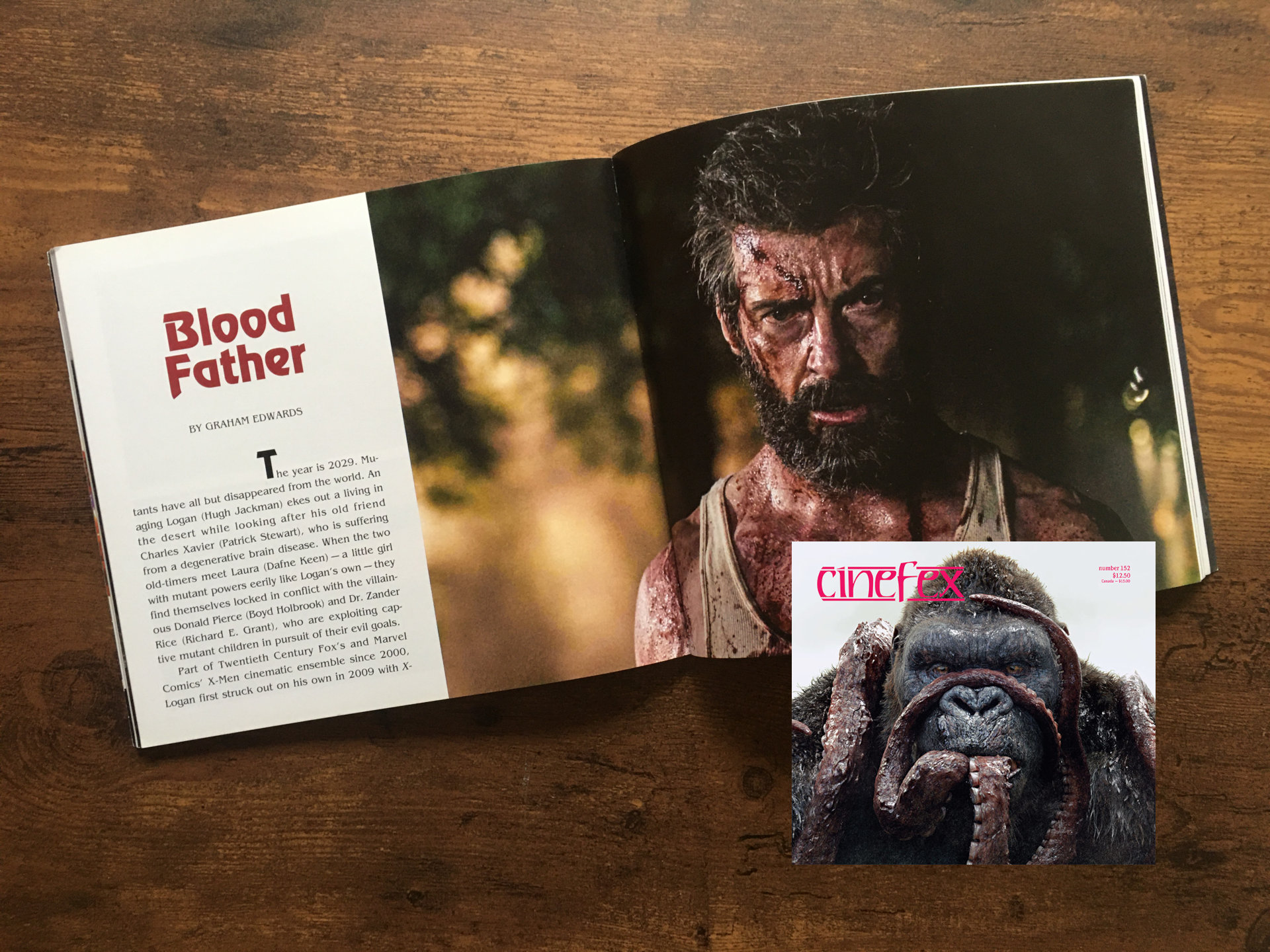
The year is 2029. Mutants have all but disappeared from the world. An aging Logan (Hugh Jackman) ekes out a living in the desert while looking after his old friend Charles Xavier (Patrick Stewart), who is suffering from Alzheimer’s disease. When the two old-timers meet Laura (Dafne Keen) — a little girl with mutant powers eerily like Logan’s own — they find themselves locked in conflict with the villainous Donald Pierce (Boyd Holbrook) and Dr. Zander Rice (Richard E. Grant), who are exploiting captive mutant children in pursuit of their evil goals.
Part of Twentieth Century Fox’s and Marvel Comics’ X-Men cinematic ensemble since 2000, Logan first struck out on his own in 2009 with X-Men Origins: Wolverine. Having helmed the 2013 sequel The Wolverine, director James Mangold returned for Logan’s third solo adventure, which he envisioned as a superhero movie more akin to a brooding western than a glossy tentpole blockbuster. The grittiness evident in the script — written by Mangold and screenwriters Michael Green and Scott Frank — dominated the production shoot, with director of photography John Mathieson lensing sun-bleached New Mexico locations through layers of atmosphere conjured by the special effects department. Overall visual effects supervisor Chas Jarrett extended the film’s earthy sensibilities into the digital realm, working closely with visual effects producer Kurt Williams to apportion 315 visual effects shots to Soho VFX and 299 to Image Engine, with Rising Sun Pictures and an in-house team handling around 230 shots apiece. Lola VFX contributed an additional 50 shots and Halon Entertainment delivered previs and postvis.
“I came on board in December 2015 as the script and some initial previs tests were being finalized,” said Chas Jarrett, “and it was already pretty clear what type of film Jim wanted to make — a superhero movie with a very raw, simple aesthetic that didn’t rely on ‘effectsy’ effects. Everything we created had to feel like it lived in a real world, with real people using it day in, day out. Jim and I had a very united vision in that regard.”
One set of items guaranteed to get a major workout in a Wolverine film is the hero’s trademark adamantium claws. In Logan, no less than three characters sport the lethal knuckledusters. First up is Logan himself, whose antiquated claws have become chipped and corroded over time. The film’s second clawbearer is a youthful Logan clone with the codename X-24 — also played by Jackman — who wields the bright, shiny blades familiar to fans of previous X-Men and Wolverine films. Finally comes young Laura, otherwise known as X-23, with two short claws sprouting from each hand and a death-dealing spike concealed in each foot.
During principal photography, Hugh Jackman and Dafne Keen wore soft claws mounted to gripper rigs concealed inside their fists. For closeup action, the actors exchanged these for cut-off foam ‘stubbies’ that permitted safe contact with their opponents, or else fought clawless with tracking markers on their knuckles. Soho VFX received a set of reference claws with accompanying 3D scans. “They sent us over the props that they used on set,” said Soho VFX visual effects supervisor Keith Sellers. “We had the painted rubber ones that they used while filming, as well as a metal pair they had made as a general guide.” Working in Autodesk Maya and The Foundry MARI, artists created master CG claw assets for all three characters, for distribution among the film’s visual effects vendors.
Logan has barely begun before the claws come out. In the film’s opening scene, a gang of carjackers disturbs Logan as he sprawls drunk inside his limousine, prompting the metal-boned mutant to force out his rusty blades and lay into the would-be thieves. The filmmakers worked towards an R-rating by staging the violent encounter with bloody abandon. “Part of the fun of this film is that we’re not bound to a PG-13 rating,” remarked Chas Jarrett. “Finally we get to show audiences what many have always wanted to see in a Wolverine movie — the blood and limbs and heads flying! What Garrett Warren, the stunt coordinator, and his fight coordinator Steve Brown did so well was stop it from feeling too cartoony. The fights are pretty brutal, to the point where we’ve had to hold back the gore in some areas. I think we found a good balance in the end.”
On set, makeup department head Joel Harlow served up a gruesome array of severed body parts. For a shot in which Logan cuts off a carjacker’s arm, Harlow fabricated a silicone limb plus two cylindrical chunks of flesh. “We were conscious of the reality of what these blades would do,” said Harlow. “If he slices somebody’s arm off with three sharpened blades, there are going to be three cuts. So we created the severed arm, and then a couple of doughnuts! It’s a violent film, so a lot of the damage we did to Logan and other characters was pretty extreme — which was fun. We hadn’t done one of those in a long time.”
Rising Sun Pictures enhanced the ferocious fight action with digital Wolverine claws. “When it starts off he’s drunk and casual,” said RSP visual effects supervisor Dennis Jones, “so when his claws come out they’re a bit rusty and stuck. One claw doesn’t come out — sort of like a brewer’s droop! There’s a point where he loses it and becomes the berserker Wolverine, and then he’s just offing people left, right and center.” Artists augmented shots with carefully-placed splatters of digital gore. “In films like 300, someone gets a little tap on the shoulder and buckets of blood come out, but in this we tried to be a lot subtler. It feels a lot more in-camera and less like a visual effect.”
Special effects shot practical blood splash elements against greenscreen. For the most part, however, RSP favored the use of Side Effects Houdini fluid simulations. “Unless you shoot the elements specifically it’s very hard to get the right angle,” observed Jones. “We had a few different lighting contexts as well — for example, the limo fight is in front of a big advertising screen so there are a lot of strong colors like magentas and cyans.” Seeking reference for claw strikes, the team dug up an internet gold mine of weapon test videos. “These guys had made human torsos out of ballistic gel, with anatomical structures inside. They would fill them up with blood and test weapons like Viking axes. There are a few shots where we see an open wound clearly for several frames — for those we would do a proper CG patch that was modeled, rigged and lit. But a lot of the time the action was so fast we would just get away with a quick hit. Sometimes we just painted on a bit of red for one frame, and then it was gone.”
Logan leaves the carjackers dead in the dirt and retires to lick his wounds. Because his mutant powers are waning he no longer heals the way he used to and so his body is peppered with scars. “There are bullet holes and old slashes on his body,” Joel Harlow observed. “They’re on his chest, arms, back, a little bit on his face, and that increases throughout the course of the film. Where the blades come out we did puckered scars between his knuckles. His blood is infected so there’s a little pus, and the wounds are healing only now and then. The character’s in a lot of pain and we tried to convey some of that in the makeup.” Harlow and makeup artist Ozzy Alvarez covered Hugh Jackman’s torso and face with individual silicone appliances, using reference photographs and a vacuformed facial template to ensure accurate positioning. With up to three units shooting at any one time, and Logan’s physical state changing constantly throughout the shoot, continuity was an ongoing issue. “The biggest continuity problem for us was tracking blood — whether it be Logan’s blood or the blood of his victims. We’d have to take Hugh from A-unit to B-unit, clean him up, do that shot, take him back to A-unit, put all the blood back on — it was really complicated!”
At his hideout — an abandoned smelting plant in the desert — Logan tends to the ailing Charles Xavier, who is languishing inside an overturned silo. Xavier begs his friend to seek out a mysterious new mutant, but Logan dismisses the plea. Joel Harlow applied subtle age makeup to Patrick Stewart, wrinkling his skin with glue and planting rogue hairs into the actor’s nose and ears. “Our idea was that his mutant powers are what caused his baldness,” said Harlow. “Now, his powers are waning, and so his hair is starting to grow back in. Gloria Pasqua Casny, the hair department head, had a wig made by Khanh Trance.”
Logan meets a woman with a child named Laura, whom she claims is her daughter. The woman hires Logan to drive them over the walled border between Mexico and the United States. Production shot live-action for border scenes alongside a levee wall in New Orleans, leaving Rising Sun Pictures to extend the plates. The environment department used digital matte paintings to integrate a background of a Mexican landscape, and added foreground dressing and a CG border crossing bridge lined with traffic. Texture painters coated the digital assets with industrial grunge. “We did a lot of our texture stuff with Allegorithmic Substance Painter,” commented Dennis Jones. “It’s a nice procedural lookdev tool that can do a lot of aging and is more topologically aware, so you can actually run water down objects and you get all the correct drip marks.”
Before Logan can do the cross-border run, the woman is killed. Laura is nowhere to be found so Logan returns to the smelting plant, only to discover the little girl hiding in the trunk of his limousine. Xavier is delighted by the stowaway’s appearance, declaring her to be the mutant Logan is destined to meet.
On Laura’s trail is Donald Pierce, sinister associate of Dr. Zander Rice and leader of a band of thugs known as Reavers. Pierce has a robotic right hand, which Soho VFX created as a CG construct based on production concept art. “Pierce’s hand is obviously very futuristic,” said Soho VFX visual effects supervisor Berj Bannayan, “but it’s also very worn. The screws don’t match, it’s dirty, it’s cracked, he’s got a piece of tape holding it together. He treats it like he treats a gun — he’ll strip it down, clean it and fix it, and put it back together again.” As part of the design development, the modeling team thinned down the fingers and perforated the hand’s internal structure, aiming to convince audiences that this was a functioning device and not a metallic glove worn by the actor.
Pierce’s hand attaches to a wrist brace supported by an elbow strap. On set, Boyd Holbrook wore a green or blue glove marked with tracking dots; for some shots he also wore a practical wrist attachment. Artists tracked the live-action and replaced Holbrook’s hand with the digital asset. “Occlusion of the background is always the main concern when your shots involve removing foreground objects,” remarked Chas Jarrett, “and Pierce’s hand seemed to always be in front of something important! Usually this is solved by shooting clean passes of the background, but in some instances the character was using his human hand to interact with the robot hand, so we had to create a CG human hand to rebuild the background.”
Animators took their cues from Holbrook’s performance, following the actions of his fingers while at the same time making their movements more linear and less smooth. Whenever the character was touching or picking up objects, the team endeavored to retain the real props, especially in closeups.
In one scene, Pierce removes his hand for repair, then reconnects it to the wrist brace. “Getting the actor’s hand and arm movements right was paramount for me,” said Jarrett, “so we had the props department make a green proxy section of the wrist for him to pick up. We had them saw off one edge so it looked like a C shape — this meant the actor could hold it to keep his fingers in the right place, but could also slide the open edge over his other wrist to get the movement of attaching it back together.” Having reconnected the hand, Pierce puts it through a calibration routine. Soho VFX used CG patches to repair areas of the plate obscured by the proxy wrist — which was slightly larger than its CG equivalent — and animated the robotic fingers bending backwards in a series of inhuman contortions.
Text copyright © Cinefex 2017. Reprinted here with permission.
 Graham Edwards