The following is an extract from my article on Star Trek Beyond, published in Cinefex 148, August 2016
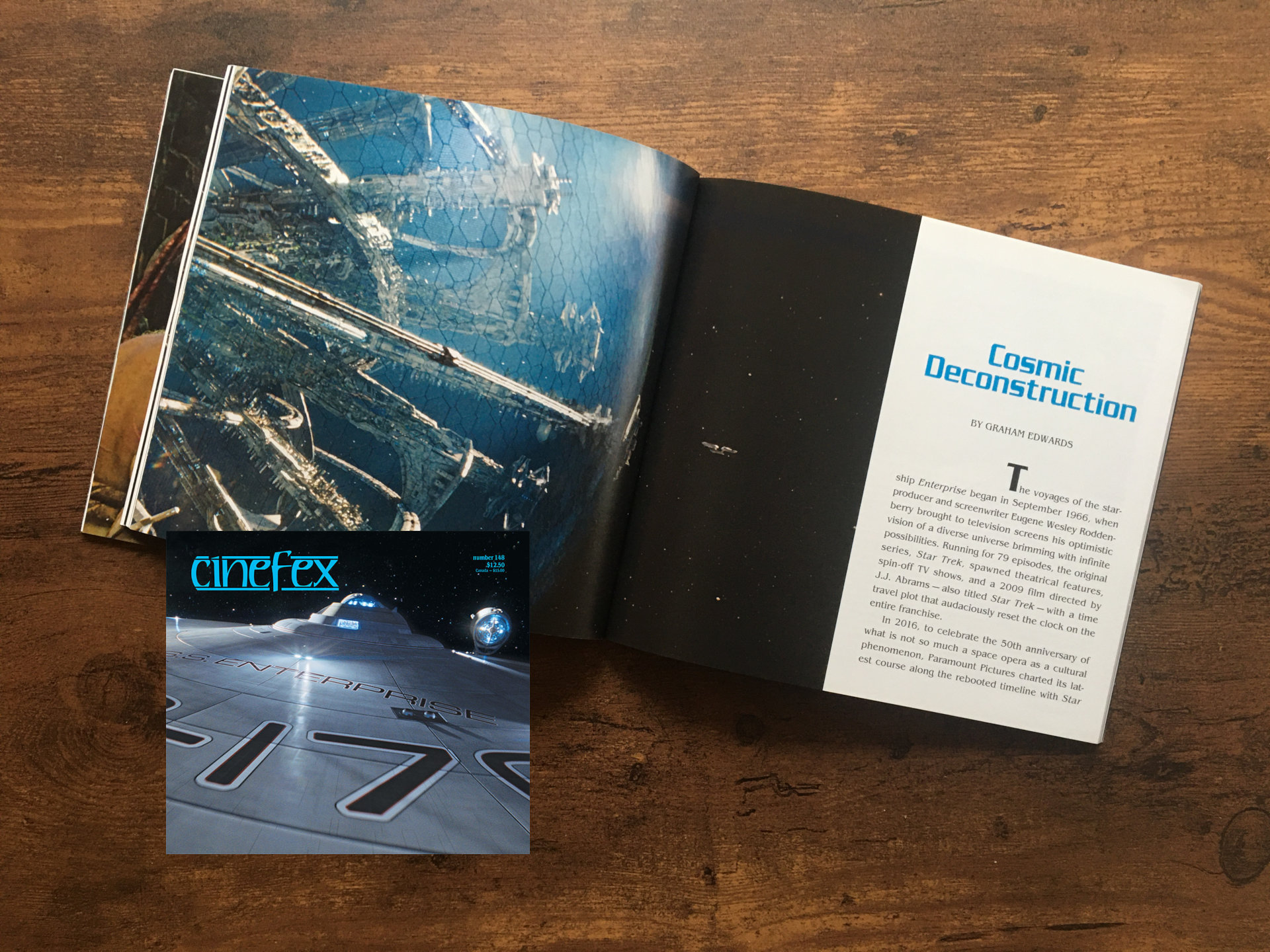
The voyages of the starship Enterprise began in September 1966, when producer and screenwriter Eugene Wesley Roddenberry brought to television screens his optimistic vision of a diverse universe brimming with infinite possibilities. Running for 79 episodes, the original series, Star Trek, spawned theatrical features, spin-off TV shows, and a 2009 film directed by J.J. Abrams — also titled Star Trek — with a time travel plot that audaciously reset the clock on the entire franchise.
In 2016, to celebrate the 50th anniversary of what is not so much a space opera as a cultural phenomenon, Paramount Pictures charted its latest course along the rebooted timeline with Star Trek Beyond, the third adventure for the rejuvenated Captain James T. Kirk and his loyal crew.
In preparing for Star Trek Beyond, director Justin Lin tapped into childhood memories of the original TV series. “Star Trek was a big part of my life growing up,” said Lin. “My parents worked pretty much every day, seven days a week, and so it was our time to bond. It was great to connect with a show where you would get to explore, and I loved the idea of a group of people going on a shared journey.”
The central theme of exploring frontiers drove the new film’s storyline, by way of a screenplay written by Simon Pegg and Doug Jung. “What J.J. did in the 2009 reboot was amazing,” Lin remarked. “He honored and embraced what came before, but he also created a new canon. I wanted to take that DNA, and make sure that we were true to these characters. At the same time, anything can happen. These characters could be making decisions today that are going to change who they are. They might not end up being the same people as on the other timeline.”
Pursuing its five-year mission to explore the cosmos, the crew of the U.S.S. Enterprise falls under attack from a seemingly invincible foe. With his beloved starship destroyed, Captain Kirk (Chris Pine) struggles to reunite his scattered crew, including Commander Spock (Zachary Quinto) and Doctor McCoy (Karl Urban). Teaming up with alien scavenger Jaylah (Sofia Boutella), the survivors of the disaster make a desperate attempt to prevent renegade warmongerer Krall (Idris Elba) from wiping out the population of Yorktown, a gigantic Federation outpost floating at the far frontier of space.
To handle the considerable visual effects workload of Star Trek Beyond, production visual effects supervisor Peter Chiang and production visual effects producer Ron Ames — also associate producer on the film — assembled a crew of their own. Double Negative acted as main vendor, with close-quarters support from Atomic Fiction, Kelvin Optical, and a small in-house team. “My concept was ‘all for one and one for all,’” said Ron Ames. “If you have too many vendors, it becomes a management issue, with too many people sharing too many assets. If you have three or four companies, you really can make a unified visual effects production and postproduction pipeline.”
Known for his action-heavy series of Fast and Furious films, Justin Lin was keen to bring a gritty sensibility to the spacegoing saga. “The technology has evolved to the point where film, videogames, and animation are all kind of morphing together,” commented Lin. “As a viewer, I feel like humanity is being slowly drained out of the aesthetic. I felt it was appropriate in this film to try to bring that back.”
Lin planned visual effects sequences from the perspective of a second unit director, who might choose to cover action scenes with a large number of relatively low-quality cameras. “We had a lot of crazy conversations,” Lin recalled, “talking about it as if we were actually prepping to go shoot in space.” Directing the second unit was Alex Vegh, who also supervised previs and postvis, managing artists from Proof, Inc. and an in-house team.
During previs, Vegh blocked key action sequences with coverage from up to twenty cameras, devising choreography that accentuated the three-dimensional qualities of space, yet remained grounded in reality. “One of the things for me was getting what I considered to be realistic camera moves,” said Alex Vegh. “I wanted it to feel like there was someone out there in space operating these cameras.”
The same philosophy influenced the look of final rendered images. “When Justin makes action films,” Ron Ames remarked, “usually the second unit gets sent out with not the best equipment, not the biggest crews, and they have to make do. He wanted that quality of making do in the visual effects.” Lin encouraged visual effects to add dirt and scratches to the camera lens, reduce depth of field, and replicate optical and chromatic aberrations. “If our effects looked too perfect, Justin would say: ‘It looks like CG! It’s too beautiful! We have to mess it up!’”
Among the many references studied by the visual effects team was Gosh, a music video created by Erik Wernquist for producer and remix artist Jamie xx. “The video was about finding a planet and terraforming it,” said Sean Stranks, visual effects supervisor at Double Negative, London. “There were a couple of really nice shots where they had bright sun, dirt on the lens, and MIR-style lighting on the ships. We tried a few things like that, and it felt really good.”
Even the sleekly contoured U.S.S. Enterprise found itself rolling in the dirt. “We worked hard to create shots that really showed the Enterprise from a different slant,” said Peter Chiang. “We wanted the pearlescent white of NASA footage, with the overexposure of shooting on anamorphic film. We wanted to re-create that grittiness, so the Enterprise would be blown out in the highlights, and underexposed in the darker areas.”
The Enterprise seen at the beginning of Star Trek Beyond differs slightly from the ship that closes the previous film. “There’s a big story point about the vulnerability of the ship,” Chiang explained. “Justin wanted it to resemble a little more the original 1966 Enterprise, where the nacelles and neck were quite thin.”
Double Negative’s model supervisor Tosh Elliott, along with principal modelers Andreas Maaninka and Daniel Prentice, built the new starship based on the hero asset created by Industrial Light & Magic for Star Trek Into Darkness. “It’s a big old monster,” remarked Sean Stranks. “We were flying all around it, with angles from a tiny little Enterprise that takes up a hundredth of the screen, to close up on an escape hatch. We couldn’t build every little last bit at high resolution, but we came pretty damn close.”
Enterprise interiors received their own makeover. Atomic Fiction extended sets built by production designer Thomas Sanders, and contributed to the design of the new-look engineering deck. “The plates came to us as greenscreen,” said Atomic Fiction visual effects supervisor Ryan Tudhope. “They were shot on a stage, where they had built some of the gantries and other elements. But they required a lot of design to flesh them out. It was one of those ‘pinch yourself’ moments, like, ‘Holy shit, we’re designing the interior of the Enterprise!’”
Atomic Fiction concept artist Marc Gabbana designed engineering deck interiors, which artists then modeled in Autodesk Maya and textured in The Foundry MARI, Finished assets passed subsequently through a lighting and rendering pipeline built around Chaos Group V-Ray and The Foundry Katana. “We put a lot of thought into how the exterior structures translated to the interior,” Tudhope commented, “and how these massive bolts connected everything.”
Another Enterprise upgrade came courtesy of the special effects department. “We put the bridge set on a shaker deck,” said special effects supervisor Cameron Waldbauer. “Actually, I believe we introduced shaker decks to the Star Trek franchise.” Elevated on a steel frame, the vibrating set rested on three-foot-diameter airbags, with an array of manually controlled pneumatic rams providing three inches of movement in all directions. “It was only six inches of movement in total, but when it hit the rubber stoppers, it really jarred the set. When the actors were rehearsing, they were all doing the standard Star Trek ‘shake yourself in the chair’ thing. Then we fired up the shaker deck; they thought it was so cool that they didn’t have to pretend the ship was running.” Waldbauer constructed a similar rig for the bridge of a second Federation ship, the Franklin, seen later in the film.
Star Trek Beyond begins as Captain Kirk delivers a peace offering to the inhabitants of the planet Tenaxi. Due to a trick of perspective in the bowl-like audience chamber, Kirk believes that the five aliens perched high above him are hulking giants. A comedic reveal shows the creatures to be only two feet tall.
Basing designs on a full-scale maquette used as reference during principal photography, artists digitally sculpted the ferocious-looking Tenaxi ambassadors. “They were designed to look like they were seven feet tall,” said Raymond Chen, visual effects supervisor at Double Negative, Vancouver. “They had powerful arms and broad chests, and a lot of detail in the skin and horns. We did six hero builds — the grizzly old warrior, the young buck, the muscle. We made sure to give each of them personality.”
Keyframe animation brought the aliens to life, based on motion studies undertaken by the animators. “We have a motion capture suit,” Chen explained, “which we used to figure out walks. The way the Tenaxi move is almost like a gorilla, so our animation team used cut-down crutches to extend their arms.”
As the diplomatic mission goes south, hundreds of angry aliens pour down the curved sides of the chamber towards Kirk. Inspiration for the slapstick action came from pinball-style ‘Pachinko’ arcade games. “We did rigid body dynamics simulations of Tenaxi bouncing down the walls,” said Chen. “For the guys who were down on the ground, we relied on brute force animation, filled out with keyframe animation cycles.”
Escaping from the Tenaxi, Kirk brings the Enterprise to the Federation outpost of Yorktown, an immense 16-mile-diameter space station, for some well-earned shore leave. “Yorktown is the pride of the Federation,” said Peter Chiang. “It’s a neutral zone, kind of like a United Nations. It has multiple arms with cities on them that extend out in all directions, each with its own gravity. You may be in a building on one arm, but you look up in the sky and there’s another arm that’s pointing 90 or 180 degrees down at you. It’s disorienting — you don’t know which way is up.”
Supplied with artwork and basic geometry by concept designer Sean Hargreaves, a core team of four modelers and two texturers at Double Negative’s Vancouver office constructed Yorktown as a single digital model — the biggest asset ever created by the company. “This film is very brave in terms of getting close to CG,” said Double Negative CG supervisor Stuart Farley. “The entire thing was a hero build — you could fly a camera up to anywhere on it.”
Building in Maya, the team began with the Yorktown superstructure, which included 32 arms, a network of docking tubes, and a surrounding shell. Modelers detailed the geometry with a kit of parts comprising some 810 unique modular elements, instanced over ten million times. “The superstructure alone was 200 billion polygons,” said Yorktown build supervisor Rhys Salcombe. “We had this pool of assets that we could mash together into interesting shapes, then cache out to lighting, but the placement of all the instances was done by hand. The process was pretty quick and efficient — you textured something once, and it looked great everywhere. In shading, we defined color and weathering variants, to disguise the repetition.”
To flesh out Yorktown’s 64 separate cityscapes — two per arm — Double Negative’s London team built a suite of around 60 buildings based primarily on modernist Dubai architecture. Artists in Vancouver used a new generation version of Double Negative’s proprietary urban layout software to lay out city blocks, adding bridges, plazas, and lakes along the length of the arms. “We initially relied on our procedural tools to generate the city layouts,” said Raymond Chen, “but we found the cities looked a little bit too procedural. For a lot of the hero locations, we tried to create a harmonious space that would provide more interesting visuals than randomly scattered buildings, placing the buildings by hand and moving them around for composition.”
Modelers seeded Yorktown’s parks and woodlands with seven types of tree, including Dubai-inspired palms and a range of European species. Low-level vegetation incorporated flower color variation to add randomization. When laying out forests, artists abandoned procedural techniques, defining tree densities through scatter masks derived from real-world aerial photography.
Double Negative used its proprietary crowd system, Riot, to populate city streets with crowds of humans and aliens, with character assets built from 3D scans and photographic reference of performers taken during the production shoot. The same system filled skies with airborne traffic. “We used our crowd tool to fly shuttles down the length of the arms at different heights and different trajectories,” said Rhys Salcombe. “We laid traffic flying between arms as well, just to add more complexity.”
Containing Yorktown’s atmosphere is a spherical metallic lattice faceted with transparent panels. “It’s not quite a honeycomb,” Salcombe observed. “We veered away from hexagons because that’s a bit of a stereotype. When you see Yorktown from the outside, there’s refraction of its interior elements. When you see it from the inside, the shell acts a little bit like a mirror — that was how we justified the Dubai levels of atmosphere, the bounce lighting, and the blue sky elements.”
Ground level shots employed plates photographed during a month-long production shoot in Dubai, with 2D supervisors Mike Brazelton and Sebastian von Overheidt overseeing the meticulous compositing work required to blend in CG Yorktown elements. “We put distant city arms in the sky, and the shell in the background,” said Stuart Farley. “Every shot was carefully choreographed to create several planes of depth. Justin wanted to play with distance in every shot.”
Lighting the overhead structures called for some artistic license. “We would have one arm in bright sunlight,” commented Rhys Salcombe, “but the arm next to it would be in complete shadow — that was an eight-mile city that looked kind of dull. So, every arm had scattered pools of light, as if it was being shadowed by an arm offscreen.”
The enclosed docking tubes were largely self-illuminated, with runway-style spotlights and uplighters artfully positioned to bounce off the hulls of passing vehicles. Certain sections received light from more exotic sources, such as city lakes that penetrated all the way down into the tubes, creating god rays and caustics.
The complete Yorktown asset weighed in at over 1.3 trillion polygons. “The scale of this thing was so huge that we really pushed the boundaries of what the software was capable of,” remarked Stuart Farley. “We were speaking continually with the software manufacturers to get patches to work around certain issues.”
Although artists used Maya for modeling and assembly, only when the data passed to Isotropix Clarisse for lighting and rendering did full previews become available. “We couldn’t ever look at the whole thing — or even a small section of it — in Maya,” said Rhys Salcombe. “We would define where a city block was, but we didn’t load everything within that block. We converted that for use in Clarisse, with everything regenerated as point clouds. When Clarisse rescattered all of the buildings within the blocks according to the point clouds, we could actually view the whole of Yorktown in one go, and tumble around it. That was pretty impressive.”
Text copyright © Cinefex 2016. Reprinted here with permission.
 Graham Edwards