The following is an extract from my article on Alien: Covenant, published in Cinefex 153, June 2017
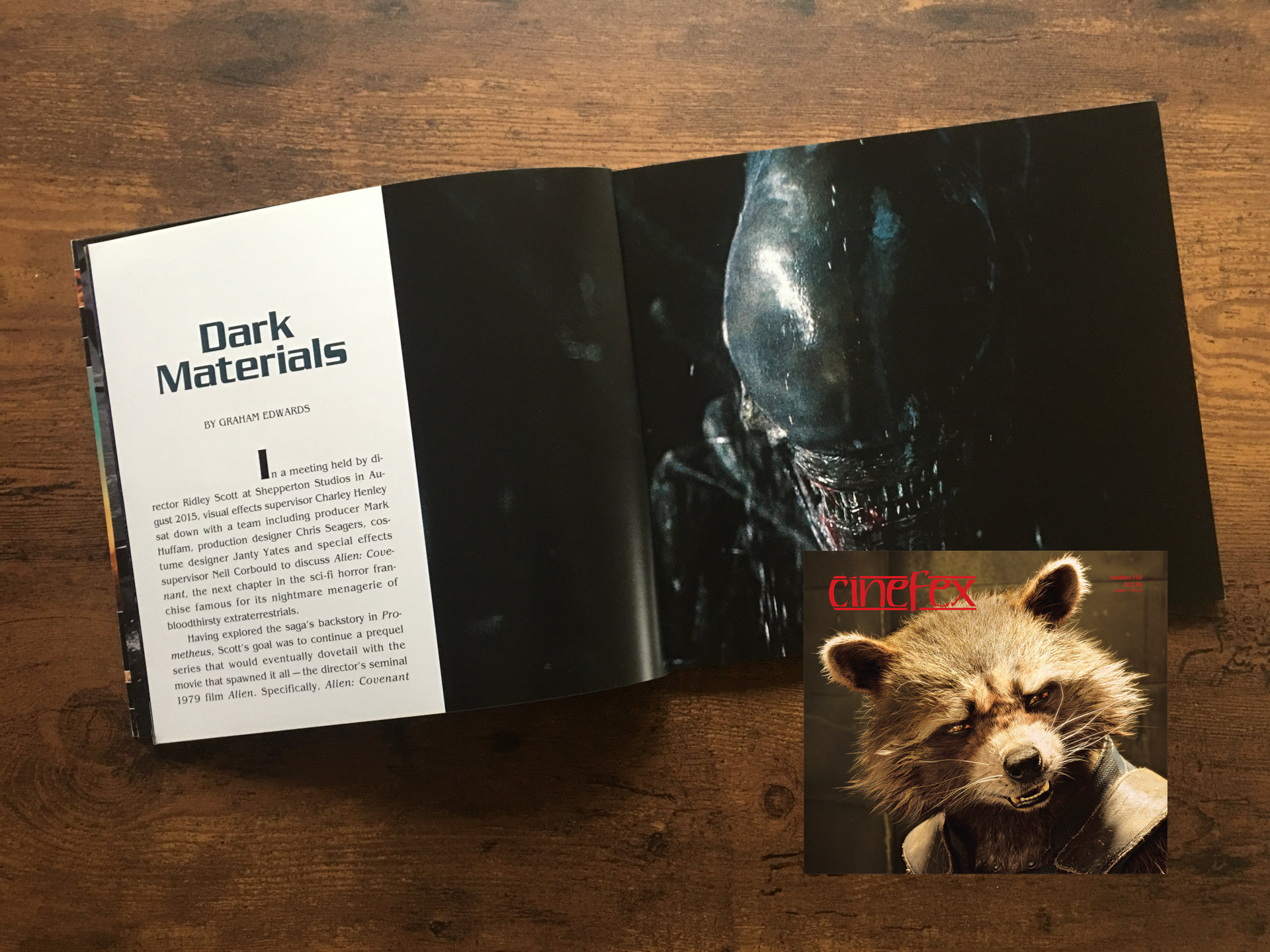
In a meeting held by director Ridley Scott at the UK’s Shepperton Studios in August 2015, visual effects supervisor Charley Henley sat down with a team including producer Mark Huffam, production designer Chris Seagers, costume designer Janty Yates and special effects supervisor Neil Corbould to discuss Alien: Covenant, the next chapter in the sci-fi horror franchise famous for its nightmare menagerie of bloodthirsty extraterrestrials.
Having explored the saga’s backstory in Prometheus, Scott’s goal was to continue a prequel series that would eventually dovetail with the movie which spawned everything: the director’s seminal 1979 film Alien. Specifically, Alien: Covenant would reintroduce a classic movie monster — the hideously elegant xenomorph originally designed by Swiss artist H.R. Giger. At the heart of the emerging storyline was the unsettling question: ‘Who made the alien, and why?’
“The meeting was in a huge room plastered with concepts,” Charley Henley recalled. “Ridley had a wealth of material that he’d been developing over the months before I joined. Chris Seagers had been working on designs. There were some costumes which had a kind of Moebius look. There were sketches of ships by concept artists like Steve Messing and Steve Burg. There were creature designs, including some historical work done for Prometheus that hadn’t come to fruition. Ridley told us he was keen to have a film that was more gritty than Prometheus; he already had that aesthetic clearly in his mind.
“Ridley also had some pretty clear ideas of the things he wanted to bring into the classic xenomorph design. We laid out all the drawings from Giger, photos from the original Alien, and other material that he liked. We knew from the outset that we were going to do fully CG versions of all the creatures, but Ridley also wanted to have something there on set that he could frame on and direct, and that could interact with the actors. We started with the idea of reference puppets; later this evolved into high quality creature suits.”
As preproduction continued, art director Ravi Bansal explored alien designs with a concept team at MPC. Then, creature design and makeup effects supervisor Conor O’Sullivan of Creatures Inc. and creature effects supervisor Adam Johansen of Odd Studio took over the ongoing design process, assembling a 50-strong team of artists, sculptors and designers. “At first I was told that everything was designed and there were going to be no men in suits,” said O’Sullivan. “They said I was just going to do makeup effects, and asked if that was enough for me. In November, I finally saw 100-odd designs for the creature going back 10 years, and Ridley still hadn’t committed. Then the producer rang me up, and said, ‘Do you guys want to be the creature designers?’ That’s when it all started kicking off. Then we got to January, and Ridley wanted to put men in suits!”
Meanwhile, Scott was working with Argon Entertainment previsualization supervisor Jason McDonald to block out key sequences, including a blood-drenched drama in a medbay, a tense airborne rescue and the film’s climactic showdown. The Third Floor handled previs for outer space scenes. “Ridley would do his own storyboards and Ridleygrams,” recalled Charley Henley. “He’d sketch out the scene, and then the previs guys would set up the key shots and do a rough cut. We’d print that out for Ridley as stills and he’d fill in the gaps. It was a kind of cyclic process.”
Principal photography for Alien: Covenant began in spring 2016 on location in New Zealand’s Fiordland National Park, on stages at Fox Studios Australia, and on exterior sets at Potts Hill, a former reservoir near Sydney. Following the shoot, Proof Inc. delivered postvis. “Pietro Scalia, the editor, came out to Australia and was constantly building the movie as the scenes were shot,” Henley related. “So they were already in quite a good place on wrap. Ridley was very keen to get straight in and cut the movie, so we made a big effort to get postvis and temps into the film as soon as possible.” During post, visual effects producer Sona Pak divided work between lead vendor MPC, Framestore, Animal Logic, Luma, Rising Sun Pictures, Atomic Fiction and Peerless Camera Company. Additional visual effects supervisor Richard Bain oversaw elements shoots and assisted in supervising an in-house team.
The Alien: Covenant screenplay by John Logan and Dante Harper carries the crew of the interstellar spacecraft Covenant to a distant planet apparently ripe for colonization. Unexpectedly stranded on the surface, they learn the fate of Dr. Elizabeth Shaw (Noomi Rapace) and the android David (Michael Fassbender), sole survivors of the ill-fated Prometheus mission. All goes to hell when the would-be colonists fall prey to a host of ferocious aliens. Their choice is simple: escape the planet or die.
Three-quarters of a mile long, the Covenant transports its sleeping crew through space inside numerous identical ‘colony pods.’ Framestore assembled the vessel from a kit of repeating parts, using in-house tools within Autodesk Maya to instance tens of thousands of individual structures along its length, randomized through subtle variations in geometry, texture and position. “We built individual pieces that came together at the rendering stage,” said Framestore Montreal visual effects supervisor Christian Kaestner. “That allowed us to have a lot of surface data and still manage the asset. Everything got a slight kink here and there, so when you look down the ship it’s not a perfect straight line.” Framestore installed retractable antennae and plugged in roughly 18,000 lights. “Ridley was quite specific about the antennae — he wanted them to break the silhouette of this really elongated ship.”
Running low on power, the Covenant deploys ten million square feet of energy sails. Framestore undertook technical R&D to determine how the flimsy, mylar-like material would unfurl in zero gravity, and tuned the deep-space lighting environment to maintain scale. “We used the starfield as fill light with an additional nebula digital matte painting as support,” noted Kaestner. “We manually placed individual brighter stars to create slight color variations and pings. Any sort of broader fill light just made the sail look like cloth or plastic.”
A cosmic shockwave impacts the Covenant, damaging a sail. Framestore executed the shockwave as a distortion effect that echoed the way light warps around black holes. Artists rendered 3D bubbles with which they refracted and distorted the background, adding subtle volumetric lighting within the geometry to help the wavefront read against the blackness of space.
Crossing the starfield, the shockwave reveals a hidden spectrum of colors. “Our stars have very intense color values — they just appear white because they’re really bright,” Kaestner explained. “When we moved the camera or convolved our effects on the stars, that would bring out the colors.” To create high-resolution starfields free of flicker, the team mapped 64 background tiles onto a sphere, rendered in Solid Angle Arnold at 4K resolution.
The shockwave penetrates the Covenant. Neil Corbould elevated a 20-foot-tall colony pod interior set on air bellows and shook it with hydraulic rams. Corbould’s team mounted a dozen cryosleep chambers on rubber shock absorbers and showered them with sparks; release mechanisms dropped the chambers from their supports as the chaos peaked. Luma painted the transparent chamber hoods with holographic displays. In keeping with the film’s gritty aesthetic, the team styled highly saturated graphics that were more angular in shape than the curvaceous holograms seen in Prometheus.
Artists at Luma extended the colony pod set with corridors snaking into the distance, keying out a greenscreen backdrop and inserting repeating structures dwindling in size. For locked-off shots, compositors duplicated plate photography from B and C cameras. When the camera was moving, the team projected the photography onto matchmoved virtual set geometry, or reconstructed the spaceship interior in 3D. “We did whatever worked for the shot,” said Luma visual effects supervisor Brendan Seals. “Perspective and parallax were key — we wanted to sell that depth and make it feel that the interior space was never-ending.”
A fire breaks out inside the cryosleep chamber containing Captain Branson (James Franco), burning him to death. Creature and makeup effects provided an articulated dummy, which special effects blasted with a three-stage fire effect. Luma mapped plate photography of Franco’s face onto a digi-double and composited it with the live-action. Effects artists added supplementary CG fire and smoke.
Following the disaster, pilot Tennessee (Danny McBride) leads a spacewalk to fix the ripped energy sail. Ridley Scott’s son, Luke, directed actors on a black stage, with set pieces representing portions of the ship’s exterior. The performers wore ‘ECO’ spacesuits fabricated by UK-based FBFX. Working closely with Janty Yates and associate spacesuit costume designer Michael Mooney, FBFX abandoned soft fabrics and took the unusual step of fabricating the ECO suits entirely from hard-shelled components. Referencing deep sea diving suits, the team designed and 3D-printed interlocking body parts and complex rotating joints. Carbon fiber kept each suit’s torso section lightweight, while a multichannel LED system actuated helmet displays and external lights, and illuminated the actor’s face. FBFX also manufactured the functional ‘IVA’ suits seen later in the film.
Special effects mounted one of the ECO suits on a pole-arm. Both camera and pole-arm glided under motion control, enabling operators to enact free-floating moves established in previs. Framestore added visor glass and reflections, composited the spacewalkers into deep space environments, and extended the set pieces with its Covenant asset. In certain shots, artists replaced parts of the live-action spacesuit — sometimes retaining only the performers’ faces — while other shots featured full digi-doubles.
Back on the Covenant’s bridge, the crew deciphers a mysterious signal intercepted during the spacewalk. Analysis reveals a holographic message from Elizabeth Shaw, a lost member of the doomed Prometheus mission. Animal Logic rotomated Noomi Rapace’s performance, blended it with a second performance by a member of its effects team, and used the combined hybrid to drive a digi-double of the actress. Artists filled the resulting 3D volume with particle simulations and incorporated stuttering scanline effects to create what became known as the ‘Shawlogram.’
The Covenant sets course for the planet identified in Shaw’s transmission. Animal Logic devised holotable data displays to communicate key story points during the journey, and in a number of subsequent sequences.
Working closely with the previs and editorial teams, designers prepared still frame concepts for the holographic projections. Animators brought individual display components to life in Adobe After Effects, ready for assembly in Side Effects Houdini. “In any one panel, there could be 100-200 little animated sequences,” said Animal Logic visual effects supervisor Paul Butterworth. “We made sure they were offset, so when you came back to a shot it was never the same data. It all had to feel like it could be legitimate. For the flight dynamics system, we analyzed F-35 fighters and Airbuses. If we were in weather mode, the interface would be temperature indicators and GPS coordinates.”
Using Animal Logic’s proprietary Glimpse renderer, the team developed a graphic style that emulated the output of laser projectors. “When you look at laser light, it’s really blown out at its core, but then it rolls through quite a strong saturation,” Butterworth commented. “When you mimic that, it instantly looks like light. That’s always the challenge with a hologram — moving it away from being a graphic thing to something that actually feels like it’s being projected.” Artists controlled the amount of visible information to ensure clarity of storytelling, introducing depth of field and culling polygons facing away from camera. “It’s all designed for the audience. If you really were to project this large cloud of stuff, it would just be a mess.”
Animal Logic composited its holograms into plates shot on the Covenant bridge set, which contained a glass-topped holotable with interactive LED lighting. The team built a CG bridge based on set lidar, which artists used to render reflection passes. Compositors tweaked the lighting baked into the plates to respond to the animated displays.
For scenes of the Covenant entering orbit, Framestore created vistas of the alien planet seen from space. Artists mapped digital matte paintings of terrain onto a sphere, referencing satellite photography of real locations including Spotted Lake in British Columbia, Olympus Mons on Mars, and New Zealand’s Lake Rotorua. Artists used Houdini alongside Framestore’s proprietary effects tools to generate layers of storm cloud punctuated by dramatic cumulus towers and laced with lightning. The team assembled rough cloudscape geometry from simple spheres and cylinders, before working up shots as digital matte paintings.
Descending towards the surface, the Covenant’s shuttle — known as the Lander — passes through the storm. Neil Corbould simulated extreme turbulence by mounting a Lander interior set on a six-axis rig capable of shunting the 10-ton construction a distance of three feet in less than a second. Corbould combined gross movements with underlying vibrations using Concept Overdrive software controllers. “Ridley said: ‘I want to shake the shit out them,’” commented Corbould, “so we did. All that stuff you see in that sequence is real — they really were getting airborne.”
Text copyright © Cinefex 2017. Reprinted here with permission.
 Graham Edwards