
The following is an extract from my article on Spider-Man: Far From Home, published in Cinefex 166, August 2019
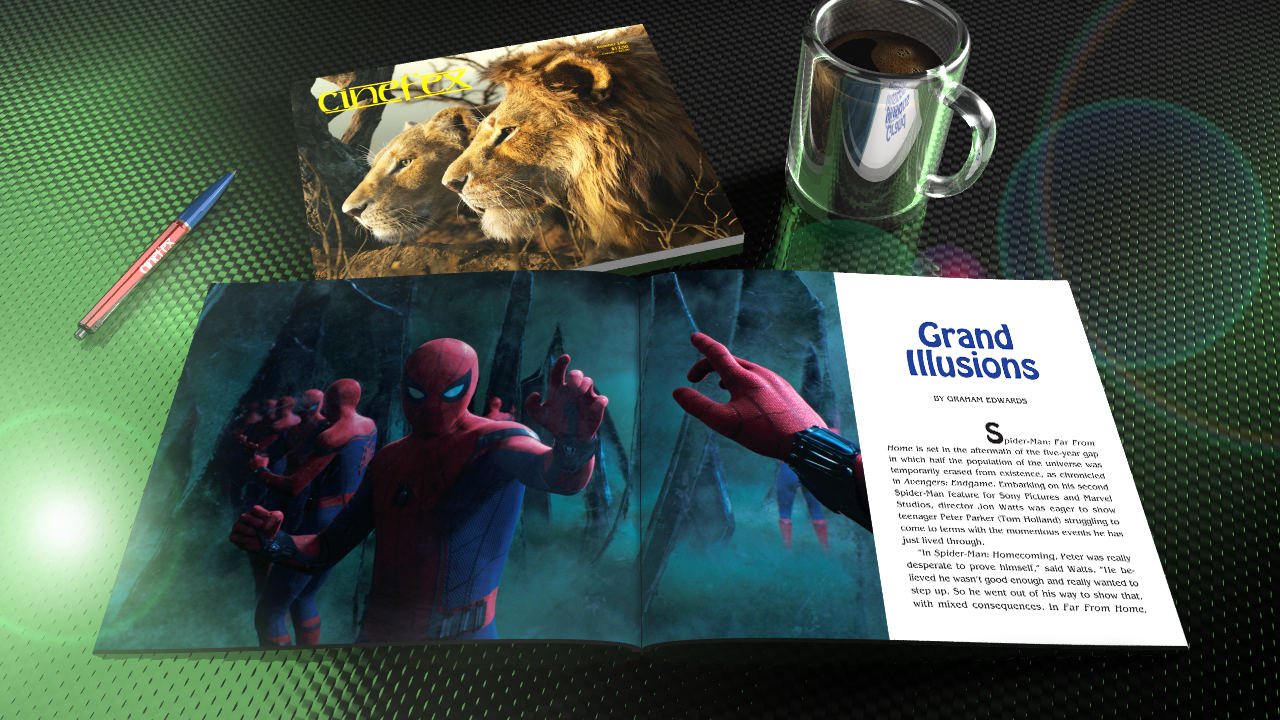
Spider-Man: Far From Home is set in the aftermath of the Blip, the five-year gap in which half the population of the universe was temporarily erased from existence, as chronicled in Avengers: Endgame. Embarking on his second Spider-Man feature for Sony Pictures and Marvel Studios, director Jon Watts was eager to show teenager Peter Parker (Tom Holland) struggling to come to terms with the momentous events he has just lived through.
“In Spider-Man: Homecoming, Peter was really desperate to prove himself,” said Watts. “He believed he wasn’t good enough and really wanted to step up. So he went out of his way to show that, with mixed consequences. In Far From Home, there’s no more Tony Stark, and the world is now asking Peter to step up. As eager as he was in the first film, in this one he’s starting to question whether or not he’s good enough to fill Tony’s shoes and be the superhero the world needs and believes him to be. It’s that feeling you get when you’re a kid, when you really want to be treated like an adult … until the day that you are.”
For the director, Spider-Man: Homecoming had been something of a rite of passage in terms of visual effects production. His mentor was the film’s overall visual effects supervisor Janek Sirrs, who reprised that role for the sequel. Working alongside visual effects producer Cyndi Ochs, Sirrs orchestrated work by artists at Sony Pictures Imageworks, Industrial Light & Magic, Framestore, Scanline VFX, Image Engine, Luma, Rising Sun Pictures, Territory Studio and Perception. During the shoot, special effects supervisor Andy Williams brought a grounded reality to the film’s comic book action.
On the streets of New York City, the Blip has left many people homeless. Aunt May (Marisa Tomei) and Peter Parker — in his Spider-Man guise — have organized a charity event in Queens to help out. ILM delivered roughly 65 shots of Peter wearing the ‘Iron Spider’ suit fabricated for him by Tony Stark.
A town hall in London’s Bethnal Green district doubled as a Queens community center. The cramped kitchen area made for a cozy working environment. “It was pretty tight getting a whole film crew in there,” recalled ILM visual effects supervisor Julian Foddy. “We shot it with one or two main cameras and two or three witness cameras, with Tom wearing a full-body gray fractal suit.” Match-animating Holland’s performance, ILM retained the actor’s face and neck and composited in a digital suit.
The match animation process was painstaking in the extreme, not least because the skin-tight fractal suit revealed the subtlest twitches of Tom Holland’s muscles. For most of the scene, the mask is retracted to expose Peter’s face; accurate alignment was therefore critical to ensure the digital suit’s collar stuck like glue to Holland’s neck. “It proved more of a challenge than we gave it credit for when we started,” Foddy confessed. “The fractal suit terminated on Tom’s collar bone, and that’s where we had to do a lot of additional by-eye tracking, looking at little imperfections on his skin or the folds in his neck. We tracked all the little tendons firing and got the collar to react to those. While we put some of the artists through the meat grinder in terms of how many iterations they had to do, the results really do show up on screen.”
ILM deployed m-cor, its model correction team, to fine-tune the digi-double’s musculature. “The match animators used a rig and positioned joints to match Tom’s performance,” Foddy said. “M-cor did shot sculpting to get the skin lined up with Tom perfectly. We had to do that before we could even try putting the Spidey suit on top — differences of even a millimeter or two really jumped out.” ILM propagated Holland’s movements out through the suit’s three-layered construction. “Janek and I agreed we wanted independent movement in each layer. The collaring snuggest to his neck pretty much hugs the skin, then that movement is absorbed as we move out in the layers.”
For shots of Spidey’s mask retracting, ILM built on the look established in the previous two Avengers movies. Artists brought vector art of computer motherboards into Side Effects Houdini, then procedurally generated geometry on a per-frame basis to show the suit’s nanoparticle structure flowing like wet solder over Peter’s head. “There was nowhere for us to hide with our nanotech shots,” Foddy remarked. “In the Avengers films it was just a couple of frames in big action sequences. We were head-and-shoulders closeup, no camera movement, no motion blur.” Compositors warped the plates to make Tom Holland’s hair and ears pop out from beneath the retracting mask. “The hair progressively springs up a frame or so after it’s been uncovered, then oscillates a little as it settles back into place. The ears do the same. We graded the subsurface scattering out of Tom’s ears as they’re being revealed, to help sell the light hitting them. It’s very subtle.”
Peter dons his Spider-Man suit again to take down a bunch of gangsters from La Maggia, an organized crime syndicate familiar to Marvel Comics readers. Production designer Claude Paré created an Italian restaurant set at Leavesden Studios, inside which Tom Holland and a team of stunt performers enacted a frantic fight that results in a dozen or more hoodlums getting webbed to the walls and ceiling. Holland and his stunt double Greg Townley — a gold medal-winning member of Great Britain’s tumbling team at the 2017 Trampoline Gymnastics World Championships — performed as Spider-Man wearing a fractal motion capture suit.
“Greg could do things without wires that were pretty incredible,” Foddy observed. “They would put a little trampet just below camera, and he would jump off that, do two or three backflips and land on a table in perfect Spidey pose. This guy is about as close to a real life Spider-Man as you can get.” Despite Townley’s talents, Holland remained the Spidey of choice. “We did a day with Tom doing the more closeup dialogue shots and comedy moments. Even if it was just a little cock of the head, Jon Watts was keen that Tom always performed those sorts of shots.”
In all the restaurant shots, ILM replaced the performer with its digital Spider-Man, sometimes match animating, sometimes combining keyframe animation with data from a separate motion capture session done in Los Angeles. The visual effects team compiled a wishlist of specific actions such as takeoffs and landings, which it used to bookend keyframed performances. As the edit evolved, ILM often found itself kitbashing new performances. “We would take the legs or body from one shot and combine that with a head from another,” revealed Foddy, “or even do some sort of chimera where the top half was a motion capture or in-camera performance, but we would change the bottom half to something else. But the human body still can’t do everything Spider-Man can do, so there are quite a few shots where it is fully keyframed.”
Restaurant backgrounds were plate-based. For shots requiring reframing or push-ins, artists reprojected plates onto simply geometry, sidestepping the need for a full 3D build. The asset team churned out an array of props including tables, chairs, crockery, cutlery, and even a leg of Parma ham. A digital fish tank contained animated fish and plant life within a Houdini water simulation, showcased when Spider-Man webs the aquarium to stop it flooding the restaurant.
The ILM team emulated the somewhat splattery look of the webs seen in Spider-Man: Homecoming. “The webs don’t really look much like spider webs,” Foddy commented. “It’s more an organic mass of fluid, almost like someone has squirted a load of Silly String.” The web effect was based on a procedural Houdini simulation, layered up with random seeds to generate organic complexity. Effects artists cached out simulations as curves, lit in The Foundry Katana and rendered in Pixar RenderMan. The semi-transparent web material behaved unpredictably under lighting. “It was very, very shot-dependent. The same light rig and shader settings could come out looking really wet and sticky, or really dry and matte, depending on the shot. We had to massage it all on a per-shot basis to get this feeling of a translucent, viscous liquid.”
For shots showing La Maggia goons encased by webs, artists projected performance plates onto match-animated digi-doubles. These were rendered at the same time as the web elements, allowing the glutinous gunk to refract the live-action footage correctly. With hundreds of thousands of simulated web curves in motion at any one time, noise-free renders took anywhere between eight and 24 hours to output per frame.
In need of a holiday, Peter accompanies his friends on a European vacation. Stuck in a long line at the passport office, he cheekily uses Droney — one of his suit’s robotic accessories — to push a button and open a new counter. Rising Sun Pictures composited a digital Droney into live-action plates, and animated the boy’s backpack flexing for closeups of the critter climbing out of the pocket.
Peter arrives in Venice with his friends, but they have little time to enjoy the sights before a gigantic water monster bursts from a canal and starts causing havoc. The actors performed at Leavesden Studios on a backlot set representing the Italian city’s Rialto Bridge area. Scanline VFX combined the footage with plates of Venice. CG supervisor Ioan Boeiru led the build of a detailed digital environment replicating both the set and the real location. Artists populated the streets with digital crowds based on scans of extras in costume and directed using Massive software.
Scanline’s simulation and development specialists David Stopford and David Stopford, Tzung-Da Tsai, along with company president Stephan Trojansky, established the look of the water monster, Hydro-Man, by integrating Scanline’s proprietary Flowline software into a traditional character animation workflow. “Mattias Brunosson supervised our animation team,” said Scanline visual effects supervisor Julius Lechner. “Animators worked with a regular biped puppet, but instead of having legs his lower body resembles a wide skirt flowing into the water. The most straightforward approach would have been to emit water from the character and have it pouring down. But we wanted Hydro-Man to attract all the water around him, and have it flow continuously into the skirt and up his body.” New tools within Flowline forced the simulated water to conform to Hydro-Man’s physiognomy, while still responding to the laws of physics. “The water reacts to his movement — it detaches from his arms when he moves too fast, for example.”
Multi-tiered simulations added successive layers of detail, beginning with a base fluid layer that defined the overall motion. Next came foam, spray and mist layers, each increasingly fine in detail. “We completely changed the way we do mist,” Lechner noted. “Usually you do it with soft atmospherics, but when you get close that doesn’t look great. Our new atmospheric simulation looks like a regular volume from a distance, but the closer you get the more detail you see, down to superfine mist particles you can fly right through.” A typical Hydro-Man shot relied on 30 computers running the simulations simultaneously, rendered through V-Ray in Autodesk 3DSMax. “We gave the compositors additional passes, but there was always one main Hydro-Man render with all the spray and mist combined into one. Adam Balentine and Curtis Carlson supervised the compositing work.”
Many wide shots were fully digital. With plate-based shots, Scanline usually replaced most of the liquid in the canal when Hydro-Man was present, transitioning to live-action water in the far distance. “Venice water has its own distinctive look,” remarked Lechner. “It has a nice green tone, then when it gets hit by the sun it is more yellow. But when water gets churned up it gets aerated and turns white, so we had to find a good balance between green and white to keep Hydro-Man readable.” Artists referenced the huge sprays of water employed by NASA to suppress the thunderous sound of rocket launches. Rainbows and volumetric god-rays added finishing touches to the brilliantly sunlit shots.
An enraged Hydro-Man fires blasts of water across the canal. Special effects used a pneumatic cannon to fire slugs of water at a gray styrofoam bridge in Leavesden’s exterior tank. Synchronized wire pulls shattered the dummy structure on impact. “It was basically the biggest water pistol you’ve ever seen,” said Andy Williams. “The water came out of the barrel as a perfect cylinder, then the air resistance broke the front of it apart and made the water stream backwards. By the time it had gone a few feet it looked like a comet.” With a three-foot bore and a range of 120 feet, the cannon took around 15 minutes to reset between takes. Scanline blended the practical footage into its CG environment, and used rigid body destruction tools to bring down the bridge.
Certified as safe to use with actors, the water cannon soaked a gung-ho Tom Holland from head to toe for shots of Peter caught in the firing line on the Rialto Bridge. A stunt ratchet pulled the actor backwards for added oomph. “Poor Tom Holland,” quipped Jon Watts. “He’s been in The Impossible, In the Heart of the Sea — every movie, the director tries to drown him!”
A mysterious superhero swoops in and starts battling Hydro-Man. Scanline introduced Mysterio (Jake Gyllenhaal) as a fully digital character, and led the look development of his signature fishbowl helmet, which contains a roiling smoke simulation based on pyroclastic clouds. Scanline also conceptualized the trails of green smoke that accompany Mysterio through the sky. Effects lead Hannes Krieger conformed fluid simulations to predetermined paths, creating ‘smoke snakes’ to suggest the trails were partially under the superhero’s control.
Mysterio draws Hydro-Man away from the canal for a showdown in a nearby plaza, during which the monstrous creature threatens to bring down a bell tower. Peter spins webs to prevent its collapse. At Leavesden, the construction department erected a 40-foot bell tower on a special effects teeter rig. Hinged on one side, the rig used a hydraulic ram to tilt the entire structure sideways. Scanline combined animated characters with live-action plates and a partially digital plaza, fully rigged for destruction.
Text copyright © Cinefex 2019. Reprinted here with permission.
 Graham Edwards