
The following is an extract from my article on Pacific Rim Uprising, published in Cinefex 159, June 2018
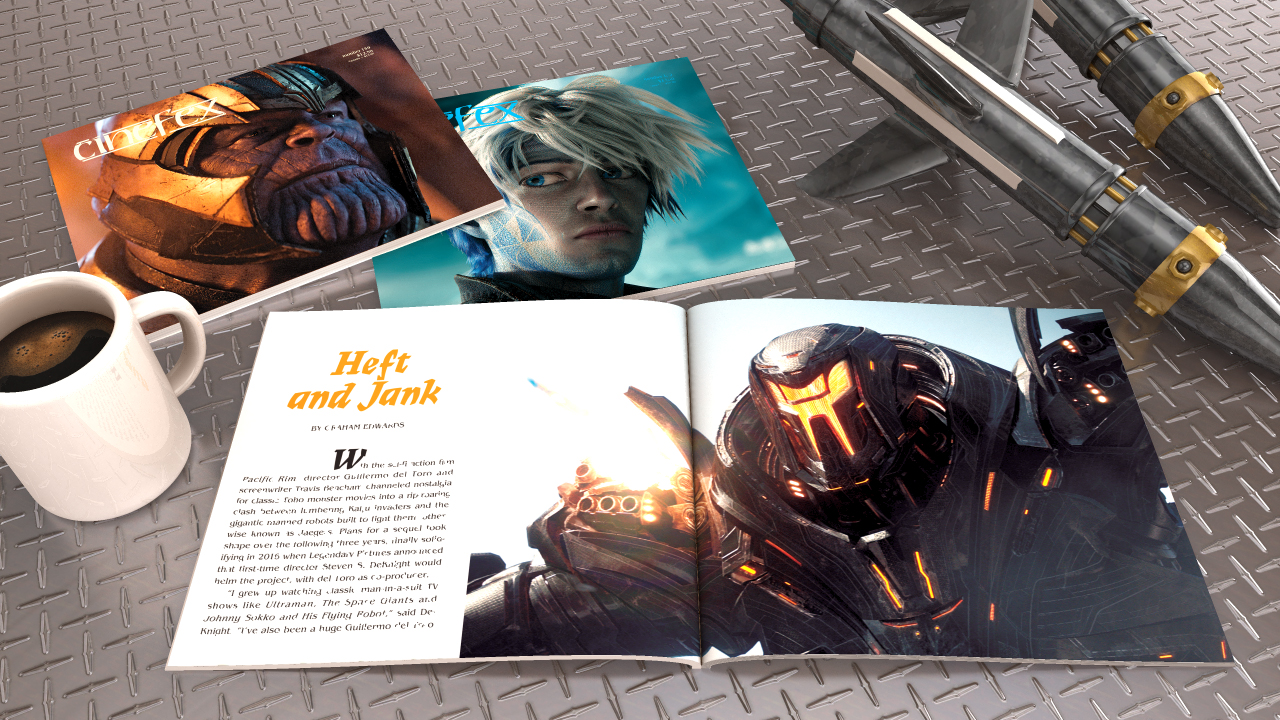
With the sci-fi action film Pacific Rim, director Guillermo del Toro and screenwriter Travis Beacham channeled nostalgia for classic Toho monster movies into a rip-roaring clash between lumbering Kaiju invaders and the gigantic manned robots built to fight them, otherwise known as Jaegers. Plans for a sequel took shape over the following three years, finally solidifying in 2016 when Legendary Pictures announced that first-time director Steven S. DeKnight would helm the project, with del Toro as co-producer.
“I grew up watching classic man-in-a-suit TV shows like Ultraman, The Space Giants and Johnny Sokko and His Flying Robot,” said DeKnight. “I’ve also been a huge Guillermo del Toro fan ever since Cronos. When I was first approached to direct the sequel to Pacific Rim, I broke out the original and watched it a couple more times. I was struck by what Guillermo did with night, rain and underwater, but there was no way I was going back to that because he mined it for everything it was worth, and did it beautifully. I wanted to present something different — take the essence of the first movie and push it into the future. I wanted the battles to be a little faster because the robots in the new story have been upgraded, and I wanted to have them take place in broad daylight — knowing full well that would put the visual effects department in a pinch.”
An experienced writer and producer of television shows including Marvel’s Daredevil and the Starz series Spartacus, the director was acutely aware of the need to balance spectacle with story. “It’s very easy in a movie like this to let the effects take over,” DeKnight observed. “You always have to keep an eye on that, because you’ll start to lose the audience if they’re not engaged with the characters and the stakes and the emotion. That is actually not that hard with the concept that Guillermo and Travis set up in the first movie. You need two people inside one of these giant machines to make it work, so while the action outside should always be spectacular, it’s the human drama inside that really engages the audience.”
Pacific Rim Uprising begins a decade after the heroes of the first film closed the interdimensional Breach through which the Kaiju entered our world. Yet, even after 10 years of peace, the Pan Pacific Defense Corps still maintains its defense force of robotic Jaegers. When scavenger Jake Pentecost (John Boyega) is arrested for stealing valuable Jaeger parts, his adoptive sister Mako Mori (Rinko Kikuchi) offers to wipe his record clean if he will train new Jaeger pilots at the PPDC Shatterdome base on the Chinese island of Moyulan. Teaming up with his former friend Nate Lambert (Scott Eastwood) and the precocious Amara (Cailee Spaeny) — who has built herself a mini-Jaeger called Scrapper — Jake faces not only new Kaiju attackers but also the ambitious Liwen Shao (Jing Tian), who has developed her own brigade of remotely-operated drone Jaegers. Meanwhile, Dr. Hermann Gottlieb (Burn Gorman) and Dr. Newt Geiszler (Charlie Day) make unsettling scientific discoveries that will forever change the way that Jaegers and Kaijus go to war.
Work on the sequel began in earnest in the spring of 2016, with Jim Berney in place as production visual effects supervisor. In November of the same year, Peter Chiang took over that role, with Double Negative on board as sole visual effects vendor. During postproduction, Double Negative outsourced selected work to Territory Studio and BLIND LTD, and shared a total of 1,059 visual effects shots between its London, Vancouver and Mumbai studios. When the workload expanded late in the schedule, Legendary brought in Atomic Fiction to pick up some 350 additional shots. “I headed up the London team along with our associate visual effects producer Sara Khangaroot,” said Double Negative visual effects producer Matt Plummer. “We were also globally running the whole show across the three sites, managing close to 1,000 artists, with 80 animators. The full 3D creature and environment work was done in London and Vancouver; Mumbai also did some less effects-heavy animation and creature work, with more comp and environment extensions.”
Early in preproduction, Jim Berney worked with The Third Floor and editor Mark Livolsi to assemble a pitchvis designed to secure a green light from the studio. “It was by far the most fun I’ve ever had on a project for prep,” Berney commented. “I realized pretty quickly that if you’re in this 300-foot robot, you don’t want the camera shooting into the back of its head. Turn that camera around to look out of the window and you’ve got a beautiful view of a city being destroyed by Kaiju. We did that as much as possible, and we also gave the robots more agility.”
Doug Lefler, head of story at The Third Floor, storyboarded multiple sequences including the film’s climactic final act, set in a futuristic Tokyo. “The nice thing about pitchvis is you can spend more time polishing shots than in regular previs,” said The Third Floor previs supervisor Mark Nelson. “I’d just come off The BFG and Kong: Skull Island, so I’d learned a lot of things about scale, like using a long lens to make a creature look really big behind a foreground object. Or, if you’re looking up at a Kaiju or a Jaeger, keep the camera low and use a wider lens. We didn’t have the luxury of time to run loads of destruction simulations so we used a lot of canned compositing effects and prebaked debris pieces.” The Third Floor went on to do previs for two major action sequences set in Sydney and Siberia.
The preproduction unit built Jaeger and Kaiju assets based on designs emerging from a virtual art department spread around the globe, overseen by production designer Stefan Dechant. While an in-house team created key scene art at the production office in Los Angeles, Industrial Light & Magic deployed artists in its Vancouver, San Francisco and London studios to tackle Jaeger designs under the stewardship of ILM art director Thang Le. First out of the gate were the stalwart Gipsy Avenger — successor to the first film’s Gipsy Danger — the athletic Saber Athena and the diminutive Scrapper. Characters were color-coded for instant readability and styled with a distinctly Anime vibe.
“We thought of the Jaegers in the first film as being tanks, whereas we were designing fighter jets,” said Stefan Dechant. “We wanted to slim Gipsy down but still give him a forceful quality. For Saber, we wanted a lightweight, fast Jaeger — originally she had all these air brakes that would flip out when she needed to stop.” The film’s producers offered their own input: Cale Boyter wanted to grant each Jaeger a unique skill, Thomas Tull requested a belly-mounted gun turret for Bracer Phoenix, and Mary Parent kept Scrapper’s junkpile aesthetic just the right side of Rube Goldberg.
Dechant assigned Kaiju designs to Weta Workshop, where art director Leri Greer led a team developing Doug Lefler sketches into three primary creatures: armor-plated Hakuja, gangly Raijin and hulking Shrikethorn. The design team retained the characteristic glowing energy stripes of the Kaiju from Pacific Rim — referred to as the ‘blue livery’ — but sunk them beneath the surface of skin.
Vastly complicating the Kaiju design process was the fact that, during the film’s final act, the monstrous trio merges together to form a colossal Mega Kaiju. “We got probably 80-85 percent there with Weta in New Zealand,” said Dechant. “When we were getting close to our presentation with Universal, we transferred to Legacy Effects in L.A., so I could actually sit down with the guys there and work it out.” Sculpting in 3D using Pixologic ZBrush, Legacy Effects concept artist Scott Patton adapted the Weta Workshop designs and refined the complexities of the three-into-one assembly routine.
As preproduction gathered pace, Halon arrived to share the previs load with The Third Floor; Halon then segued into postvis duties. “It’s an animator’s dream to work on a show like this,” said Halon previs supervisor Brad Alexander. “Jim Berney and Peter Chiang both let us do what we do best, creating fun shots with dynamic motion or crazy-cool camera moves. We have a small motion capture volume at the Halon studio, and I absolutely could not wait to put the suit on and be Gipsy. I did that for an entire sequence and we animated around it — I just pretended I was a big bad robot and no one seemed to complain!”
During the final push before shooting began at Fox Studios in Sydney, Day for Nite deployed its Australian team to explore previs for the climactic battle. “We built the entire city from scratch and turned around over 400 shots in just a few months,” said Day for Nite previs supervisor Andreas Hikel. “We built our Kaijus around human rigs, and our animators used motion capture as a base, with a lot of adjustment on top. With the Mega Kaiju transformation we knew there would be a lot of trial and error in visual effects, so we focused more on the timing of moving all the pieces into place.”
Two weeks before the shoot, Peter Chiang arrived in Sydney with visual effects producer Theresa Corrao to take up the reins as production visual effects supervisor. “A lot of the previs had been done or was underway,” said Chiang, “but we redesigned a lot of the sequences to make sure that they were exactly what Steven and Legendary wanted. Then, my job out there was to determine what they would build relative to what visual effects could take over in post, and to make sure that all of the plates were what we needed. We made the decision early that we would shoot plates for every single visual effects shot. We knew we wouldn’t necessarily use those plates, but we would always have them as a guide.”
Stefan Dechant’s sets occupied soundstages in Sydney and at Wanda Studios in Qingdao, China. Location shoots took in Sydney and Brisbane, plus the South Korean cities of Seoul and Busan. Additional photography in California and Japan accommodated late changes to the film’s final act. The constant need to frame for grappling giants meant that aerial shots were always on the slate. In urban locations, XM2 Cinematography flew drone cameras to fill the gap between the 500-foot lower limit for safe helicopter flight and the 100-foot maximum reach of camera cranes.
Among the most complex sets were the Conn-Pods — the cockpits from which the Jaegers are controlled. To lend motion to the 18-ton Gipsy Avenger Conn-Pod, the special effects department constructed a custom hydraulic six-axis gimbal — the largest in Australia at that time. “First we built the floor and a big external truss that we called the coat hanger,” said special effects supervisor Dan Oliver. “Then construction built the set on that. Right next to it we built the gimbal, then lifted up the set with cranes and slid the gimbal beneath it. We had about 10 weeks to do it — an extremely tight schedule.” A second gimbal held other Jaeger Conn-Pods on four airbags, which could be individually inflated and deflated to generate a wallowing motion. Air rams actuated ‘walk mode’ by pulling the set down on left and right sides alternately, and hydraulic rams delivered lateral shocks. Most gimbal functions were controlled manually by operators, using Concept Overdrive motion control software.
In the original film,the feet of the Jaeger pilots were physically attached to the robot’s legs. In the sequel, a magnetic field levitates the operators above an open pit. “Steven really wanted to lose that walking mechanism,” Stefan Dechant noted. “I started thinking about a suit with an exoskeleton that can lift you up. That way you can do a flying kick — which you couldn’t really do in the old Jaegers — or you can be knocked ass over teakettle.”
On set, performers ran on infinitely-variable green treadmills installed by special effects and controlled by the stunt department; visual effects later removed the treadmills. A certain level of physical connection remained in the form of mobile arms running down from the ceiling and connecting to the performers’ backpacks. Special effects technician Jason Christopher designed arm components using Dassault Systèmes Solidworks, following concepts by Stefan Dechant and art director Ron Mendell. Some components were machined or laser-cut from aluminum, while others were 3D-printed, molded and cast. Each arm featured a hydraulically-powered upper section mobile in two axes, coupled to a passive lower section capped with a 360-degree rotation bearing. Remote operators controlled the upper arms, while the loose lower link allowed performers to move freely and safely.
A second pair of gimbals drove the movement of the smaller Scrapper cockpit. The airbag edition held a fully dressed set and was used for walking shots. “We used mechanical timers for the Scrapper airbag gimbal,” Dan Oliver related. “Once we worked out a good pressure, those timers would inflate and deflate the airbags to get a good, repeatable walking rhythm going.” Oliver’s team built a twin-ring gyroscopic cradle in which Cailee Spaeny rode while the rest of the set jostled around her. Used for shots of Scrapper in ‘rolling mode,’ a separate six-axis gimbal allowed cradle and actor to be photographed against bluescreen, leaving visual effects to add the wildly-spinning cockpit interior.
Text copyright © Cinefex 2018. Reprinted here with permission.
 Graham Edwards