The following is an extract from my article on Solo: A Star Wars Story, published in Cinefex 160, August 2018
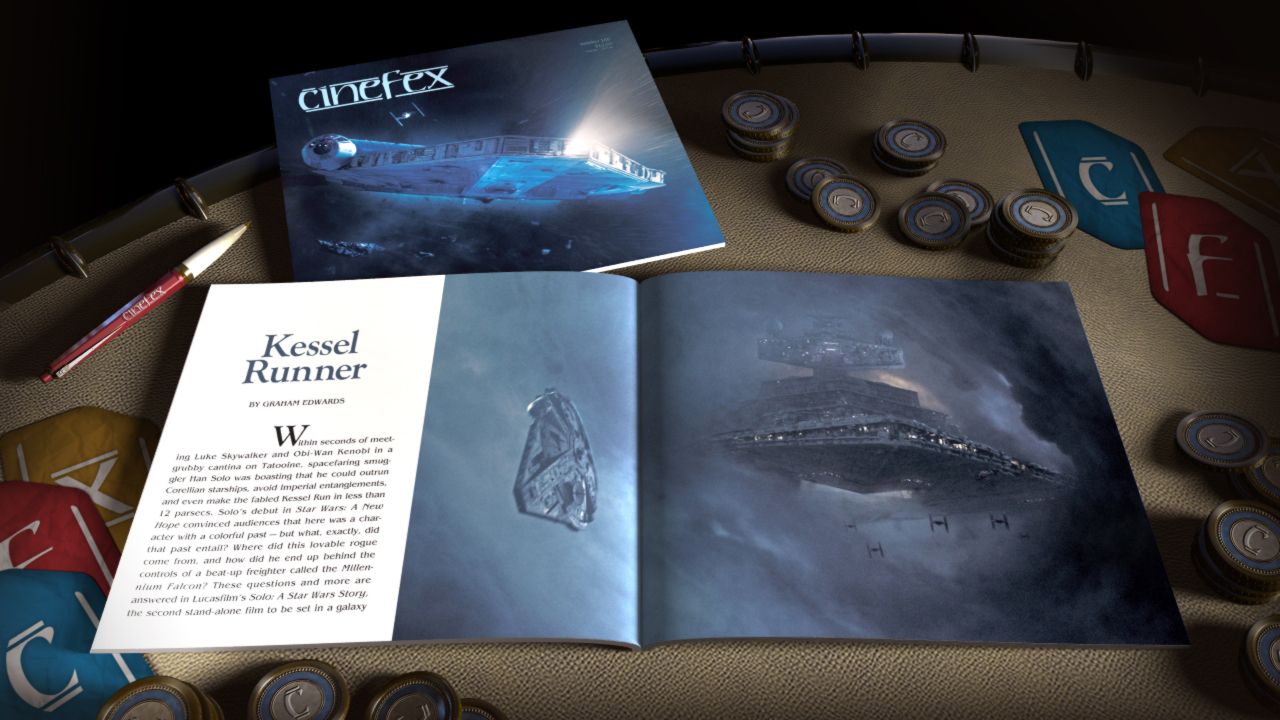
Within seconds of meeting Luke Skywalker and Obi-Wan Kenobi in a grubby cantina on Tatooine, spacefaring smuggler Han Solo was boasting that he could outrun Corellian starships, avoid Imperial entanglements, and even make the fabled Kessel Run in less than 12 parsecs. Solo’s debut in Star Wars: A New Hope convinced audiences that here was a character with a colorful past, but what exactly did that past entail? Where did this lovable rogue come from, and how did he end up behind the controls of a beat-up freighter called the Millennium Falcon? These questions and more are answered in Lucasfilm’s Solo: A Star Wars Story, the second stand-alone film to be set in a galaxy far, far away.
Principal photography began on Solo: A Star Wars Story in February 2017, with Chris Miller and Phil Lord directing from a script by Star Wars stalwart Lawrence Kasdan and his son Jonathan, and with Alden Ehrenreich in the title role. In late June, Miller and Lord left the project due to creative differences and Ron Howard took up the directorial reins to steer the movie through the rest of the main shoot, a round of additional photography, and postproduction.
One of the new director’s primary concerns was ensuring that the film’s hero remained firmly in the spotlight throughout. “This isn’t a war movie with an ensemble cast,” said Ron Howard. “It’s about young Han’s rite of passage, running this gauntlet on his quest for freedom. I wanted to make it first-person and put the audience right alongside Han throughout the adventure, to give it an urgency and excitement.” Howard also tuned into the film’s pre-existing themes and retro vibe. “One of the things I inherited was an approach that I really agreed with, which was a kind of earthy naturalism. There are always elements of the American Western and Kurosawa’s samurai films in Star Wars and I wanted to add a kind of ‘70s energy to all that — which was already there in the mind’s eye of Larry and Jon Kasdan, who wrote with kind of a rock‘n’roll vibe. In addition, I always remembered that A New Hope had a very unpretentious attitude about the spaceships, the worlds. George Lucas always said you have to throw all that stuff away. Don’t go for beauty shots. Don’t linger.”
Industrial Light & Magic handled all visual effects for Solo, under the guidance of production visual effects supervisor Rob Bredow. Also a co-producer on the film, Bredow was appointed senior vice president, executive creative director and head of ILM two days before Solo’s 2018 Hollywood premier. “From the beginning, Chris Miller and Phil Lord had wanted it to feel like it could have been shot in the years leading up to A New Hope,” Bredow noted. “They cited references like McCabe & Mrs. Miller and The Driver — they really wanted that grounded ‘70s feel. We wanted to get as much in camera as possible and use old-school effects techniques wherever applicable. Then, I was able to bring in the best of the best new technology to supplement those techniques.”
ILM executive visual effects producer Luke O’Byrne, visual effects producer Erin Dusseault and visual effects supervisor Pat Tubach led the company’s San Francisco team and shared assignments across ILM facilities in Vancouver, London and Singapore. Backing them up were third-party vendors including Hybride Technologies, which delivered over 400 shots split evenly between its Montreal and Piedmont divisions. Virtuos built assets, Raynault VFX and Jellyfish Pictures crafted set extensions and environments, and Tippett Studio supplied stop-motion animation and compositing. Certain layout, paint and rotoscoping duties fell to Yannix, Exceptional Minds, Lola and StereoD; the latter also did stereo conversion. The Third Floor handled most of the film’s previs supplemented by a small team at ILM.
ILM art director James Clyne kickstarted designs with a small team during the summer of 2015, before relocating to the U.K. at the end of the year to hook up with production designer Neil Lamont, who had just set up his department at Pinewood Studios. Clyne’s team explored concepts for planetary environments including Han’s homeworld of Corellia, inspired partly by punk-era New York City. Renderings of mountainous Vandor echoed Frederic Remington’s paintings of the American Old West. Developing vehicle designs, Clyne went old-school. “For the new ships and speeders, we brought in a small crew of physical modelmakers,” said Clyne. “They had all the same kits that Lorne Peterson and his modelmakers used for the original films, and we built full maquettes of everything. We then took everything back to ILM to build our final 3D assets.”
One task made everyone quake: reinventing the galaxy’s most famous piece of junk. “How do you approach even adding a single bolt to the Millennium Falcon?” Clyne mused. “The more I thought about it, the more scared I got!” According to the script, the Falcon’s familiar grungy fuselage began life concealed beneath a smooth outer shell. “I proposed to the production and Lucasfilm Story that, through the film, this shell gets progressively torn off. In A New Hope, when Luke sees the Falcon and says ‘What a piece of junk,’ maybe Chewie shrugs his shoulders because he’s been spending his weekends getting this thing back up to some kind of running order since the end of Solo! Maybe Han has added engine parts and plumbing. The first thing we did was just strip all that down.” Clyne and his artists used pen and paper to sketch the new-lookfreighter — the most striking feature of which is its nose-mounted escape pod — before progressing to Adobe Photoshop renderings and 3D models. The modelmaking team then developed the outer shell by retrofitting Falcon plastic construction kits. The final slick-skinned aesthetic contained a conscious echo of early Falcon concepts drawn by Ralph McQuarrie and Joe Johnston for A New Hope.
Looks are one thing. Performance is another. Poring over the original Star Wars trilogy, ILM animation supervisor Matt Shumway broke down the Millennium Falcon’s movements as if it were a character in its own right — which some might argue it is. He confirmed that the spacecraft maneuvers like a fighter jet, banking before it turns, and discovered it was less agile than he remembered. A consultation with veteran ILM visual effects supervisor Dennis Muren revealed why. “I learned that it was the limitations of how they needed to shoot the model under motion control,” said Matt Shumway. “It actually moves as if it’s on a rail.” Shumway shared his findings with ILM animators via the company’s intranet, even including details about the ship’s weight distribution. “The Falcon’s center of gravity has always been at your convenience. It should be in the center of the ship, but when you’re looking out of the cockpit it feels more natural to make the move from the center of the cockpit instead, even though that would look wrong from the outside.”
The story of Han Solo’s early life begins on Corellia, where the Empire has taken control of vast shipyards. Handling hot goods in the form of a vial of coaxium — a highly prized hyperfuel — streetwise orphan Han and his girlfriend Qi’ra (Emilia Clarke) confront the Corellian equivalent of Oliver Twist’s Fagin, the caterpillar-like Lady Proxima, voiced by Linda Hunt.
The studio set for Proxima’s lair contained a 15-foot-deep water tank, in which a Proxima puppet was immersed. Special effects raised the puppet from the water using cables and a hydraulic scissor lift, while a pole arm delivered body movement. “We actually had puppeteers inside it,” said creature designer Neal Scanlan. “The whole thing was submerged to the point where their mouths were just above the waterline.” Scanlan’s team built Proxima’s body around a tower of flexible hollow tubes that allowed water to flow freely in and out. Head of fabrication Vanessa Bastyan clad this with sections of wrinkled foam latex skin, finished with water-resistant polymer paint and adorned with lightweight fabrics and jewelry. The uppermost of Proxima’s many arms were rod-puppeteered.
Animatronics designer Adrian Parish mechanized Proxima’s head. Facial performance was controlled through a computerized system designed by electronic design and development supervisor Matthew Denton. Used widely for animatronic characters across the film, the performance system processed signals from mitts or trigger-equipped joysticks through custom software and onboard hardware. Pulling back a joystick might cause a character to smile by combining preprogrammed lip, cheek and brow movements; pushing the same joystick forward might induce a frown. All expressions were proportional to the degree of movement on the input device.
ILM added rows of CG arms to Proxima’s serpentine torso, and digital artists Amy Shepard and Sam Stewart removed the rigs. “Sometimes we could grab the clean plate and put it behind Proxima,” said ILM paint supervisor Beth D’Amato. “A lot of times it was frame-by-frame paint, because there were crowds of people standing behind her, all moving individually.” Although the animatronic Proxima had nailed the performance, dialogue changes during postproduction required ILM to adjust the puppet’s mouth movements. “I would play a shot and listen to the new audio, then scrub through frame by frame and write down the main beats. I worked out a sort of library of mouth shapes per shot. Say a shot was 150 frames, but the cut was only 45 frames — I would choose different mouth shapes from the entire shot as my heroes, put those in place, then paint the inbetweens. For some moments, I was completely reconstructing her.”
Neal Scanlan’s team provided an animatronic head worn by suit performer Harley Durst as Proxima’s sidekick, Moloch (voiced by Andrew Jack), who chases Han and Qi’ra from the lair with his pack of Corellian hounds. On set, trained dogs wore zip-up suits made from foam latex and stretch netting, based on a sculpture by Martin Rezard. ILM did cosmetic work on the suits, painted in paws and re-animated snarling mouths.
The pursuit continues as our heroes flee in a stolen speeder. Live-action speeders navigated the twists and turns of a Corellia set constructed at the decommissioned Fawley Power Station near Southampton, U.K., with a stunt team driving wheeled vehicles at speeds of up to 80 miles per hour through a labyrinth of abandoned boilers and ducts. Special effects supervisor Dominic Tuohy constructed four speeders — duplicate pairs for Han and Moloch — with body shells of aluminum and fiberglass. The muscle-car fin on the back of Han’s ride cunningly concealed a safety roll cage. Senior technician Tony Turner designed custom chassis fitted with 525 brake horsepower V8 engines, adapting a system used in rally cars that enabled drivers to switch between two- and four-wheel drive at the touch of a button. “It was a pneumatic system, quite unique, that used five clutches to engage the drive,” said Dominic Tuohy. “You could go into a corner in two-wheel drive, then suddenly engage all four wheels to give it a different-looking drift. That’s great for Star Wars, so people don’t say, ‘Oh, there’s just a car underneath it.’ We had champion rally drivers — plus the Stig from Top Gear — and they got those speeders doing some really dynamic movements.”
BLIND LTD designed animated graphic displays for the practical speeders, fed live to tablets installed in the dashboards. Fuzzy-edged, flickering animation prevailed, inspired by early computer imaging like the SAGE (Semi-Automatic Ground Environment) cathode ray radar system introduced by the North American military in the late ‘50s. “We looked at computer artists like John Whitney,” said BLIND screen graphics designer Shaun Yue. “His son, John Whitney Jr., worked on Westworld, and we were interested in that because Solo has a very Western feel. We’ve never really seen that time period in Star Wars before, back when just drawing a pixel was an engineering feat.”
“We designed a rear-view camera display based on the cel-animation style of the X-wing targeting device,” BLIND computer graphics supervisor Andrew Booth elaborated. “We also did a map, which we tethered to the compass on an iOS device inside the vehicle. The animation changed in response to real-time data based on the speeder’s actual movement.” On set, a BLIND team acted as ‘graphic puppeteers,’ using Unity-based graphics controls and Derivative TouchDesigner software to adjust color and timing on the fly. “We broke the pre-rendered graphics into separate layers, which responded to external stimuli like the compass, or a DMX light control, or our own wireless controls.” BLIND also supplied cockpit screen graphics for other vehicles, including the Millennium Falcon.
ILM constructed a sprawling shipyard environment whose architectural design reflected Corellia’s most famous product. “I had a scale model of the Falcon on my desk at the time,” recalled James Clyne. “I thought maybe the environment should look like that. The top and bottom of the Falcon are pretty clean in relationship to its midsection, where you get this area of high-density detail. So, on Corellia, there are horizontal strips of heavy detail everywhere. We called them ‘gak bands.’”
ILM layout supervisor Tim Dobbert established shipyard geography, connecting looming pill-shaped structures with ocean-spanning causeways. “We built it as a contiguous world,” said ILM visual effects supervisor Greg Kegel, who oversaw the Vancouver team. “We choreographed the chase through that world based on a stitching-together of the live-action footage. During editorial, things shifted around and we had to cheat a bit. The causeways were built from a handful of pieces with dressing running along the sides — lightposts and other techy bits and bobs. All the structures had this consistent design language, so we could repurpose sections and put them together in different ways.” Layout artists sprinkled in the building blocks of iconic Star Wars ships, treating audiences to fleeting glimpses of TIE fighter fuselage spheres and deconstructed Star Destroyers.
Wide shots of Corellia were fully digital, and most shots of the practical speeders benefited from set extensions. Often, artists painted out the wheels of the live-action vehicles and retained the bodies. Sometimes a half-practical, half-CG solution was pursued, with a speeder split along a natural seam line. ILM added backgrounds to bluescreen shots of the actors in a gimbal-mounted speeder buck, commonly replacing the vehicle exterior with its digital twin in pursuit of convincing reflections. Many shots used fully CG speeders. “From an animation standpoint, you can treat a speeder like either a boat or a car,” Matt Shumway remarked. “We tried both and the boat version just felt fake. When we matched it to the physics of the cars, it felt like this classic ‘70s driving movie, which Ron loved.” Stunt gags inspired standout action beats, including a moment when Han pulls a high-speed donut in the middle of a causeway. The maneuver was shot practically on a runway at Dunsfold Airfield, then realized by ILM as a fully digital shot.
Text copyright © Cinefex 2018. Reprinted here with permission.
 Graham Edwards