
The following is an extract from my article on The Fate of the Furious, published in Cinefex 153, June 2017
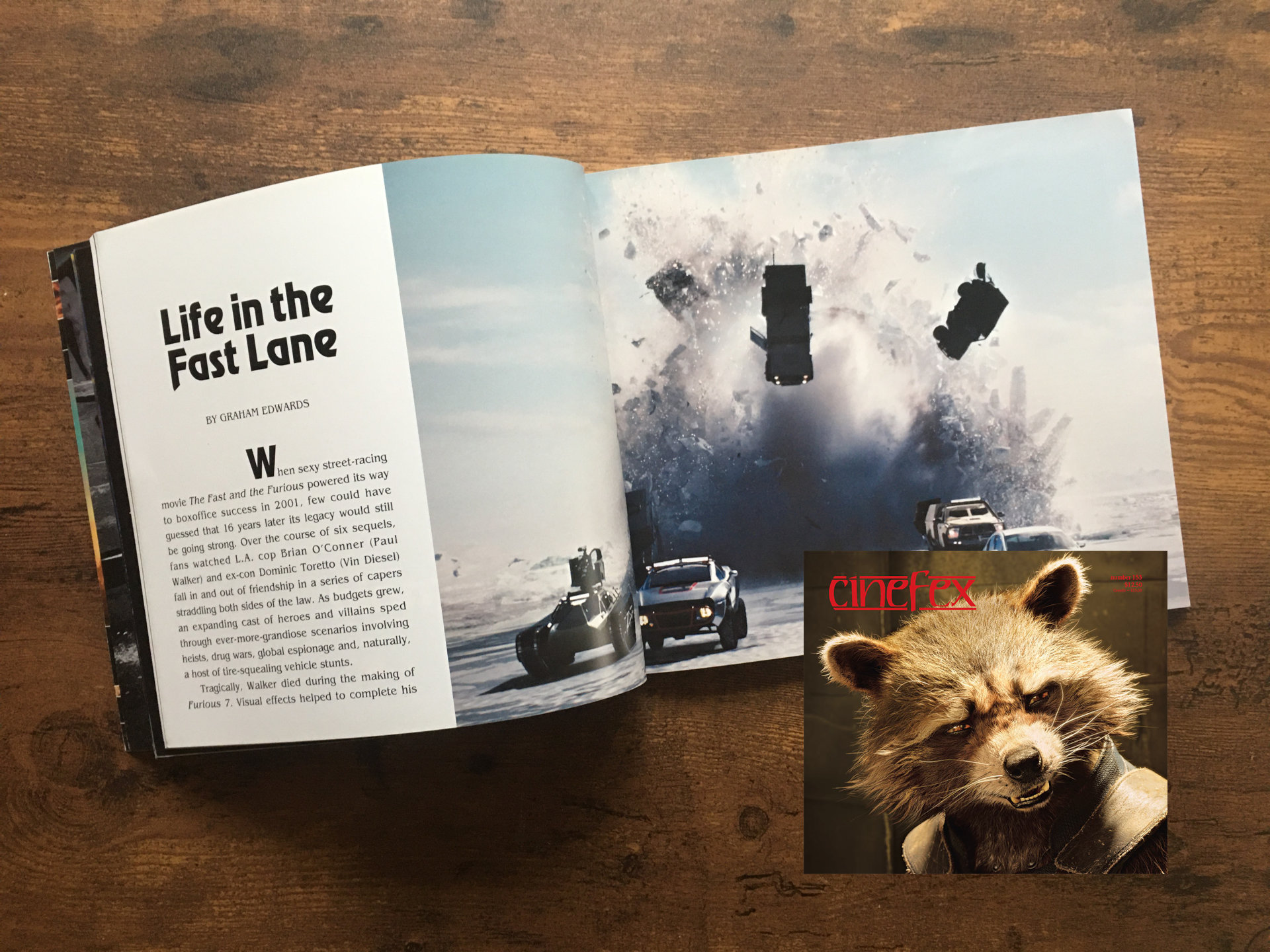
When sexy street-racing movie The Fast and the Furious powered its way to box-office success in 2001, few could have guessed that 16 years later its legacy would still be going strong. Over the course of six sequels, fans watched L.A. cop Brian O’Conner (Paul Walker) and ex-con Dominic Toretto (Vin Diesel) fall in and out of friendship in a series of capers straddling both sides of the law. As budgets grew, an expanding cast of heroes and villains sped through ever-more-grandiose scenarios involving heists, drug wars, global espionage and, naturally, a host of tire-squealing vehicle stunts.
Tragically, Walker died during the making of Furious 7. Visual effects helped to complete his performance by blending in footage of the actor from previous films, and through the judicious use of digital head replacement. Furious 7 went on to make over $1.5 billion worldwide, placing it among the top ten biggest grossing films of all time.
The cars may be the stars, but in common with the preceding seven films, the central theme of The Fate of the Furious is family — as epitomized by Dom’s loyalty to his charismatic gang of racers. With producer Neal H. Moritz steering the shows since day one, and with many key department heads returning time and again, the production team too has become a kind of family.
“I think one of the big attractions to working on these films is the team,” said visual effects supervisor Michael Wassel, veteran of every film in the franchise but one. “We have a remarkably high percentage of alumni that return — I think we just enjoy working together.” As the films have become more spectacular, so the role of the visual effects department has evolved. “My first gig as visual effects supervisor was The Fast and the Furious, where we were doing impossible things with cameras to sex things up. It’s different now. Now, it’s driven a lot by logistics and the scale of production, and creating really over-the-top effects that look practical. We’re always trying to ride the line of believability between incredible action and: ‘Yeah, you just might be able to do that with a real car.’”
Doing it with real cars has remained an integral part of the franchise, even as the scope of the action sequences has escalated. During the production of The Fate of the Furious, no less than 300 vehicles were reduced to scrap, with much of the mayhem overseen by second unit director Spiro Razatos and stunt coordinator J.J. Perry. Special effects supervisor J.D. Schwalm played his part, managing a 130-strong crew and devising massive practical rigs for use across three continents. “It was definitely the largest budget I’d ever put together,” said Schwalm. “The size and scale of the gags were so above and beyond what you would normally do in a film. The motto was: ‘We like to do this for real,’ and that’s what they went with throughout filming, the whole time.”
Embarking on the eighth film in the series, the filmmaking family first came together over 13 pages of treatment drawn up by screenwriter Chris Morgan. Early to the preproduction table were director F. Gary Gray and Michael Wassel. “Chris had outlined the overall structure of the movie,” Wassel recalled, “but a lot of the details weren’t laid in at that point. It was up to us, through storyboards and beat sheets, to expand out on top of Chris’s ideas. Gary wanted shot designs that would differentiate this film from all the others, so he asked us to bring him ideas that hadn’t been seen in the other films. He was very inclusive in terms of creative input — I ended up putting together the initial treatment of one of the sequences myself.”
The production transported large crews and fleets of vehicles to sets and locations in Cuba and Iceland, and in and around Atlanta and Cleveland in the U.S. During principal photography, Wassel accompanied main unit while visual effects supervisor Kelvin McIlwain toured with second unit. Coming together in post, the team assigned visual effects for the film’s climactic final act to Digital Domain and divided other major sequences between Double Negative, Pixomondo and Rodeo FX. Cantina Creative visualized high-tech computer interfaces central to the storyline, Trixter and RISE stepped in towards the end of postproduction, and an in-house team provided essential additional support. Proof Inc. handled previs and postvis.
The Fate of the Furious begins as Dominic Toretto enjoys a Cuban vacation with his wife, Letty (Michelle Rodriguez). Caught up in an argument over a debt, Dom enters a road race against Raldo (Celestino Cornielle). As the two men hurtle through the streets of Havana, Dom squeezes more speed out of his heavyweight Chevrolet Fleetliner by ejecting seats and body panels.
Stunt drivers enacted the race on location in Havana. Pixomondo blended bluescreen car interiors with backgrounds shot on location, and selectively used CG vehicles to spice up the action. “In some shots the filmmakers wanted to move the cars around to create a bigger gap between Dom and Raldo,” said Pixomondo visual effects supervisor Nhat Phong Tran. “For those we had to go digital.” The Pixomondo team populated Havana streets with digital crowds containing up to 500 cheering spectators, using Basefount’s Miarmy plugin for Autodesk Maya.
Robbed of its protective hood, Dom’s overburdened engine bursts into flame. Effects artists employed Side Effects Houdini simulations to torch a CG motor and splinter the car’s windshield. When the flames threaten to incinerate Dom, he spins his car through 180 degrees and wins the race in reverse gear. The final sprint takes place along the Malecón, a five-mile esplanade on Havana’s north shore famous for its dramatic crashing waves. The sea was calm during the shoot, so Pixomondo used water simulations to add the essential spectacle.
“When we analyzed the way the waves broke,” Tran related, “we found it was highly dependent not only on the visible parts of the jetty, but also the foundations. We built the whole Malecón wall, but in order to create interesting wave crashes we also had to lay out the ocean bed.” Effects supervisor Bahador Mehrpouya developed customized Houdini simulations to mimic the look of the Malecón waves. “We had to write our own CVEX code. First, the scale of the waves couldn’t be easily computed out-of-the-box. Second, we had to art direct the waves, because the filmmakers wanted to keep the surrounding ocean calm. So there was a slight disconnect between the physics of the plates and the creative requirement.” Wherever possible, Pixomondo retained the real Havana environment. When water splashed directly over the esplanade, compositing supervisor Eddee Huang conjured realistic refraction effects by incorporating sections of the digital Malecón.
At the finish line, Dom careers towards the watching crowd. At the last moment he steers his Chevy into the wall and jumps clear. The car flips into the ocean — a gag staged on location and duplicated on a backlot in Atlanta. Using the live-action as reference, Pixomondo replaced the somersaulting Chevy with a digital vehicle.
Reunited with his family of associates, Dom undertakes a covert mission in Berlin, leading a fleet of Dodge Challengers into a secure facility in order to steal an electronic device. To aid their escape, technical expert Tej Parker (Chris ‘Ludacris’ Bridges) has rigged the surroundings with booby-traps. Production shot live-action at the Guardian Centers complex in Perry, Georgia. A training ground for disaster response organizations, the former Northrup Grumman missile plant boasts a 350-acre urban environment complete with pre-collapsed buildings.
For a scene in which the cars crash through a concrete wall, special effects prefabricated a breakaway wall from two-part foam blocks. The crew also filled the complex with enormous fans of flame, generated at 10 locations by nozzles jetting a gasoline-diesel mix skywards at a rate of around 200 gallons per minute.
As Dom’s gang flees, security vehicles give chase. The resulting pursuit sequence showcases the dynamic car interior shots for which the franchise is known, and which feature throughout The Fate of the Furious.
During a lengthy bluescreen shoot, actors performed inside cars mounted on a range of special effects rigs designed to spin, slide and flip vehicles every which way. Arrays of LED panels, displaying background plates shot previously using a six-camera car rig, threw interactive lighting onto the vehicles. “In previous Fast & Furious films we mixed and matched bluescreen with live-action rig-and-tow work,” said Michael Wassel. “As the cast has grown, it’s become impossible to coordinate all the actors’ schedules and photograph them practically on location, so the driving work is done on a stage.”
Special effects built a car rig around a six-axis hydraulic motion base, with computer controls allowing operators either to program movements established through previs, or else maneuver cars on the fly. A separate system floated vehicles on air bearings on a 10,000 square foot epoxy floor. Manual controls permitted cars to slide alongside one another — useful for scenes showing drivers exchanging dialogue. Next came a hydraulic rotisserie capable of spinning vehicles sideways or end over end. “We utilized the same mounts as the motion base,” J.D. Schwalm commented, “so you could go back and forth between the gimbal and the rotisserie in a relatively speedy manner. Everything was heavily engineered because we had all these million-dollar actors inside the cars.”
Yet another setup — christened the ‘four-post rig’ — delivered high-frequency vibrations to accurately simulate road noise. “Involuntary body movements are one of the things that make it look like you’re driving fast,” observed Michael Wassel. “Even a well-trained actor will struggle if they’re just sitting in a chair. If we simulate a road surface with high-speed hydraulics, we can transmit real harmonic vibrations from the car’s suspension to the actor.”
The innovative four-post rig worked by strapping each tire to a pair of two-foot-square hinged steel plates. Sandwiched between the plates were two hydraulic cylinders. When extended, the cylinders snapped the plates open, lifting the attached wheel up to 36 inches off the ground in a fraction of a second. “We ran it through a computer system that mimicked sound waves,” explained J.D. Schwalm. “We would set a frequency for the front wheels and they would start jittering up and down. We set a delay between the front and rear wheels to simulate the delay between the front tire bump and the rear tires hitting that same bump. We had a couple of joystick sliders that could simulate a right and left turn.”
The rig’s tiny footprint benefited the camera department. “Because the car wasn’t moving in large swings in any dimension,” Michael Wassel noted, “that allowed us to get very close with the LED panel lighting. The cinematographer was able to lay out cameras in a precise way — more so than if we were working on a motion base.”
For the Berlin chase, Rodeo FX integrated bluescreen footage of actors in the vehicle rigs with background plates. The team assisted with plate selection, with artists stabilizing, warping, stitching and retiming backgrounds as required to assemble mini-cuts of the sequence for approval within Autodesk Flame, before final compositing in The Foundry Nuke. “We ended up being responsible for a fair amount of the continuity for everything that pertained to the bluescreens,” said Rodeo FX visual effects supervisor Philippe Soeiro. “We had to keep up with the editorial changes, because some shots ended up being in different places than originally anticipated. The process also allowed us to quickly identify which shots would require CG or matte painting backgrounds.” Rodeo FX fabricated an extensive digital environment with which artists extended and enhanced the live-action, with Houdini fire simulations pouring extra fuel on the practical flames.
The complex rig movements tested the mettle of the matchmovers. “It was quite tricky to discriminate between the camera movement and the shaking of the car,” Soeiro remarked. “And we hadn’t anticipated the amplitude of the motion — we had shots where the camera was swirling around the cars over 180 degrees. That made it tricky to create something that moved naturally. For the benefit of the shot, we often had to diverge from reality.”
The bluescreen cars were glassless, so artists inserted digital windows — a procedure reliant on accurate matchmoves. “The windshield of a Challenger goes over the frame of the car,” Soeiro observed, “so we couldn’t do a 2D cheat — we had to model the actual windshield, faithfully reproducing refractions and reflections.” The team employed live-action backgrounds as the main source of reflections. Artists typically matchmoved a CG car to the bluescreen vehicle on its rig, then surrounded it with a virtual sphere onto which they projected stitched background plates, for use as a reflection map. When camera moves were extreme, a CG vehicle replaced the practical car completely. “The reflections had to be plausible in terms of speed and content — if not absolutely accurate in terms of where they were geographically. That was also true of dirt passes and all the interactions between dirt and light and reflections. These weren’t your average bluescreen car comps!”
With the security vehicles close behind, Dom’s team enters a construction zone. Tej activates a remote control, causing a gigantic wrecking ball to demolish their pursuers. In the spirit of doing things for real, special effects staged the event full-scale at the Guardian Centers.
In consultation with New York’s McLaren Engineering Group, and aided by computer simulations modeled in Dassault Systèmes SolidWorks, J.D. Schwalm determined that a 10-foot-diameter, 35,000-pound wrecking ball traveling at 50 miles per hour would deliver sufficient force to take out five vehicles without losing momentum. Schwalm assembled a hollow ball from hoops of inch-thick steel plate cut at varying diameters using a computer numerical control plasma cutter. The wrecking ball was too heavy to transport in one piece, so the team welded it together on site.
Special effects spent around two weeks rigging the gag, which required the wrecking ball to be suspended on a pair of 200-foot ropes from a 650-ton crane. Four guylines — each 1,000 feet long — anchored the crane’s jib to 50-ton counterweights, two on each side. “The ropes were two inches in diameter,” said J.D. Schwalm. “We used synthetic rope because of the weight — it’s actually a little stronger for its diameter over steel cable. We put digital dynamometers in line on every rope, all remotely viewable. The most dangerous part of the gag was when we pulled the ball back and it was floating 55 feet up in the air, 100 feet away from the crane, putting a huge sideload on it.”
The rig’s geometry established a 65-foot-long collision zone immediately beneath the crane. It was critical that the five vehicles enter this zone at the exact moment the ball was passing through it. To achieve precise timing, the special effects team extended a rope from the back of the ball to a counterweight at the far end of the track. The rope returned through a pulley and attached to the vehicles. As the ball swung through its arc it pulled on the rope, which in turn drew the convoy into position.
Schwalm kept the target cars rolling straight by threading them onto steel guide cables stretched taut along the track. “We bolted a Kaydon bearing to the front wheel,” Schwalm explained. “Off the side of that, a metal tube ran forward — because it was on the bearing, the pipe didn’t roll with the wheel. We ran the guide cable through the tube and that steered the car dead center.” A pressure-activated blade automatically detached car from cable the instant the ball struck. The only other modification the crew made to the vehicles was to remove the engines.
After two test runs, the wrecking ball performed before a multitude of cameras. “We had a pneumatic hook that released the ball,” said Schwalm. “Directly under the crane, it impacted the first vehicle and then the rest followed on. We did it in one take and it just ate those cars for dinner!”
Text copyright © Cinefex 2017. Reprinted here with permission.
 Graham Edwards