
The following is an extract from my article on Terminator: Dark Fate, published in Cinefex 168, December 2019
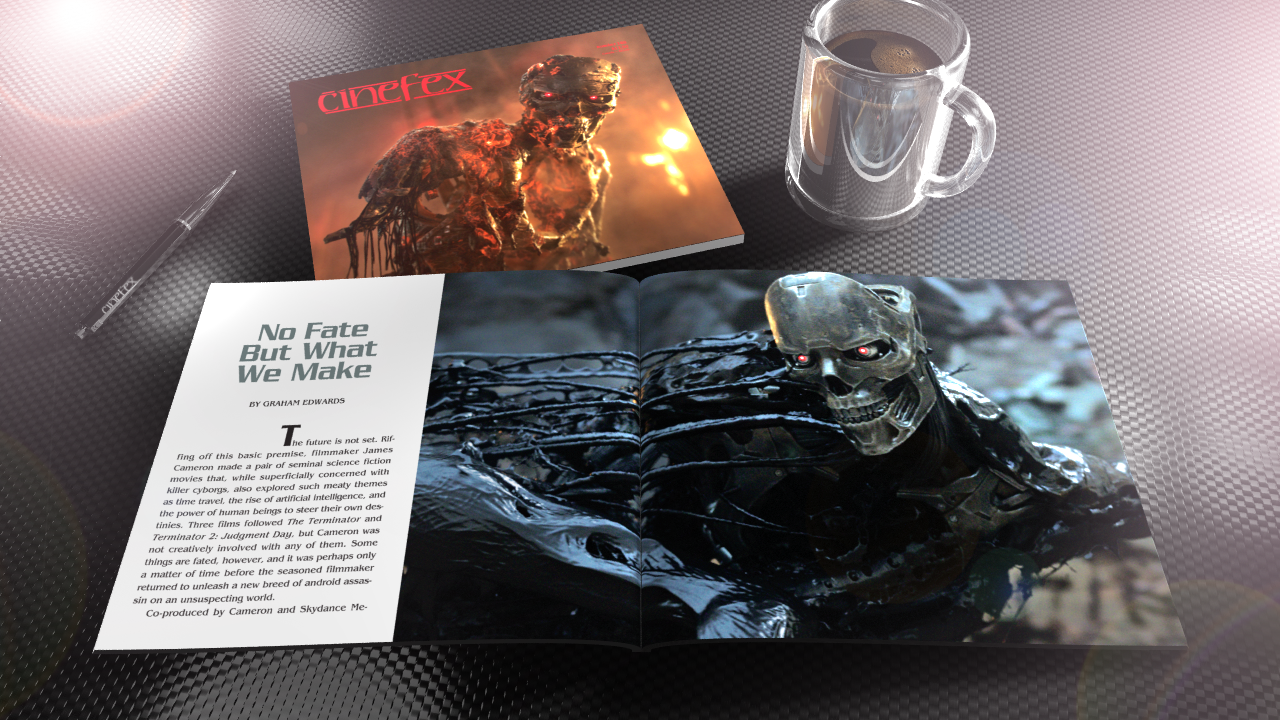
The future is not set. Riffing off this basic premise, filmmaker James Cameron made a pair of seminal science fiction movies that, while superficially concerned with killer cyborgs, also explore such meaty themes as time travel, the rise of artificial intelligence, and the power of human beings to steer their own destiny. Three films followed The Terminator and Terminator 2: Judgment Day, but Cameron was not creatively involved with any of them. Some things are fated, however, and it was perhaps only a matter of time before the seasoned filmmaker returned to unleash a new breed of android assassin on an unsuspecting world.
Co-produced by Cameron and Skydance Media’s David Ellison, and directed by Tim Miller, Terminator: Dark Fate originated with a simple idea of Ellison’s: to ignore all previous sequels and make a direct follow-up to T2. Miller first entered the fray when he met Ellison at a pre-release screening of the director’s debut feature, Deadpool. “David said he felt like he didn’t do the franchise justice with Terminator Genisys,” recalled Miller. “He wanted to try again and would I be interested? After several weeks of courtship, I said, ‘Yeah!’” High on Miller’s wishlist was the return of actress Linda Hamilton as Sarah Connor, the waitress-turned-warrior whose son John is destined to be the future savior of mankind. “The franchise never came to a satisfying end for me, mostly because there was no Linda. Jim Cameron coming back made it a continuation of that story, and when we actually got Linda on board that solidified it all.”
The challenge of picking up the narrative threads from the first two films was considerable. By the end of T2, Sarah Connor has destroyed Cyberdyne Systems — the corporation behind Skynet, an artificial intelligence that tries to wipe out humanity on what becomes known as Judgment Day — and removed all traces of the robots sent back in time to either kill her or protect her. The temporal loose ends were neatly tied – or were they? “The way the new storyline works,” Miller explained, “is that even though Sarah destroyed Cyberdyne, the rise of AI is inevitable and Judgment Day happens again, just in a different way. All Sarah did is kick the can down the road.”
In Terminator: Dark Fate, a new AI called Legion sends a Rev-9 robot (Gabriel Luna) back through time to kill Dani Ramos (Natalia Reyes), a young woman destined to become a major thorn in Legion’s side. Conceptualizing the Rev-9 was an intensely collaborative process. “We had a big whiteboard in the writer’s room,” said Miller, “and we threw up literally everything against the wall. Maybe the Rev-9 can create railguns with his arms; maybe he can heat up and burn things. At some point it became: ‘What if it was still an endoskeleton but instead of being covered in flesh, it was liquid metal? And what if those two parts could split and operate independently?’”
The twin entity concept stuck, with the metal skeleton and liquid body becoming known as the Endo and Ecto, respectively. “The Endo is all about strength,” commented Miller. “For the Ecto, I pretty much stuck to gnarly bladed stabbing weapons like the T-1000. I wanted this film to be about grit and brutality, not gadgets and gags.” The Rev-9’s split personality gives it certain strategic advantages. “They can work together like hunters. One might go downwind while the other scares the prey towards him.” Faster and more agile than any old-school Terminator, the Rev-9 can interface with all the technologies a 21st-century audience takes for granted. “Nowadays, you can’t imagine a Terminator who doesn’t have Bluetooth or Wi-Fi, right?”
Overall visual effects supervisor on Terminator: Dark Fate was Eric Barba of Industrial Light & Magic, the company originally slated to handle all the film’s visual effects. As the scale of the set pieces steadily expanded, the visual effects quota doubled to over 1,900 shots, leading Barba and visual effects producer Lisa Beroud to establish a production-side visual effects department and spread the work across multiple vendors. During post, ILM’s Jeff White joined them as additional visual effects supervisor.
Ultimately ILM retained nearly 700 shots, and in particular spearheaded the Rev-9 character work. Rebellion VFX operated as an in-house team with 670 shots and, in partnership with The Third Floor, powered through over 1,800 postvis shots. The remaining visual effects work fell to Digital Domain, Scanline VFX, Method Studios, UPP and Miller’s own company, Blur Studio, backed up by capital T and Mammal Studios. Weta Digital handled late-breaking sequences arising from additional photography, while Cantina Creative and Unit Image created tactical heads-up displays. Proof, Digic Pictures, Les Androïds Associés and Blur all delivered previs.
With just 12 artists, the Rebellion team handled visual effects basics such as bluescreen composites, environment fixes and digital cosmetics, but the company’s role extended much further. “If Tim had an idea for anything,” said Rebellion founder and visual effects supervisor Jacob Maymudes, “we would mock something up or show him concept frames. Being in-house, we were nimble enough to quickly iterate whatever he wanted, on the fly.” Easy access to the director brought additional responsibilities. “We had a huge hand in film-wide pipeline protocol. If anyone had a question regarding color space or delivery specs or how to do burn-ins for dailies, they came to me.”
The Third Floor arrived in November 2018 to share the postvis load. “We would mostly handle the Rev-9, digi-double and CG-heavy shots,” said The Third Floor co-founder and postvis supervisor Nick Markel. “We would track shots, animate them, then pass the files to Rebellion. They would do the comp work and shots that were exclusively 2D.” Fast turnarounds were a given; skimping on details not an option. “Tim’s eye for animation was incredibly precise. He’s very attuned to what things need to look like and he gave really good notes. That forced us to up our game.”
In classic Terminator style, the film’s 2,000-frame opening shot presents an apocalyptic vision of Skynet-era war machines emerging from the ocean to deal a devastating blow against humanity. Production shot footage from a beach on the Spanish coast, with a stuntman providing height reference for a single T-800 endoskeleton. Scanline replaced the performer with an animated robot and introduced around 30 more Terminators striding out of the ocean.
Scanline received a T-800 asset used in previous sequels, then modified it to bring it in line with the practical robots constructed by Stan Winston Studio for T2. “They had shot the beach with a pan to the right,” noted Scanline visual effects supervisor Arek Komorowski. “That preset the speed of our T-800s coming out of the water. We started with them walking slowly like the T2 animatronics, but in the end we had to speed them up a little to accommodate the camera move.” Scanline visual effects producer Robert Schajer proposed a fan-pleasing Easter egg. “One of our Terminators steps on a human skull and crushes it —our little homage to T2.” Scanline filled the skies with aerial Hunter-Killers, digitally modeled from scratch to replicate the vacumetalized miniatures built by Fantasy II for T2. Artists paid close attention to the HKs’ highly reflective outer shells, balancing their intense gloss with the need to settle the vehicles realistically into the shot.
In a scene set soon after the events of Terminator 2: Judgment Day, Sarah and John Connor (Linda Hamilton and Edward Furlong) have a fateful encounter with a T-800 Terminator (Arnold Schwarzenegger). ILM replaced the heads of body double performers with digital likenesses of the lead actors as they appeared in 1991. Eric Barba’s wealth of experience in the development of digital humans — including an Academy Award for his work on The Curious Case of Benjamin Button — informed his approach. “I felt strongly we needed Linda, Arnold and Eddie to drive their younger selves,” Barba stated. Natural wear and tear on the actors’ bodies limited their participation to facial performance. “A younger person stands a little differently than an older person. An older person has different flexibilities, different muscles, and the spine has maybe collapsed a little bit from age. All that comes across in mocap, hence the decision to use performers with youthful bodies.”
ILM began with high-resolution 3D scans of Hamilton, Schwarzenegger and Furlong’s body double, Jude Collie, captured at the University of Southern California’s Institute for Creative Technologies (ICT). Digital sculptors stripped decades from the adult performers and transformed Collie into the teenage Furlong. “Arnold was the most straightforward,” said ILM visual effects supervisor Alex Wang, “because he’s been scanned and cast so many times throughout the years. We dug through that history, which helped our artists create his head replacement asset.” With less historical reference available for Hamilton and Furlong, ILM matched reference frames from T2. “We researched what happens to humans as they age — what parts of the body deteriorate, even changes to the skull — and subtracted those changes from Linda’s ICT scan. They had done a good job finding a young boy with some likeness to Eddie, but of course it wasn’t all the way there. So with Jude it was more a case of adding details.”
Once the sequence had been cut together, Schwarzenegger, Hamilton and Furlong delivered their facial performances. At the heart of the process was Disney Research|Studio’s markerless Anyma system, which ILM had adopted for Smart Hulk (Mark Ruffalo) in Avengers: Endgame, then refined for the Genie (Will Smith) in Disney’s 2019 Aladdin. The Anyma booth used for Terminator: Dark Fate trained three fixed cameras on the actor. Software retargeted the 2D tracking data onto a digital asset, achieving high levels of fidelity by treating the face as a collection of localized areas, rather than applying a single global deformation. Anatomical constraints accommodated such things as skin thickness and muscle tension, adding realism. The great advantage for the actors was their ability to move freely within the booth, unrestricted by head-mounted cameras.
ILM used its proprietary Blink software to retarget raw Anyma solves onto the digital faces. Traditional blend shapes — generated from a FACS capture session and sculpted to match the T2 shot bible — helped achieve accurate likenesses. “We manufactured a whole shape library,” Wang related, “which allowed the retargeting system to understand how we wanted to make this performance hit that target.” Animators adjusted subtleties like eyelines. “For Linda playing her young self, the performance definitely came through. Eddie was more of a challenge because he is so different now. But the likeness was still there. Nobody but Eddie could be that personality.”
In the present day, a time bubble deposits a nude woman in the middle of a Mexico City road bridge. She is Grace (Mackenzie Davis), a super-soldier whose human body has been augmented with concealed technology, sent from the future to protect Dani. A second bubble deposits the Rev-9 in mid-air above a tenement courtyard, causing lines of washing to freeze solid — unlike Skynet’s red-hot time bubbles, Legion’s are ice-cold. Special effects supervisor Neil Corbould made wax replicas of the hanging clothes, which shattered when dropped to the ground.
Time bubble effects for T2 had been achieved by photographing dry ice inside a plexiglass tube, composited into an animated sphere. Equipped with a vast array of modern digital techniques,ILM’s artists faced a challenge more creative than technical. “It’s one of those eye-of-the-beholder things,” remarked ILM visual effects supervisor David Seager. “It’s still a sphere, and there’s still the fun gag of its cutting through whatever is there when it arrives, but ask anyone what that energy actually looks like and you’re in kind of a magical territory.” Driven by effects simulations, the new look was dubbed the ‘water balloon.’ “Plasma is bursting on the inside of the bubble so you get these impacts rippling across the surface. There’s more plasma on the outside and lightning striking out into the environment.”
Grace’s bubble scoops a hole out of the bridge’s road bed. She falls through to the ground below, in a shot achieved by stitching together two plates and introducing a plummeting digi-double. Surrounded by cops, she fights her way clear using superhuman speed and strength, aided by computer-enhanced vision.
Cantina Creative designed and executed Grace HUD shots, deliberately keeping the overlaid graphics non-intrusive. “In the previous sequels, there were some really wild HUDs,” observed Cantina Creative lead designer Andrew Hawryluk. “Tim wanted to keep Grace’s HUD sleek and minimalistic.” Initial concepts used mathematical shapes to call out points of interest, inspired by Leonardo da Vinci’s famous study of human proportions, L’Uomo Vitruviano. Artists progressively stripped away complexity to achieve the streamlined utilitarianism sought by the director.
The Rev-9’s window on the world is altogether different. Unit Image created HUD imagery devoid of written language, contextual windows or other human conceits. “It was a thrilling challenge,” said Unit Image creative director François-Côme du Boistesselin. “Tim Miller had a precise idea of the Rev-9’s abilities — this is an artificial intelligence able to analyze a gigantic stream of information in microseconds. We got really inspired by the visual treatment of algorithms like quadtree representations and the point clouds used on 3D reconstructions in photogrammetry. The idea was to differ from the T-800 vision, while keeping some of the graphic codes for the viewer to recognize the Terminator style.” Ingesting shots provided by other visual effects vendors, Unit Image artists applied complex distortions in Adobe After Effects, using Red Giant’s Trapcode Form plugin to introduce specific 3D effects.
In the Mexico City car factory where they work, Dani Ramos and her brother Miguel (Diego Boneta) are visited by a man they recognize as their father (Enrique Arce). Grace appears and, shockingly, shoots him in the head, whereupon he transforms into the Rev-9 and engages Grace in brutal combat. The future soldier deals out massive blows but her opponent’s liquid flesh heals instantly.
The factory shoot took place over four days at the Mercedes-Benz manufacturing plant in Kecskemét, Hungary, and on a set at the nearby Origo Studios in Budapest, home to the stage work during principal photography. Neil Corbould outfitted the set with a working conveyor belt and lightweight car engine mockups. ILM built a digital interior and extended the soundstage photography. Artists filled backgrounds with hyperactive KUKA industrial robots. “Tim wanted always to see some movement back there,” Alex Wang reported, “but he didn’t want it to detract from what was going on in the foreground. The robots do the same thing over and over, so we ran animation cycles and that became the background motion.”
ILM and Digital Domain shared visual effects duties across the factory sequence, stretching the Rev-9’s arms into stabbing blades and enhancing stunt action with head replacements and digi-doubles. ILM animation supervisor Scott Benza devised an aggressive body language for shots where the Rev-9 spins a bifurcated blade like a buzzsaw. Gabriel Luna carried weights to add inertia to his arm movements, but at no point did the actor wear prosthetic blades. Tracking the Rev-9’s ever-changing damage was a full-time job, since ILM’s shots cut back to back with Digital Domain’s.
Text copyright © Cinefex 2019. Reprinted here with permission.
 Graham Edwards