
The following is an extract from my article on Arrival, published in Cinefex 150, December 2016
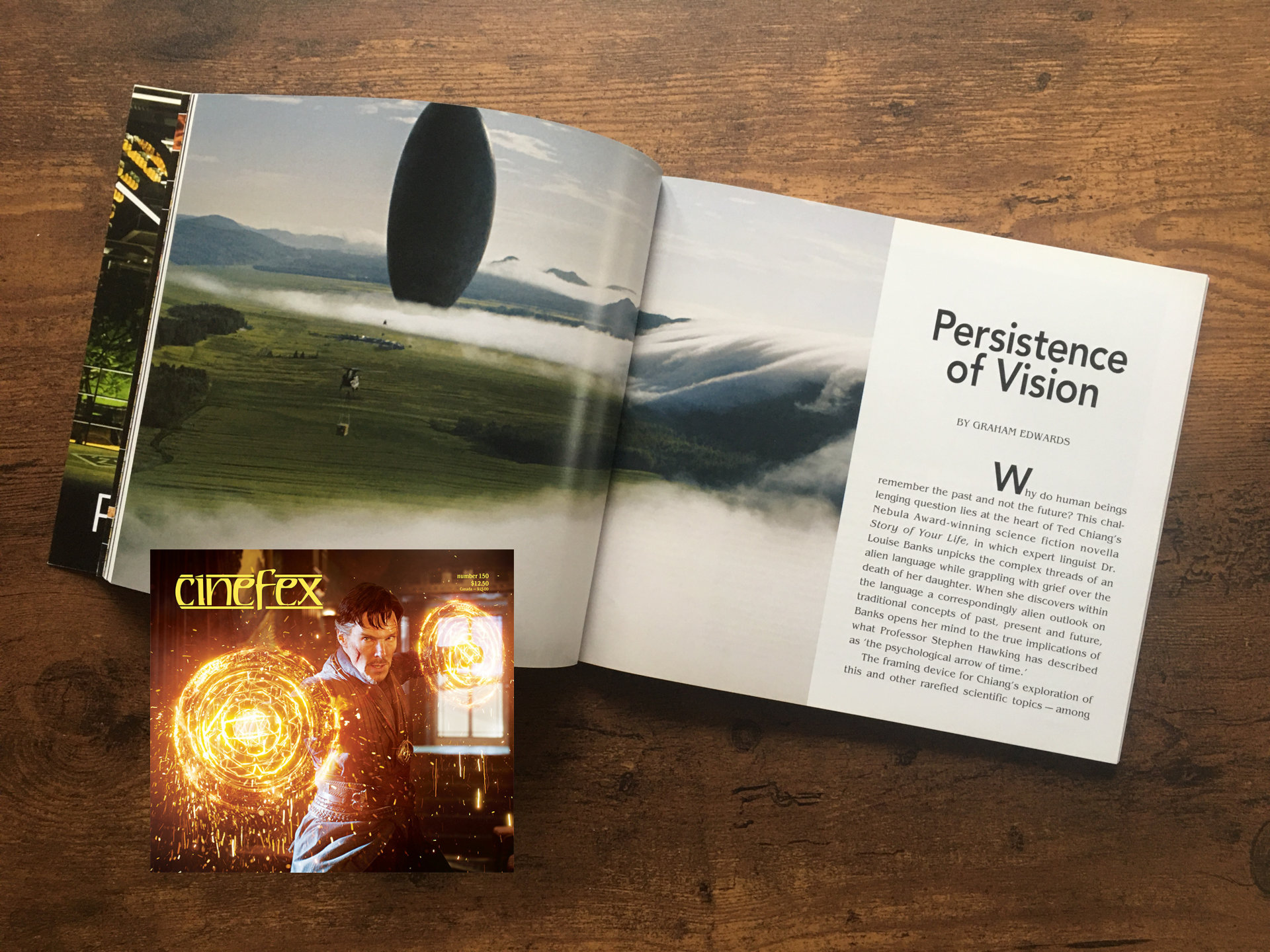
Why do human beings remember the past and not the future? This challenging question lies at the heart of Ted Chiang’s Nebula Award-winning science fiction novella Story of Your Life, in which expert linguist Dr. Louise Banks unpicks the complex threads of an alien language while grappling with grief over the death of her daughter. When she discovers within the language a correspondingly alien outlook on traditional concepts of past, present and future, Banks opens her mind to the true implications of what Professor Stephen Hawking has described as ‘the psychological arrow of time.’
The framing device for Chiang’s exploration of this and other rarefied scientific topics — among them Fermat’s principle of least time and the Sapir-Whorf hypothesis of linguistic relativity — is a reassuringly familiar tale of first contact between human beings and an extraterrestrial species. This central theme of alien visitation naturally shapes the story of Paramount Pictures’ Arrival, an adaptation by FilmNation, Lava Bear Films and 21 Laps Entertainment of Chiang’s novella, for which screenwriter Eric Heisserer developed a script that not only honored the scientific rigor of Story of Your Life, but also retained its beating emotional heart.
When Canadian filmmaker Denis Villeneuve joined the project as director, he brought with him collaborators from his previous feature, the critically acclaimed Sicario — including production designer Patrice Vermette, editor Joe Walker, composer Jóhann Jóhannsson and visual effects supervisor Louis Morin. “One of the big things for me was that they teamed me up with experienced people, but not experienced in visual effects,” said Louis Morin. “Denis was comfortable with effects — we did some pretty good stuff on Sicario, but that was small-scale. When you get involved in aliens, then it becomes another story. The same for Bradford Young, the director of photography. He’s extremely talented, but this was his first time dealing with so many visual effects. It was a big show, and a learning experience for him. But all of this was beneficial, because those guys came in with fresh ideas, and came up with something different.”
Balancing the script’s scientific, philosophical and emotional themes, Denis Villeneuve resolved to tell the story of Arrival largely through the eyes of its main protagonist, Louise Banks, and to normalize the extraterrestrial narrative by having the visitation occur on an ordinary day beneath overcast skies. A key tonal reference in this regard was Jonathan Glazer’s 2013 science fiction film Under the Skin. “Denis didn’t want a Hollywood super-colorful, over-the-top kind of look,” Morin commented. “So everything is simplified. Nothing is sensational. I remember we were sitting in editorial — it was February, it was grey, cold, no sun, a very boring day — and Denis looked out the window, and said, ‘That’s what I want.’”
Adhering to the ‘unsensational’ brief, Morin labored with co-visual effects producers Meggie Cabral and Sandra Germain to steer roughly 700 shots through a postproduction phase lasting around eight months, with the final shot delivered in June 2016. In the face of an ever-evolving script, the team remained quick on its feet, revising concepts and reassigning shots as the need arose, and according to the availability of a multitude of vendors. “The movie was evolving as they were trying to perfect the storyline,” noted Sandra Germain, “so our biggest challenge was to keep track of every change in the cut. One day there would be a shot and then two days later that would be omitted, so there was a lot of back and forth. We used Shotgun, which helped a lot.”
In Arrival’s haunting prologue, Dr. Louise Banks (Amy Adams) reflects on the short life of her deceased daughter Hannah (played at different ages by young actresses Carmela Nossa Guizzo, Jadyn Malone and Julia Scarlett Dan). For sensitive scenes showing the 12-year-old Hannah dying of cancer, Rodeo FX digitally treated a handful of shots of Scarlett Dan to simulate the emaciating effects of the disease, and the hair loss resulting from its treatment. Rodeo FX visual effects supervisor Arnaud Brisebois hand-painted facial skin and shadow elements in Adobe Photoshop, which compositor Michel Frenette projected onto 3D geometry tracked to Scarlett Dan’s face, separating textures into layers for final compositing into the original plate. To enhance the painted bald cap worn by the actress during her performance, CG supervisor Jean-Sebastian Guillemette added sparse wisps of digital hair.
The grieving Banks continues her work as a language professor, but the school day is interrupted when a small armada of alien ships mysteriously appears on Earth. Dazed like the rest of the world by this unexpected visitation, Banks finds herself approached by the U.S. military’s Colonel Weber (Forest Whitaker), who assigns her the task of interpreting the alien language. The linguist departs aboard Weber’s helicopter, in a shot performed by Adams on a minimal bluescreen set. Rodeo FX planted the scant live-action elements into a fully digital environment that included house architecture and vegetation rigged to blow in the downdraft from a CG Sikorsky Sea King.
The helicopter’s destination is a hastily-erected military base nestled deep in the Montana hills. Suspended just above the ground is a huge alien craft referred to as a ‘shell’ — one of a dozen such vessels hanging motionless in seemingly random locations around the world. “Denis is the poet of the everyday,” commented Patrice Vermette. “So the places chosen for the landing of the ships were totally matter-of-fact — there’s no White House in the background, no Eiffel Tower. It’s just ordinary.”
In consultation with military advisor Matthew W. Morgan, Vermette established a base camp set on farmland in Canada’s Bic National Park, near the city of Rimouski. Oblique FX enhanced wide shots, extending the set to double its size and replacing characteristic Québécois square field patterns with wilder terrain more appropriate to the Montana setting. Artists modeled digital set extensions in Autodesk Softimage, bulking out a 60-second aerial establishing shot in which the camera circles the base. “We constructed tents and sidewalks in 3D,” said Oblique FX visual effects supervisor Alexandre Lafortune. “The shot was turning almost 360 degrees, so we had to roto everything and do accurate layouts to get 3D masks.”
Oblique FX lined up a fleet of digital vehicles — including a U.S. Army Abrams tank — and flew in a veritable swarm of helicopters comprised of Black Hawks, Sea Kings, Boeing Chinooks and Apaches. Refining 3D scans of extras in military uniform, crowd artists used in-house tools within Softimage’s ICE architecture to populate the camp with around 350 motion-captured CG characters. Throughout, the visual effects were designed to go unnoticed. “The photography of the movie is really close range,” Lafortune commented. “You follow the characters, and everything else is kind of out of focus. So a lot of our work was just blurred at the end — you don’t see it, in fact! It’s really a story-oriented movie, not about special effects.”
One memorable element of the lengthy aerial shot — a dramatic bank of cloud rolling down from the nearby hillside — survived untouched by visual effects artists. “We were really lucky with the shot on the chopper,” remarked Louis Morin. “Those were real clouds, just falling down the mountain. It was surreal. People will think it’s CG, but it’s the real thing.”
Dominating the base camp environment is the alien ship — a smooth-sided orb 1,490 feet in height, floating in defiance of gravity some 30 feet off the ground. Described by Denis Villeneuve as ‘an old piece of rock that’s traveled the universe,’ the vessel acquired its iconic form through brainstorming sessions between Arrival’s director and production designer. “For months before we started preproduction I watched a lot of sci-fi movies,” said Patrice Vermette. “I realized that since 2001: A Space Odyssey, in every movie all the spaceships kind of look the same — except some rare examples like Dune and Tron. So I wanted to try something different.”
Riffing on the screenplay’s description of a spherical ship, Vermette began with a simple ovoid form. “We explored a smooth oyster shape,” Vermette commented. “Then I started chopping it a bit. The idea of making it black was there very early on, in the first concept drawings.” Rather than making the ship’s proportions conform to the cinematic widescreen format, Vermette and Villeneuve defied convention by making the vessel taller than it is wide. “It’s an alien technology, so we thought it needed to be surprising. The vertical configuration made it more imposing.”
Oblique FX developed Vermette’s concept into a 3D digital asset — a process facilitated by the simplicity of the ship’s geometry. Artists created wide, medium and closeup versions of the vessel, identical but for the levels of detail in the surface texture, which resembled dark grey, polished concrete. “The art department created a surface panel with the texture that Denis wanted,” said Alexandre Lafortune. “At first, I was sure we were going to go further than just having a big, black sphere, so we tried to give them more ideas — to maybe add some more texture or have a primitive symbol on it. But no, the director wanted it to be black and that was all!” Oblique also modeled the smaller travel pod that carries Banks into the alien craft later in the film.
Inside the military base, monitor screens display satellite views of the 12 alien ships at their various arrival sites. Raynault VFX fashioned top-down images of each location based on actual orbital photography. “We would select a satellite view that was interesting,” said visual effects supervisor Mathieu Raynault. “Then we would modify it, or mix two images, or change the lighting to exaggerate things. But we tried to be subtle, because Denis was very sensitive to that — it had to be grounded in reality.” Raynault incorporated Oblique’s ship asset into its reconfigured backgrounds. “For the whole film you recognize the ship as this tall, black shape, and suddenly you’re looking at it from a perfect top view and it’s just this black dot in a landscape. So the shadows were important — how it cast a shadow allowed one to recognize the shape.”
Banks meets her new colleague, theoretical physicist Ian Donnelly (Jeremy Renner). Donning protective clothing, the pair accompany Colonel Weber and a military escort to a scissor lift positioned beneath the floating vessel, which then elevates them into the ship’s interior. Oblique FX cheated the dimensions of the ship for exterior up-angles, sometimes doubling its size in order to create dramatic compositions.
Production photographed ship interiors on a soundstage in Montreal, where costume designer Renée April dressed the actors in authentic airtight hazmat suits. The special effects department modified the backpacks, which lacked the usual oxygen support tanks. “We had to put in little fans and make cut-outs in the bottom of the backpacks to get air circulation through the suits,” said special effects supervisor Ryal Cosgrove. “In the summer it gets quite hot and humid here in Montreal, so we had an air conditioning unit on standby in a little tent. Between takes, they’d come into the tent and we would stick cold air in front of the backpacks to keep them comfortable.”
The scissor lift reaches full extension, seemingly stranding the investigators at the bottom of a chimney-like shaft. The surrounding wall texture resembles a cross-section through countless layers of sedimentary rock — a design choice intended by Patrice Vermette to evoke the enormous age and accumulated wisdom of the alien species.
Text copyright © Cinefex 2016. Reprinted here with permission.
 Graham Edwards