The following is an extract from my article on Ben-Hur, published in Cinefex 149, October 2016
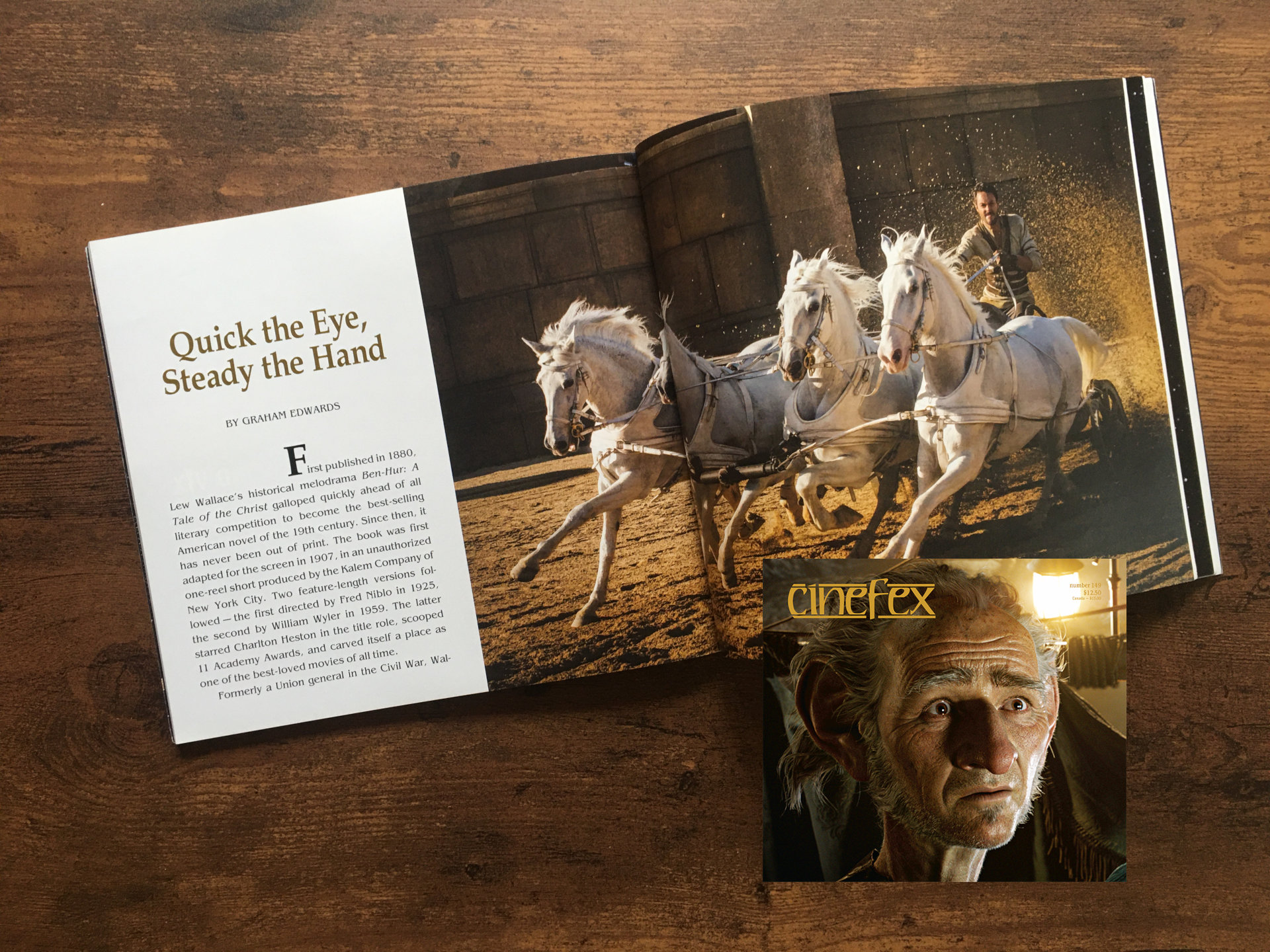
First published in 1880, Lew Wallace’s historical melodrama Ben-Hur: A Tale of the Christ galloped quickly ahead of all literary competition to become the best-selling American novel of the 19th century. Since then, it has never been out of print. The book was first adapted for the screen in 1907, in an unauthorized one-reel short produced by the Kalem Company of New York City. Two feature-length versions followed — the first directed by Fred Niblo in 1925, the second by William Wyler in 1959. The latter starred Charlton Heston in the title role, scooped 11 Academy Awards, and carved itself a place as one of the best-loved movies of all time.
Formerly a Union general in the American Civil War, Wallace conceived his action-packed tale as a framing device for the story of Jesus Christ. Wrongly condemned to imprisonment aboard a slave galley by Roman military commander Messala, Jewish nobleman Judah Ben-Hur escapes his chains and seeks revenge on his accuser and former childhood friend. Through the course of the narrative, Wallace’s fictional hero participates in key New Testament episodes, including the crucifixion of Jesus at Golgotha.
Despite the novel’s Biblical heritage and powerful emotional themes, the sequence that lingers longest in the memories of readers and filmgoers alike is the centerpiece chariot race, during which Ben-Hur and Messala compete in a high-speed battle of life and death. It was inevitable, therefore, that when MGM and Paramount Pictures put into production the latest adaptation of Ben-Hur: A Tale of the Christ, this classic showdown would be at the top of the filmmaking agenda.
Working from a speculative screenplay by Keith Clarke, screenwriter John Ridley penned a script that strengthened the bond between Ben-Hur and Messala by making them adoptive brothers. Joining the production in the fall of 2013, director Timur Bekmambetov brought with him a desire to move away from the dominant revenge plot of the previous screen adaptations, instead shifting the focus to themes of friendship and redemption. Alongside producers Sean Daniel and Joni Levin, co-producers Roma Downey and Mark Burnett — fresh from their History channel mini-series The Bible — championed sensitivity to the novel’s Christian roots.
For production visual effects supervisor Jim Rygiel and visual effects producer Robin Griffin-McLachlan, the shadow cast by William Wyler’s 1959 film was especially long. Early previs by The Third Floor allayed their fears. “I was a little skeptical at first about remaking one of the greatest films in history,” said Jim Rygiel. “Then I saw the previs of the chariot race and it sort of sucked me in. At the beginning of the race you were tight on the horses’ nostrils flaring, with atmospheric dust laid over them, and the choices of lenses and camera movements made it really cinematic. I saw where it was going in terms of filmmaking. After that, I was totally on board.”
The visceral nature of the previs echoed the gutsy choreography of Timur Bekmambetov’s previous directorial outings Wanted and Abraham Lincoln: Vampire Hunter, and the POV camerawork of the adrenalin-rich Hardcore Henry, which he produced. For Ben-Hur, the director advocated shooting live-action wherever possible; however, when it came to the all-important chariot race, animal welfare regulations naturally prohibited horses from being used for violent stunts. Rygiel and Griffin-McLachlan therefore sought a visual effects team capable of integrating digital horses seamlessly with their flesh and blood counterparts. They awarded the sequence to Mr. X, a decision based in part on a test shot pitched by the Toronto-based facility showing CG horses running flank to flank with live-action animals. “Honest to God, you couldn’t tell the difference,” Robin Griffin-McLachlan recalled. “It just blew our socks off.”
For the Mr. X team, Ben-Hur would ultimately prove to be an 18-month-long assignment. “We were engaged really early on,” said Mr. X visual effects supervisor Dennis Berardi. “We had all the reference, we were invited to set, and communication was very strong throughout. I had access to the production designer, and I could speak with the cinematographer directly. Everybody wanted us to succeed, because we all knew the stakes: this was a remake of Ben-Hur!”
With the chariots lined up, Rygiel and Griffin-McLachlan turned their attention to the film’s other big effects sequence — a spectacular naval battle between Roman and Greek fleets. The logical choice of vendor was Scanline VFX — experienced providers of large-scale water simulations for films including Battleship, San Andreas and Independence Day: Resurgence — which divided the workload between its Vancouver and Los Angeles studios. Soho VFX took on around 250 environment shots re-creating 1st century locations, notably the city of Jerusalem. Basilic Fly Studio, Locktix, Lola VFX, Park Road Post, Pixel Playground, Sandbox FX and Spin VFX filled in the gaps to raise the final visual effects tally to around 1,040 shots, while Milan-based Effetti Digitali Italiani provided additional previs. Legend3D handled stereo post-conversion.
The opening shot of Ben-Hur teases its audience with a brief glimpse of the breathtaking action to come later in the film. In a single, unbroken shot, eight starting gates fly open, releasing a line of speeding chariots. The horses thunder towards the first turn of the Circus racetrack, at which point the shot transitions in flashback to the early lives of Judah Ben-Hur (Jack Huston) and his brother, Messala (Toby Kebbell). Two of the horses linger in frame to become frolicking steeds being ridden by the brothers, while the Circus environment fades around them and is replaced by a belt of rocky terrain.
Conceived late in postproduction, the opening shot began life with drone footage of the actors performing on horseback in locations at Vasquez Rocks and Painted Canyon in southern California. Mr. X worked backwards from an aerial plate to create a fully digital lead-in. “We generated a camera move based on the B-side camera that Jim Rygiel shot, and did postvis to join the two,” Dennis Berardi explained. In order to create a seamless blend, artists replaced the horses and their riders with CG doubles. “We had to do them digitally because they had to line up with the horses on the A-side. Timur wanted it to feel like one continuous transition.”
The wheels of Ben-Hur’s plot gain momentum when Messala falsely accuses Ben-Hur of trying to assassinate a high-ranking Roman official. Caught up in a sea battle five years later, Ben-Hur escapes the galley in which he has been enslaved and comes under the wing of Sheik Ilderim (Morgan Freeman), who enters him into a chariot race at the Circus in Jerusalem, in the presence of the Roman governor of Judea, Pontius Pilate (Pilou Asbæk). When Ben-Hur learns he is to be competing against Messala, his brother and accuser, he realizes the contest represents his chance to choose between alternate paths of revenge or reconciliation.
Principal photography for Ben-Hur commenced in February 2015, on location in Italy and at Rome’s Cinecittà Studios, which also played host to William Wyler’s 1959 film. Preparing for the extensive live-action shoot of the pivotal chariot race, the art department constructed a 657-foot-long oval track on reclaimed swampland adjacent to the Cinecittà World amusement park, 15 miles south of Rome. Production designer Naomi Shohan devised partial set pieces to surround the entire circuit with barriers, gates and sections of grandstand, to a height of between 10 and 30 feet. Viewing platforms for Pontius Pilate and other dignitaries lined the first straight, while the second offered access to the production’s service and stabling areas. Dominating the center of the Circus was the 357-foot-long ‘spina’ — an architectural median strip supporting giant statues and towering obelisks, around which the chariots would hurtle. “We always planned on having the track,” said second unit director Phil Neilson, who led the chariot race shoot. “That was a non-negotiable element to pull this off. But it was never big enough, even at full scale. A chariot isn’t like a car, where you hit the gas and bring it up really quick. By the time they got up to speed, we would have three seconds of filming before we had to start shutting them down.”
Working in an enormous tent adjacent to the set, special effects supervisor Andy Williams established a veritable assembly line for the construction and maintenance of a fleet of some 45 full-scale chariots, of a style known to the Romans as ‘quadrigae.’ Built around identical tubular steel frames, with aluminum wheels and disc brakes, eight hero chariots supported ornate fiberglass body shells. Rome-based Makinarium dressed these with pairs of decorative panels — sculpted in clay, molded in epoxy resin and dressed with leather, jute and natural textiles — and outfitted the vehicles with mudguards, splinter bars and various period accoutrements. Makinarium also manufactured a range of military props for Ben-Hur including Roman standards, swords, spears and shields.
A duplicate set of ‘blind driver’ chariots featured bodywork with strategically placed apertures, giving crouching stunt drivers sufficient visibility to control the horses while the actors performed above them holding dummy reins. Chariot sections could be mounted on motorized camera vehicles for dynamic closeups. All chariot components were fully interchangeable, allowing for a fast turnaround on repairs. “I had a team of six or eight guys constantly on the track whenever we were shooting them,” Andy Williams related. “Every time a chariot stopped, the guys went in and checked all the nuts and bolts, tightening everything up, making sure nothing had come loose.”
Williams developed a range of specialty chariots for stunt use. “Each chariot ends up in some type of collision,” observed Williams. “We had versions where axles would pull off, versions where they flipped over from one side to the other, or hit something and jumped up into the air. We had hydraulic packs built into some of the chariots, which lifted them over on one wheel at 45 degrees. We used a simple bungee system that fired a leg down underneath the chariot, so it sort of hopped over. We also made a whole barnful of safe breakaway stuff that could be left on the circuit after a crash, that the other horses could run over or through without damaging themselves.”
Each chariot had four horses in the traces, selected from breeds including Lipizzans, Andalusians and Friesians. Color coding of the teams ensured audiences would instantly pick out the distinctive steeds of Ben-Hur and Messala, as well as those of their competitor drivers from Syria, Egypt, Ethiopia, Greece, Arabia and Persia. Horse master and stunt coordinator Steve Dent and horse supplier Laszlo Juhász managed extensive stables filled with grooms, farriers and veterinarians, with a rotating complement of 80 animals allowing up to 32 horses to race on the track simultaneously.
Second unit photographed chariot race action primarily with Arri Alexa XT cameras. For tracking shots, Chapman Leonard operated a robust eight-wheel Dually 2 camera platform — nicknamed the ‘Maximus’ — fitted with a 32-foot Hydrascope crane, alongside an Italian-crewed 4WD Mercedes with a roof-mounted Scorpio arm and flight head. Camera vehicles trailed rigs resembling harrows to erase pneumatic tire marks, and secondary units to simulate chariot wheel tracks.
The motor vehicles regularly struggled to keep pace with the chariots. “The horses would just go,” said second unit director of photography Fraser Taggart, who lensed the race sequence under the stewardship of cinematographer Oliver Wood. “We’d be flooring it, and we’d just about keep up with them. The thin metal wheels of the chariots would just dig into the surface, so they could corner at amazing speeds; in our tracking vehicles, we’d drift right out.”
Opting to ‘do as the Romans do,’ the crew adapted a number of chariots for use as mobile camera platforms, retrofitting them with cast metal bazooka bases and Libra stabilized heads. However, the agility these provided came at a price. “We shattered every head that we put on a chariot through vibration,” commented Phil Neilson. “We were breaking camera mounts like they were made out of wax. Ultimately, the Libra technicians built buffers out of car tires, which worked brilliantly.”
Constantly seeking dramatic shooting angles, the crew developed numerous rigs to plant cameras in the thick of the chaotic race action. Special effects fitted one chariot with a pole jutting two feet in front of the horses’ heads. Rear-facing on a Baby Libra mount, a RED Epic Dragon camera framed the chariot driver, with the tossing heads of all four horses filling the foreground. As with all the rigs, the safety of animals and performers was paramount. “Just by having that little camera out there,” Neilson noted, “we had to have something like half a ton of lead on the back of the chariot, just to balance that all out. Every time we did these things, we were adding all this weight, which just made it more dangerous all around.”
Crews meticulously tested every rig, including a trailing arm extending from the back of a chariot and balanced on a single pivoting wheel. During a trial run, Neilson himself donned padding and a crash helmet and operated the camera from the built-in seat. “Before I put anyone else on it, I had to ride it myself,” said Neilson. “On the final turn, we flipped — camera, me, everything. Everyone was all right; the chariot driver ejected and landed on his feet. The worst part was we had four horses that were still racing with themselves, dragging half a ton of metal around the track. But the horse team got them under control.”
Seeking maximum coverage, Fraser Taggart deployed cameras high and low. Rome-based Drone Services secured aerial shots with hand-built hexacopter and octocopter drones carrying lightweight carbon fiber RED Epic Dragons, while Panasonic Lumix G3 and G5 cameras gave access to tight corners in and around the set. Smallest of all were the ‘rat-cams’ — diminutive GoPros wedged into foam-rubber balls. Taggart placed these resilient gadgets strategically around the track to capture low-angle footage of the chariots racing past. When kicked by the horses, the rat-cams rolled harmlessly aside. Yet more GoPros were attached to chariot bodywork, or to harnesses worn by the actors and stunt performers.
Following two weeks of rehearsal and a ten-day first unit shoot, second unit spent 21 days shooting the chariot race. “I wanted to get the actors’ faces in it as much as possible,” Neilson remarked. “But we were off-schedule from first unit, and we would only get one actor at a time. So we were shooting it totally out of order. It was a continuity freak show.”
Rigorous safety regimes ensured that the shoot concluded without major incident, and no horses were injured. Nevertheless, with the principal performers riding front and center, in chariots regularly hitting speeds of 40 miles per hour in a dust-filled arena, there was no disguising the danger. “I think that was probably the most stressful thing I’ve ever done in my career,” asserted Andy Williams, veteran of action films including Mad Max: Fury Road and Black Hawk Down. “A car or motorbike has got an off switch. Four one-ton horses don’t. Once they’re going flat out, it’s virtually impossible to stop them.”
Likewise, the second unit director spent the shoot in a state of perpetual tension. “I worried for every person on that set,” Phil Neilson said. “It was like watching someone defuse a bomb that was on my lap. My heart was in my throat the entire time.”
Text copyright © Cinefex 2016. Reprinted here with permission.
 Graham Edwards