
The following is an extract from my article on Deadpool, published in Cinefex 146, April 2016
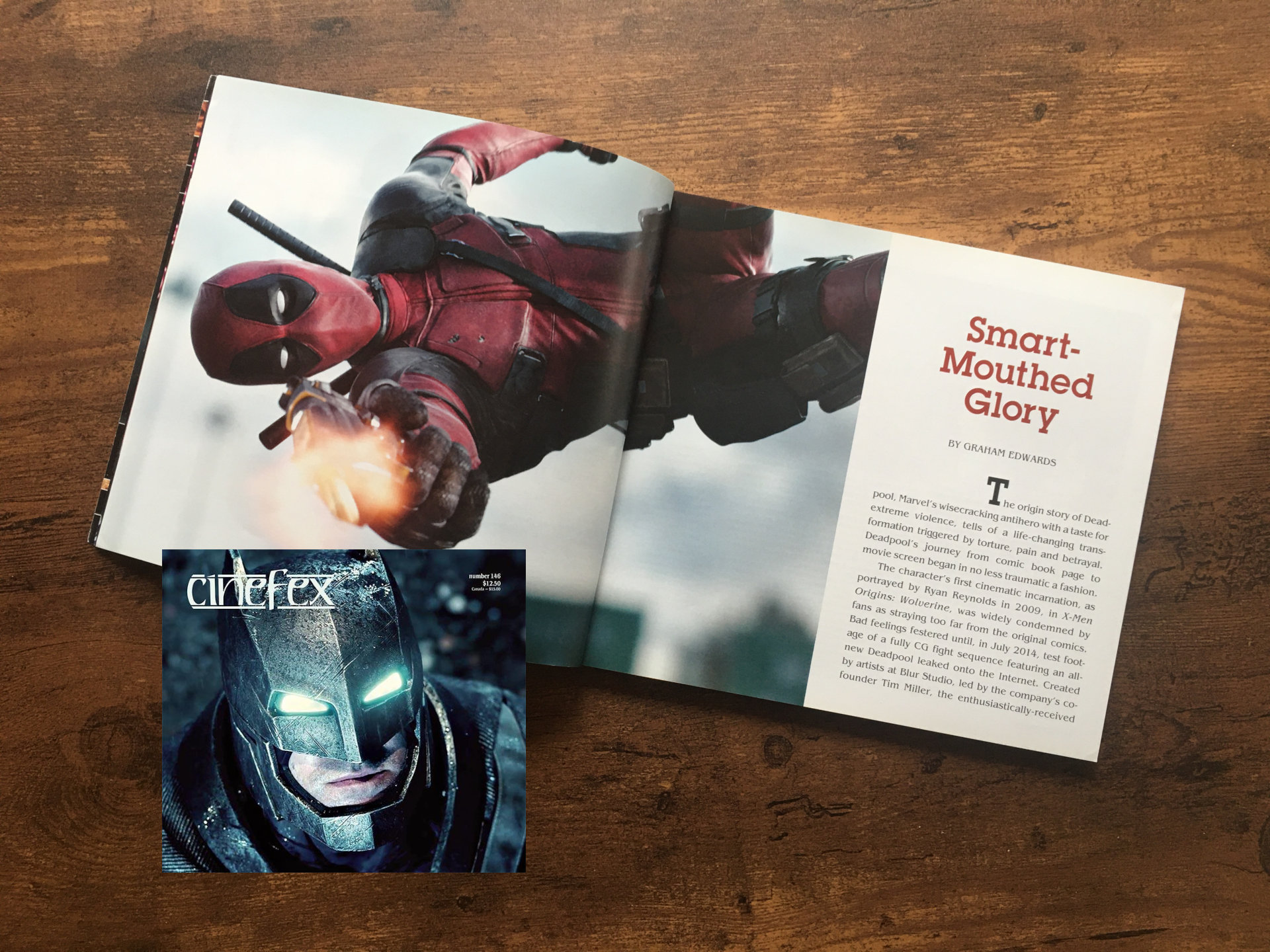
The origin story of Deadpool, Marvel’s wisecracking anti-hero with a taste for extreme violence, tells of a life-changing transformation triggered by torture, pain and betrayal. Deadpool’s journey from comic book page to movie screen began in no less traumatic a fashion.
The character’s first cinematic incarnation, as portrayed by Ryan Reynolds in 2009, in X-Men Origins: Wolverine, was widely condemned by fans as straying too far from the original comics. Bad feelings festered until, in July 2014, test footage of a fully CG fight sequence featuring an all new Deadpool leaked onto the Internet. Created by artists at Blur Studio, led by the company’s co-founder Tim Miller, the enthusiastically-received video was part of an ongoing campaign by Deadpool devotee Reynolds to resurrect the iconic character also known as the ‘Merc with a Mouth.’
The proof-of-concept video catalyzed interest among both diehard fans and studio executives, on the back of which 20th Century Fox found the confidence to greenlight a stand-alone Deadpool feature for release in early 2016. Miller would take the helm in his feature directing debut, with Reynolds not so much reprising his role as reinventing it, finally achieving his long-held goal of bringing to life the authentic Deadpool that fans had long been clamoring for.
In developing the look of the smart-mouthed superhero, production designer Sean Haworth and his team drew inspiration from the wide range of artists and writers behind the popular comics. “Rob Liefeld drew the definitive Deadpool,” Tim Miller said. “People fall in love with something for a reason, and to try and change its fundamental core values is a bad idea. It may sound like fanboy loyalty to say we wanted to be true to the comic books, but it’s really very practical for me. I wanted to have him be the character that I fell in love with.”
The morally gray area in which Deadpool operates proved particularly appealing to the first-time director. “Deadpool is a guy who’s made a lot of bad choices,” Miller remarked, “and his screwed-up life is the result. His cynicism, black humor, and sheer insanity distinguish him from other comic book characters. Humor is his main defense — but the guns and swords help! He’s always been a very different kind of character than the squeaky clean heroes in most comic books.”
In Deadpool, cancer-ridden former Special Forces operative Wade Wilson (Ryan Reynolds) seeks help from a shadowy government establishment known as Weapon X. Little does he know that the promised cure for his disease will turn him into a horribly scarred mutant possessing accelerated healing powers and super strength. Wade’s twisted sense of humor — not to mention his fourth wall-breaking awareness of himself as a fictional character — helps him deal with his new, grotesque appearance, while his enhanced abilities force him into a shaky alliance with fellow mutants Colossus (Stefan Kapicic) and Negasonic Teenage Warhead (Brianna Hildebrand), as they try to save Wade’s girlfriend, Vanessa Carlysle (Morena Baccarin), from the clutches of superhuman adversaries Ajax (Ed Skrein) and Angel Dust (Gina Carano).
In keeping with the mental state of its crazed protagonist, the Deadpool screenplay by Rhett Reese and Paul Wernick boasts a distinctly non-linear structure. “We have this character who’s hideously scarred,” explained Miller, “and he’s played by Ryan Reynolds — one of the best-looking men on the planet. We wanted to make the contrasting tragedy of his beauty’s loss more poignant, and the fractured narrative allowed us to reveal that story in an interesting way, by keeping the memory of who Wade used to be fresh throughout.”
Deadpool’s broken chronology presented the visual effects team with a number of logistical challenges. “Keeping track of all the shots was a little strange,” said production visual effects supervisor Jonathan Rothbart, “because we jump in and out of different sequences at different times. It took a little time for us to work out how we were going to manage the non-linear structure.”
Principal photography for Deadpool took place between March 23 and May 29, 2015, at sites in and around Vancouver. “We did a lot of our greenscreen shots at the Pacific National Exhibition,” said visual effects producer Annemarie Griggs. “They have an older building there for use as a soundstage.” The production art department built two enormous sets centered around a grounded military air vessel on an empty parcel of land in Richmond, south of the city, with further action staged at additional locations, including Vancouver’s Georgia Viaduct.
A combination of tight budget and condensed production schedule encouraged Rothbart and Griggs to share some 1,200 shots across a range of facilities, with the work distributed according to each company’s strengths. “Everybody has the same general way that they do visual effects,” observed Rothbart, “but each facility has its own recipe for baking the visual effects cake. It’s about trying to understand the personality of each one.”
There was no shortage of companies keen to work on the project. “As soon as people knew we were looking for bids,” said Annemarie Griggs, “they just started phoning us up. It seemed that everyone wanted to work on this show.”
Rothbart and Griggs assigned key sequences to Digital Domain and Atomic Fiction, and filled out the visual effects roster with Blur Studio, Luma Pictures, Rodeo FX, Weta Digital, Ollin VFX, and Image Engine. Blaine Lougheed provided on-set support as second unit visual effects supervisor.
Rothbart stressed to all vendors the importance of close cooperation. “From the outset,” said Luma Pictures visual effects supervisor Vince Cirelli, “Jonathan was saying, ‘Look guys, we need to be thinking about how we can share assets, because it’s going to happen no matter what.’ Everybody took that to heart, and was very collaborative. I think when you watch the film you won’t know it was done out of multiple studios.”
High on the agenda during preproduction was Deadpool’s physical appearance. While the character’s suit design remains somewhat consistent across the many comic book sources, the way his scarred face and body look beneath the costume varies considerably. “It all depends on the artist,” said makeup designer Bill Corso. “They portray him as everything from Freddy Krueger, to a rotting corpse, to just a guy with a couple of squiggles on his face. That obviously leaves quite a bit of room for interpretation.”
Working closely with Andy Clement at Creative Character Engineering, Corso developed prosthetic makeup for Deadpool, from head, hand and arm appliances up to a full body suit. “As a makeup artist,” commented Corso, “you can work your whole career and just hope for the day when you can be involved in creating such an iconic character. It’s a really cool position to be in.”
A key concern during the concept phase was balancing the filmmakers’ desire for grotesquery with the studio’s commercial interests. “The powers that be wanted to keep sexy Ryan Reynolds,” Corso remarked, “which was everything that Ryan and Tim didn’t want! So there was always that discussion: is he too gross to be considered attractive to our leading lady? The one mandate was ‘No open sores and no dripping pus!’”
Working in Photoshop over photographs of Reynolds, Corso and Clement designed four distinctly different Deadpool concepts. Based on these, a range of test makeups was then applied to a stand-in. “We did a big photo shoot of the makeups,” said Corso, “with multiple lighting and color scenarios, so we ended up with a huge library of images. We had a big meeting with Tim, Ryan, the producers and writers, and we picked and chose what we liked.”
Corso amalgamated the preferred designs into a single composite version. “We put it on Ryan,” Corso recalled, “and as we were discussing it, we went in and started freeform sculpting with silicone and gelatin, right on Ryan’s face. It was a much more organic process to come to this character than I’ve ever done before.”
Corso and Clement sculpted the final makeup in clay over lifecasts of Reynolds, then broke it down into individual components to be molded and cast in silicone. “We did the same for the stunt doubles,” said Corso. “We enhanced some of them with a likeness makeup to look more like Ryan, and then did the Deadpool makeup on top of that.” The primary head makeup was comprised of ten separate silicone appliances, with slight variations in the neck depending on wardrobe. When necessary, Reynolds also wore full hand and arm appliances.
In an application process taking up to four hours, Corso first had to hide the dark stubble beard favored by Reynolds for his character. “I was doing paper thin appliances so he could be expressive,” Corso commented, “but to do that over a beard caused a multitude of issues. So, Andy Clement made skin-colored fake tattoos in the pattern of Ryan’s beard. We would glue the beard down, lay on the tattoos, and then put the appliances over that.”
Corso developed a paint scheme that exploited the natural qualities of his materials. “Silicone has an inherent problem in that it can be too translucent,” Corso said. “Real skin has a lot more opacity. But I actually wanted to utilize that translucency. I did an entire paint job under the prosthetic appliances to enhance Ryan’s bone structure, veining and muscle tone. Then, on top of the appliances, we had another translucent paint scheme. So there’s a lot of depth.” Corso also created a ‘raw’ version of the makeup, used for scenes immediately after Wade’s mutation has occurred. This featured an accentuated color palette, as well as additional areas of swollen and loose flesh, and sloughed-off hair.
The film’s grading further enhanced the final appearance of Corso’s makeup. “Our director of photography, Ken Seng, did a great job of shooting it,” said Corso. “Crunching the color and the blacks in digital made it very contrasty, and brought out all of the subtleties.”
After long days performing beneath the Deadpool prosthetics, Reynolds habitually ignored Corso’s advice not to remove the makeup himself. “He would walk into the trailer practically clean,” Corso recalled. “The second he was wrapped, he would literally start to rip off his entire head. He was handing chunks to people. I’ve no doubt at some point there’s going to be chunks of Deadpool skin on eBay!”
For the rest of his scenes as Deadpool, Reynolds wore the iconic red-and-black suit designed by Joshua Shaw and built by Russ Shinkle and his team at Film Illusions, Inc. However, the costume’s relatively stiff mask resulted in a largely deadpan performance, which the filmmakers were keen to improve upon. “The comic book character is really known for his facial expressions,” noted Jonathan Rothbart. “We believed it was an incredibly important aspect of the film.”
To add life to the mask, Weta Digital delivered some 270 facial enhancement shots for Deadpool, building on groundwork done by Image Engine for trailers and other marketing materials. “It’s very subtle, but it’s there throughout the film,” said Tim Miller. “We created the kind of cues that people subconsciously read off faces, without having it look cartoony. I think it adds a ton to the character.”
Image Engine animated Deadpool’s masked face in over 20 promotional shots. In order to provide reference for the animators, Miller and Rothbart shot additional video of a bare-faced Reynolds replicating his on-set performance as Deadpool. “It was a kind of visual ADR,” Rothbart commented. “It gave us Ryan’s facial expressions for every line in the film where he’s wearing the mask.”
Reynolds’ ability to accurately reproduce his performances greatly facilitated the process. “We did a piece for Empire magazine,” said Robin Hackl, who shared Image Engine’s visual effects supervisor duties with Bernhard Kimbacher. “It was a minute and a half long — a single take of Ryan just spewing dialogue. He did one take with the mask and one without, and it was amazing how close the dialogue was.”
Supplied by the production with a scan of Reynolds’ head in the mask, Image Engine proceeded to build a fully articulated facial rig underneath the mesh. Lookdev lead Geoff Pedder developed mask textures, closely matching photographic reference of the costume. “Deadpool’s mask is made up of three pretty distinct materials,” Hackl noted. “Those needed to be replicated so that when Tim and Jonathan were looking at a shot, they could wipe from plate to render and the only difference they would see was the difference in facial performance.”
Image Engine developed a set of some forty blend shapes, which they used to replicate Reynolds’ performance on their CG head, before tracking the result to the original live-action. Some shots utilized full head replacement; for others, artists worked in Side Effects Houdini to convert the 3D animation data into a displacement map, which they then used to warp the live-action. Additional trailer shots created by Image Engine included environment extensions, gore enhancements and muzzle flashes.
As production progressed, Weta Digital took up the facial performance reins. Repurposing the blend shapes from Image Engine’s CG head asset, Weta comp supervisor Ben Morgan developed a bespoke animation rig in The Foundry Nuke. “The tool that we created looks like what an animator would use,” said Weta visual effects supervisor Charlie Tait, “but the animation was done by compositors. It was very simple to pick up and use, but there was a lot of pipeline engineering behind it.”
The Weta editorial department manipulated the reference video of the unmasked Reynolds to sync with the locked live-action audio. This became the template for the movement of the mask, with animators using the Nuke rig to translate the articulation of the matchmoved 3D head into a warp applied to the live-action plate. “We would transform our Deadpool face into the same position that Ryan was in,” explained Tait. “We would look at both faces at the same time, and push our sliders around to create the expressions on the various keyframes. When we did our render, the whole head was transformed back into its original position in the plate.”
As well as warping the live-action, Weta added dimensionality by generating an additional lighting pass in Autodesk Maya, using data for camera, light, neutral pose geometry, and animation nodes exported from Nuke’s 3D space. “You only get half the effect by doing a warp,” Tait observed. “When you have the lighting as well, you suddenly see a lot more, like wrinkles and frown lines. We graded down the specular highlights on the mask, and rendered a new specular pass in Maya, using the animation that we had done in Nuke. When we put that back over the image, you would see the light changing on the surface of the mask. You can’t get that just by pushing pixels around.”
While the warp-and-relight process worked for the majority of shots, a few required the use of full head replacement. “There were instances where the performer was wearing a stunt mask,” Tait revealed. “It was lighter and easier to see out of. They used it for wide shots, but sometimes he was wearing it in closeups and you could see it was different. We would replace that with a fully CG head, animated with our hero mask.”
Most of the shots requiring facial enhancement featured additional visual effects allocated to other facilities. For such shared shots, Weta operated as the first link in the chain, handing over final renders ready for further development elsewhere. “We just worked on the original photography,” said Tait, “at the full resolution of the source images — about 3K. The plan was for us to finish first, send our renders to the other guys, and then they would use them to rerun their comps.”
Text copyright © Cinefex 2016. Reprinted here with permission.
 Graham Edwards