
The following is an extract from my article on Thor: Ragnarok, published in Cinefex 156, December 2017
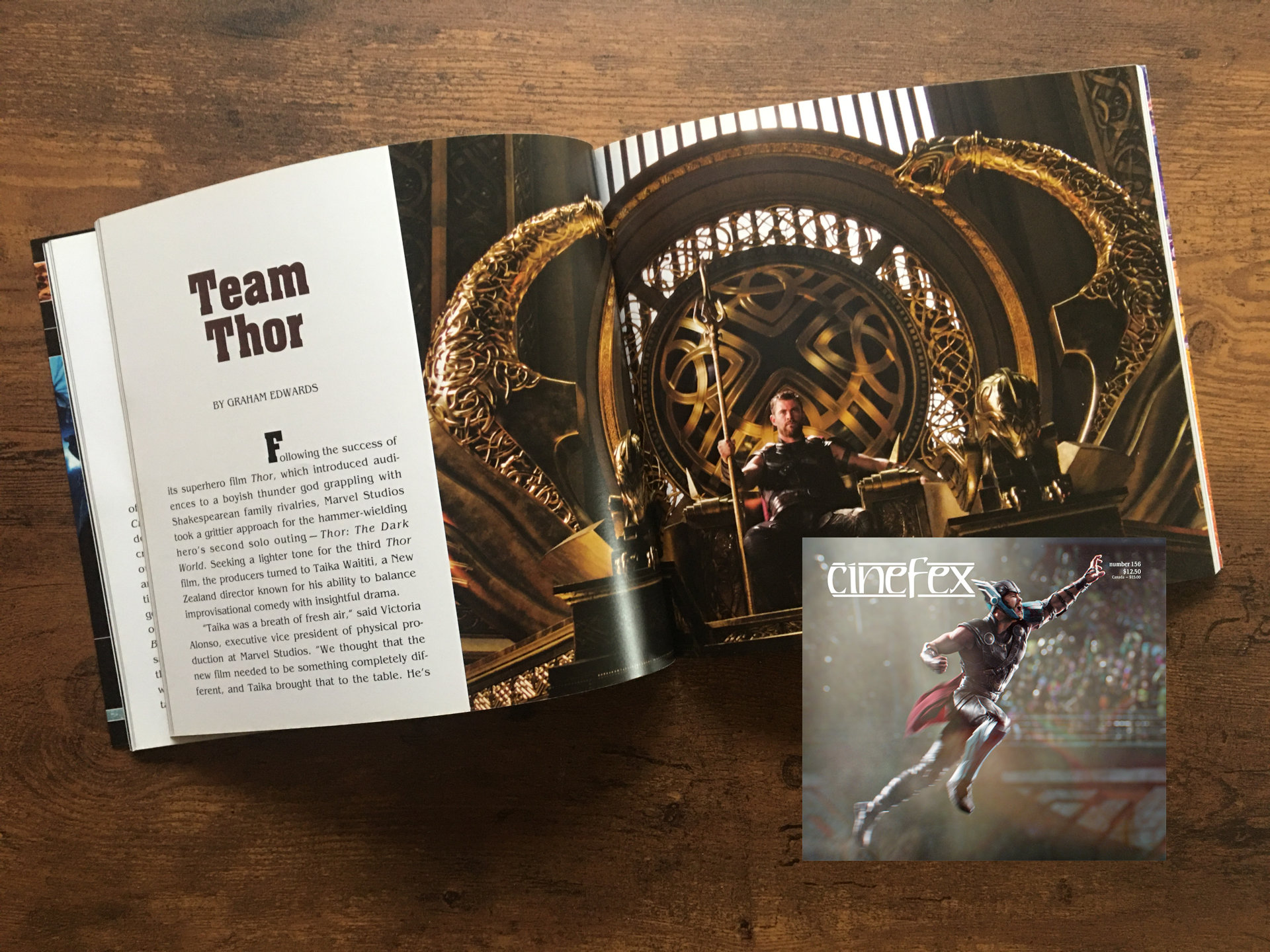
Following the success of its superhero film Thor, which introduced audiences to a boyish thunder god grappling with Shakespearean family rivalries, Marvel Studios adopted a grittier approach for the hammer-wielding hero’s second solo outing — Thor: The Dark World. Seeking a lighter tone for the third Thor film, the producers turned to Taika Waititi, a New Zealand director known for his ability to balance improvisational comedy with insightful drama.
“Taika was a breath of fresh air,” said Victoria Alonso, executive vice president of physical production at Marvel Studios. “We thought that the new film needed to be something completely different, and Taika brought that to the table. He’s as funny as funny can be, but there’s a real punch to some of the things that he says in his films — he gets you in and drags you through what’s truly important.”
Taika Waititi’s initial pitch was simple: the best character in the film had to be the one with his name on the title card. “I said they had to really concentrate on exploiting Chris Hemsworth’s talents as Thor,” Waititi recalled. “Not only is Chris built like a superhero, but he’s got the acting chops, and he’s legitimately funny. I likened the character to Jack Burton in Big Trouble in Little China — a guy who doesn’t think things through all the way before he does them, but who is so charming and lovable that he becomes the perfect hero. It was the kind of direction they wanted to go anyway. It felt like a reboot, in a way, because everyone wanted to do something new.”
The director had shot his previous independent film, Hunt for the Wilderpeople, on a small budget in just 25 days. In contrast, principal photography for Thor: Ragnarok lasted for some 85 days, and the extensive set build filled nine soundstages at Village Roadshow Studios on Australia’s Gold Coast. “Having been on sets long enough now,” remarked Waititi, “I realized quite early on that they’re all the same. There’s 400 more people, but you’re still dealing with the same core crew around you while you’re shooting. So that was very normal for me.” Perhaps more challenging was the inevitable heavy reliance on visual effects. Bluescreen abounded on the sets created by production designers Dan Hennah and Ra Vincent, and many scenes required digital characters to interact closely with the human cast. “I’d done a few visual effects things in my various films, but only a handful of shots here and there. This took it to that next level. Coming from my world of films being in-camera, that was a little reset that I had to do. But it didn’t take long before I came to terms with the freedom that affords you, and I ran with it.”
Guiding Waititi throughout the effects process was visual effects supervisor Jake Morrison, veteran of Marvel Studios productions including Ant-Man and the first two Thor films. Morrison and visual effects producer Cyndi Ochs managed a steadily-expanding team of visual effects vendors which, at the point of final delivery, had swelled to 18 different facilities. With multiple assets being developed and shared worldwide, a spirit of cross-company cooperation prevailed. Closely integrated with the visual effects process, Clear Angle Studios provided photogrammetry and cyberscanning services, while StereoD and Legend3D handled 3D conversion.
When briefing vendors, Morrison adhered to the Marvel Studios philosophy that creative ideas can come from any quarter. “Everybody at Marvel works themselves up into a frenzy on what they think is the coolest idea and the greatest design,” Morrison observed. “We pass that onto our vendors, but the vendors are always given the brief: ‘If you can think of something better, show it to us. If we love it, it’ll be in the movie.’ Everybody rose to the challenge and, hopefully, all the artists at the individual shot level felt that they had a chance to add those little flourishes that you can’t plan for, but that are amazing when you see them.”
The film’s director deepened his relationship with visual effects by donning a motion capture suit for the first time in his career to perform as Korg, a soft-spoken Kronan rock-monster who buddies up with Thor during his time on the remote planet of Sakaar. “One of the big things with mocap that I discovered was the freedom of performance,” remarked Taika Waititi, who regularly appears in his own films. “As an actor, you’re so locked into the take. With the mocap, I could put any take into any shot, mix and match the perfect performance, and then give it to the animators.” Waititi absorbed the rigors of motion capture into his directorial role. “Often I didn’t have enough time to go and take the suit off. Sometimes I’d be sitting around all day long wearing those pajamas, with dots all over my face. Luckily they’re really comfortable — as long as you take off those little nubbin things!”
The Third Floor head of virtual production Casey Schatz collaborated with Profile Studios to incorporate motion capture technology into Gold Coast sets. The team also established a separate motion capture volume christened the Performance Unit Base, or ‘PUB.’ Technoprops adorned suits with wireless infrared active LED motion capture markers, and facial capture lead Robert Nagle wrangled face camera systems for Hulk and Korg. When marker-driven capture was not feasible, performers wore the patterned leotards necessary for image-based capture. Active LED markers on the Arri Alexa 65 production camera enabled live simulcam compositing when shooting in a volume; an Ncam camera tracking system operated at other times.
“Because the footage needed to be as clean as possible, we kept our mocap cameras out of the shots,” said Profile Studios motion capture supervisor Connor Murphy. “For the big sets, we generally put them along the top edge. We had roving mocap cameras on stands to give ourselves extra coverage.” For shots of Thor interacting with CG characters inside a gladiator cell, the team hid motion capture cameras behind pop-out panels. “When the shot was just of Thor, we put the panels back to minimize the visual effects cleanup work.”
Virtual production enabled live compositing not only of Korg, but also Hulk, played by Mark Ruffalo. For a scene in which Thor and Hulk exchange dialogue in the green giant’s Sakaaran warrior suite, the team mapped Ruffalo’s performance onto a previs-quality Hulk asset and displayed it in real time, correctly positioned in space, on video village monitors.
Taika Waititi’s comedic turn as Korg required visual effects to devise a digital rock-monster capable of doing more than just grunt. Framestore laid groundwork by constructing a complex character rig that supported a constantly-moving rock mosaic. “We spent a lot of time building the underlying collision and deformation rig,” explained Framestore visual effects supervisor Kyle McCulloch. “We could push the asset to deliver different types of performance, and still get a realistic feel in how the rocks fit together. After the rig did its work, a team of artists went in and really polished how the rocks moved.” Nowhere was the rig’s articulation more critical than in the face. Framestore arranged progressively smaller stones around Korg’s eyes and mouth, allowing the character to speak and express subtle emotion.
Framestore employed its CG Korg in Thor: Ragnarok’s climactic third act; Luma handled Thor’s earlier encounter with the craggy Kronan on Sakaar. Character supervisor Thanapoom Siripopungul and character rigging TD Marcos Romero adapted Framestore’s rig for use in Luma’s pipeline. “The animators had control on top of the rig to do additional corrective shapes,” said Luma visual effects supervisor Kevin Souls. “If we had a more extreme pose, we could correct the rig so that if we needed to break the rules, we did that in a way that worked.”
The teams at Framestore and Luma began with the motion and facial capture data recorded on set. Retaining the essence of Taika Waititi’s performance, animators adapted movements to better communicate Korg’s size and weight. “When we applied a one-to-one transfer of the performance, it looked too bouncy,” Kyle McCulloch noted. “That made him look comic in a way that the filmmakers didn’t want. We kept the pace and the gestures, and found heavier, slower versions of those things.” While beefing up Korg’s overall physicality, animators kept his facial performance lightweight. “A really broad performance made him look a bit cartoony. We kept it subtle and just hit the key shapes in the mouth.”
The director’s love of improvisation continued through postproduction. “I wanted people to just go with it, even in the mocap,” Taika Waititi commented. “It was really cool to see Hulk stumble over lines, as opposed to being line-perfect. The same with Korg. You can really tell that we were thinking on the spot. I guess one of the worries when you get into post is that all of that is going to disappear. But what was cool was, I could just say some lines into a microphone in the edit suite, or we could quickly film me in the room, doing a couple of versions of the action. Then we’d get that animated, and that would keep the improvisational spirit alive, even through post.”
The film’s chief villain, Hela — the goddess of death, played by Cate Blanchett — also required digital assistance to reach the screen. During production, Blanchett wore either a regular motion capture suit or a hybrid hero outfit styled by costume designer Mayes C. Rubeo and fabricated by Ironhead Studio. The hero costume incorporated a harness carrying battery-operated LED motion capture markers, designed by Technoprops, and featured translucent urethane armor backed with reflective metallic material.
“At the beginning, they weren’t going to make a suit at all,” said Ironhead founder José Fernandez, “but Cate wanted to wear something to feel embodied. She came to our studio for a fitting — it was like having royalty in the shop. We had already used fit models, but as soon as Cate put it on it was amazing how she really did embody the character.” Ironhead manufactured a duplicate markerless costume, plus a torn and fire-damaged variant used for Hela’s introductory scene. The team also fabricated a practical Hela headdress assembled from 10 separate components, each 3D-printed in a lightweight nylon composite.
Hela’s costume and headdress were almost entirely replaced by visual effects. Animators manipulated a digi-double body based on motion capture data, although most shots incorporated the original plate photography of Blanchett’s face and hands. With multiple vendors tackling a range of Hela scenes, development of the CG character progressed in parallel around the globe. “It’s not like someone developed Hela and then we all shared that asset,” said Method Studios visual effects supervisor Andrew Hellen. “At Method we did an early version for the first trailer, then Rising Sun Pictures shared their work with us — they had a really good cowl, we had a good suit. Framestore did a version later in the film. That’s the interesting thing about working with Marvel — you kind of all make it up together.”
For maximum freedom on set, Blanchett commonly wore a headband with tracking markers. Artists used body and facial tracking to lock a CG helmet not only to her head movements, but also to the flexing of her jaw and cheeks. Internal rigging enabled animators to tweak antler positions from shot to shot. “Early on, we explored a more active headdress,” Kyle McCulloch revealed. “But if you could see the antlers shifting around it felt too alive. Instead, we used slight pose shifts that didn’t draw attention to themselves but helped with her silhouette in any given shot.”
Text copyright © Cinefex 2017. Reprinted here with permission.
 Graham Edwards