
The following is an extract from my article on The Shape of Water, published in Cinefex 156, December 2017
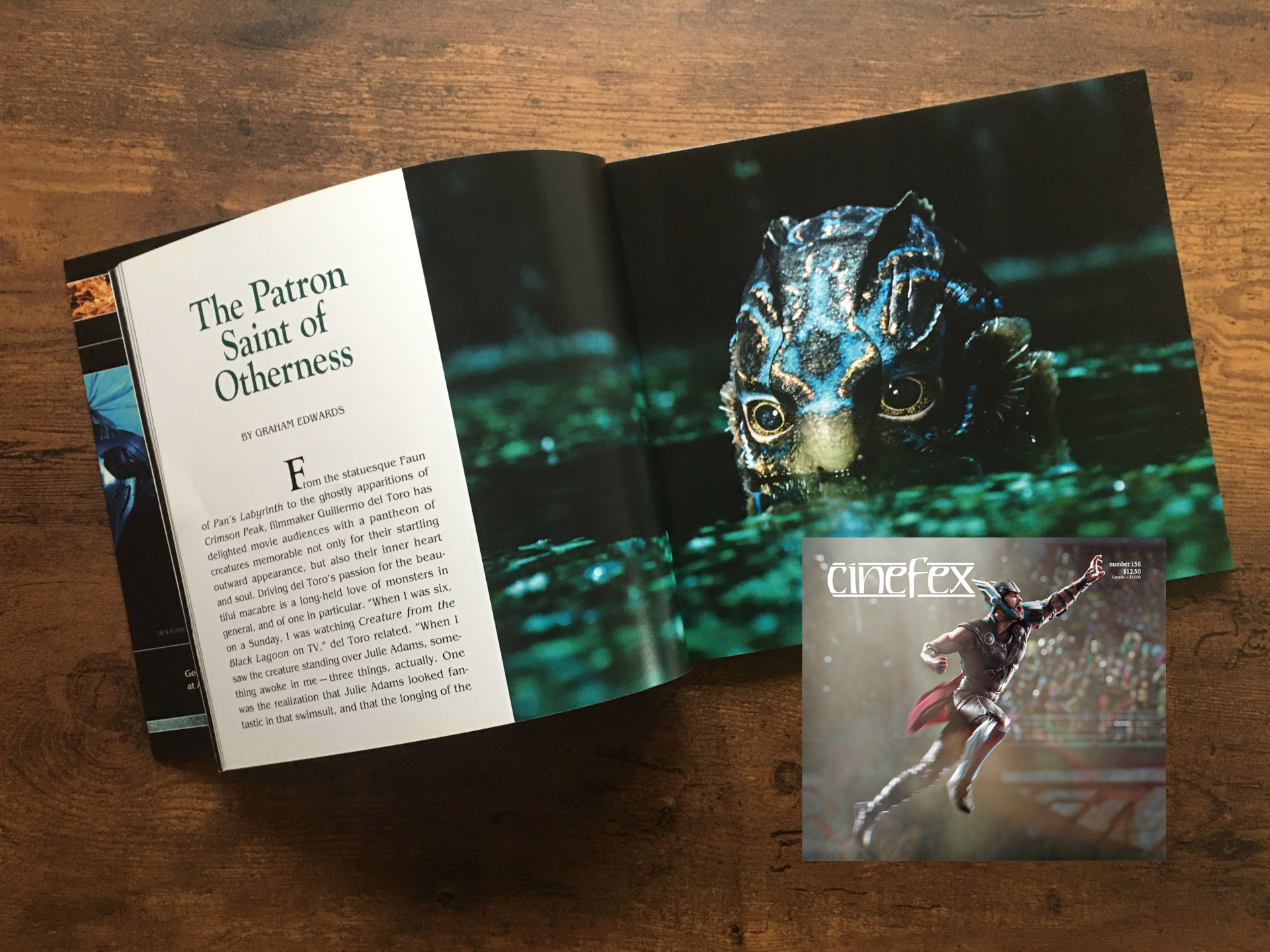
From the statuesque Faun of Pan’s Labyrinth to the ghostly apparitions of Crimson Peak, filmmaker Guillermo del Toro has delighted movie audiences with a pantheon of creatures memorable not only for their startling outward appearance, but also their inner heart and soul. Driving del Toro’s passion for the beautiful macabre is a long-held love of monsters in general, and of one in particular. “When I was six, on a Sunday, I was watching Creature from the Black Lagoon on TV,” del Toro related. “When I saw the creature standing over Julie Adams, something awoke in me — three things, actually. One was the realization that Julie Adams looked fantastic in that swimsuit, and that the longing of the creature was truly romantic. Second was the power of that image, which is just gorgeous. The third thing was I really felt an ache in my heart for them to end up together. I didn’t think about the domestic logistics! I just hoped. It stayed with me up until my adult age.”
Years later, del Toro pitched ideas based on Creature from the Black Lagoon to Universal Pictures, and was briefly attached as director to a remake to be produced by Gary Ross, son of Arthur A. Ross, who co-wrote the screenplay for the original 1954 film. “The idea was always that the creature got the girl,” said del Toro. “That the creature was the last of its species. That it was not a monster but something divine and powerful, and worth saving. That it was a god. But the stories never gelled.”
The breakthrough came in 2011 during a breakfast meeting with Daniel Kraus, with whom del Toro co-wrote the children’s novel Trollhunters, subsequently adapted as an animated series for DreamWorks. Kraus shared with the director his idea for a tale about a janitor in a government facility who befriends a captive amphibian man. Knowing at once that he had found the story he was looking for, del Toro acquired the property and, while in the throes of production on Pacific Rim, began developing a script.
Setting the narrative in Baltimore in the year 1962, he conceived a group of characters living on the edges of society — a mute cleaning woman called Elisa (Sally Hawkins), her black co-worker Zelda (Octavia Spencer) and gay artist Giles (Richard Jenkins). Together they unite to save the ultimate outsider — an amphibious humanoid (Doug Jones) captured during an expedition to the Amazon basin. The Cold War backdrop allowed the director to explore a subversively nostalgic vision of America that appears superficially bright and optimistic, yet is shadowed by paranoia, homophobia and racial tension. “What I wanted was invisible people getting together and rescuing another invisible entity,” del Toro commented. “That’s the reason they can take him — because they’re invisible. And the creature represents all the outcasts. He’s like the patron saint of otherness.”
Central to the story was the amphibian man himself. Guillermo del Toro self-financed an initial phase of concept design, hiring sculptors David Meng and David Grasso to work on clay studies at Bleak House, the director’s creative base in Los Angeles. The sessions generated around 10 finished sculptures, including busts, half statues and full figures. “I knew I wanted to give the creature sort of a Johnny Weissmuller swimmer body,” stated del Toro. “But also have him like a toreador. I wanted him to have the perfect shoulders, the perfect butt, the perfect legs. We toiled with the shoulder-to-ass ratio for a long, long time.” While acknowledging the influence of Creature from the Black Lagoon, the concept team consciously tried to avoid direct visual references to the film’s titular monster.
Next, the director invited Legacy Effects to develop the creature design by combining selected parts of the Meng-Grasso sculptures into a more refined form. By now, del Toro had decided that the amphibian man would be played by Doug Jones, an actor who had performed for him in creature roles in Pan’s Labyrinth, the Hellboy films and others. “Normally, Guillermo does not approach me about doing a movie that early on,” commented Jones. “That’s because I’ll get so excited — if anything goes wrong he doesn’t want me to go into a fit of depression! But this was different than anything we’d done together before. He said the creature really is the centerpiece of the film — he is the romantic leading man.”
The casting choice enabled Legacy artists Glenn Hanz and Mario Torres to sculpt over a 3D scan of Jones’ body, both digitally and in clay. The end result was a maquette around 18 inches tall, accompanied by a handful of interchangeable heads, secured by magnets. Although the film was ultimately made in color, at this stage the plan was to shoot in black and white; the team therefore painted the creature in blue and green tones that read well in monochrome. The maquette formed part of a presentation to Fox Searchlight Pictures in 2014, which resulted in the studio greenlighting the film. Screenwriter Vanessa Taylor then joined del Toro to complete work on the script.
Following early video tests of a prototype head, del Toro brought in sculptor Mike Hill as part of the Legacy team to revisit aspects of the amphibian man’s appearance, especially his face. “There are only a few sculptors in the world that can do a creature and make it a character,” del Toro commented. “One of the most interesting — in my opinion — is Mike Hill. So I asked Mike to become the guy that fathered the final aspect of the creature. He came to Bleak House and we would meet early in the morning, push the clay, have breakfast. We would meet at noon, push the clay, have lunch. And then at the end of the day we would push the clay, have dinner. This went on for a few weeks, and that generated about another 10 sculptures.”
“Together, we tried to give him a face that was handsome, strong and believable as this God-like being,” Mike Hill related. “The trick also was to not make the creature so fantastic that he outshone everyone around him. He was one of the leads and had to fit realistically among the other characters. It was a fine line. I started with his lips, which I tried to make appealing so Sally’s character would want to kiss him. From there it was about making a strong jawline, putting a cleft in the chin, and giving the face pleasing proportions.”
“When Guillermo and Mike talked, they had the idea of taking the scales off the body,” noted Legacy Effects project leader Shane Mahan. “The earlier sculptures had rows and rows of scales, but Mike did an upper body study that was smooth. That took it to a nice level. With a lot of our schedules these days we have to do a whole show in three months — I think we spent that just sculpting. We hadn’t been allowed to spend that much time on a creature body sculpture in clay for the longest period of time. It was such a labor of love.” Legacy concept artist Luca Nemolato explored color schemes, inspired by reference that del Toro had provided of a salamander with black skin and blue stripes. As the work progressed, discussions continued around how best to execute the design for the screen. “Very early on, the idea was that it would be a semi-animatronic head. Then we realized that we really had to bring the face down as close as possible to Doug’s face, because any space for mechanical things just didn’t allow for a gracefully proportioned head. So a makeup solution was determined to be the best.”
Aware of both the possibilities and limitations of makeup, Guillermo del Toro accepted the need for visual effects to increase facial mobility. He turned to Toronto-based Mr. X, with whom he had worked on Crimson Peak and all four seasons of his television series The Strain. “We had familiarity with Guillermo and had become very close,” said Mr. X visual effects supervisor Dennis Berardi. “When he brought The Shape of Water to me, he said that this was a special project, and he was going to ask us to do a lot with very little. We would have to use brain cycles and creative cycles as opposed to solving problems with money. When he showed me some early sketches of the creature, I realized, ‘Wow, this really is a leading man.’ I was actually afraid of it a little bit, because I wasn’t sure if we were going to be able to pull it off. But I was up for the challenge.”
“I’m not prudish about mixing digital with physical,” del Toro added, “but my entire career has been geared to favoring the physical, most definitely. So the creature’s beauty begins with the physical, and then we used the crucial extra percent that digital provides — and it is crucial. Without it, the creature would not exist as an entity. It would just be a suit.”
Shortly before the beginning of principal photography in August 2016, Legacy Effects delivered an amphibian man for a camera test painted in an approved palette of cool colors. When Guillermo del Toro judged it to be too pale and ghostly, responsibility passed to Mike Hill to create a definitive color scheme. “We started from scratch with velvety blue-black for most of the body and an almost golden front,” said Hill. Meanwhile, the 87-strong Legacy team scrambled to complete fabrication of the complete creature costume, which comprised a foam rubber body suit enhanced with silicone pieces, and multiple sets of foam rubber facial appliances.
“The suit ended up over at Mike’s shop so he could finish up painting it,” said Shane Mahan. “The day that he and I were supposed to go to Canada to start the shoot, the suit was almost sticky to the touch because the paint wasn’t dry. Literally! We flew up at that point and we were straight into it. Looking back, the word would be ‘exciting’ — at the time it was fairly terrifying. But we were just squeezing every ounce out of the creative process to get it to be as good as possible.”
Each day during principal photography, Mahan, Hill, and makeup artists Sean Sansom and Jason Detheridge spent three hours transforming Doug Jones into the amphibian man. First, Jones squeezed into the form-fitting foam rubber body suit through a small aperture in the back. The suit enveloped his body, arms and legs from the collarbones down; the feet were integral, but the arms ended at the wrists. “They would lay the suit out flat on the floor,” said Jones, “and let me wriggle myself into it feet-first as far as I could go. Once the feet were in place, they would stand me up and get the legs shimmied up to get all the wrinkles out and get the crotch to where it belonged. Then they could fold up the torso part and dive my arms in. It was so perfectly sculpted to my actual body that once it clicked into place it was like: ‘Ah, we got it, we’re there.’”
Snug in the suit, Jones moved to the makeup chair. The team completed the body by slipping on silicone gloves with translucent webbing molded between the fingers. The gloves extended halfway up the actor’s forearms, where they were glued and blended with the foam rubber. Removable silicone fins — fabricated in interchangeable ‘normal’ and ‘erect’ versions — attached near the join using hidden velcro tabs. Additional webbing was sewn permanently into the suit’s armpits, and a silicone dorsal fin attached to a separate back panel. Next came a skullcap with built-in goggles, the sockets of which were open so that removable eyes could be attached on set. Mechanical silicone gills fastened to the sides of the skullcap and extended around the throat. Aware that backlighting would reveal the gills’ moving parts through the translucent skin, Legacy designed organic-looking internal mechanisms based on coral growths.
A pair of foam rubber appliances concealed the rest of Jones’ face. The first appliance encased the actor’s lower face and bottom jaw. The second appliance overlaid this and extended across the upper face. Less durable than silicone, the foam rubber pieces were strictly one-use affairs. “We made the back of the head silicone because there were some fins on the very top of his head,” said Legacy Effects project co-supervisor Lindsay Macgowan. “We wanted to make sure that we got the light transfer through those fins. With the silicone gill piece, then the foam appliances, then silicone again, we were trying to fool the audience as to exactly what materials we were using where.”
Even though both suit and appliances were prepainted at Legacy’s studio, Mike Hill concluded the makeup sessions by painting and blending the various joins to ensure a seamless appearance. While the actor was on set, the team kept two alternative sets of facial appliances in reserve, sculpted in ‘angry’ and ‘sad’ expressions. These never actually went before the camera, but artists did make use of a separate pair of closed eyelids, which were glued over the goggles when required.
At the start of principal photography, Legacy had a single amphibian man suit up and running. By the ninth day, a second suit had arrived on set, allowing the team to rotate costumes. Two more suits followed later, bringing the final total to four. While the silicone components proved highly durable, daily immersion in water soaked the foam rubber and systematically broke down the paintwork, necessitating a robust maintenance program. “On the weekends, I would strip the suits down, dry them out, and Mike would come in and repaint the damaged areas,” Shane Mahan related. “We probably repainted all of those suits 10 times. Towards the end of the film, it became harder and harder to keep the suits closed, because they were so water-stretched and damaged. At one point, we joked that we were using all of aisle five at Home Depot — every type of glue, snap, strap and tape — just to keep Doug together!”
Anticipating the wear and tear, the Legacy fabrication shop specified dense materials that would last the course and resist water damage. This meant sacrificing a degree of flexibility. For the actor inside the suit, every movement was a physical workout. “The suit kept wanting to spring back to that standing position it was sculpted in,” commented Doug Jones. “I felt like I was wearing a head to toe Bowflex! If I was concentrating on a walk or a stance or an interaction with Sally, it was easy for me to forget and let the suit go ‘boing!’” The silicone gloves also had a life of their own. “The hands were like tire rubber. You could run them under a bus and they would be totally fine, but they wanted to spring to a paddle position. Guillermo had to keep reminding me throughout the shoot: ‘The hands! Crunch them! Flex the hands!’”
The fourth amphibian man suit benefited from slightly softer materials. It also featured pleated urethane stomach scales similar to those developed by Legacy for its Iron Man costumes. The suit turned up just in time for the film’s magical dance number, in which Elisa and the creature pirouette through a Hollywood dreamworld. “Sally and I had to hold hands and keep contact with each other at all times,” said Jones. “That included a spinout where I had to catch her hand so she wouldn’t fly across the room. If my hands weren’t flexible enough to do this, then we were going to lose Sally! So the suit on dance day was a bit more pliable.”
Text copyright © Cinefex 2017. Reprinted here with permission.
 Graham Edwards