
The following is an extract from my article on Game of Thrones: Season 8, published in Cinefex 166, August 2019
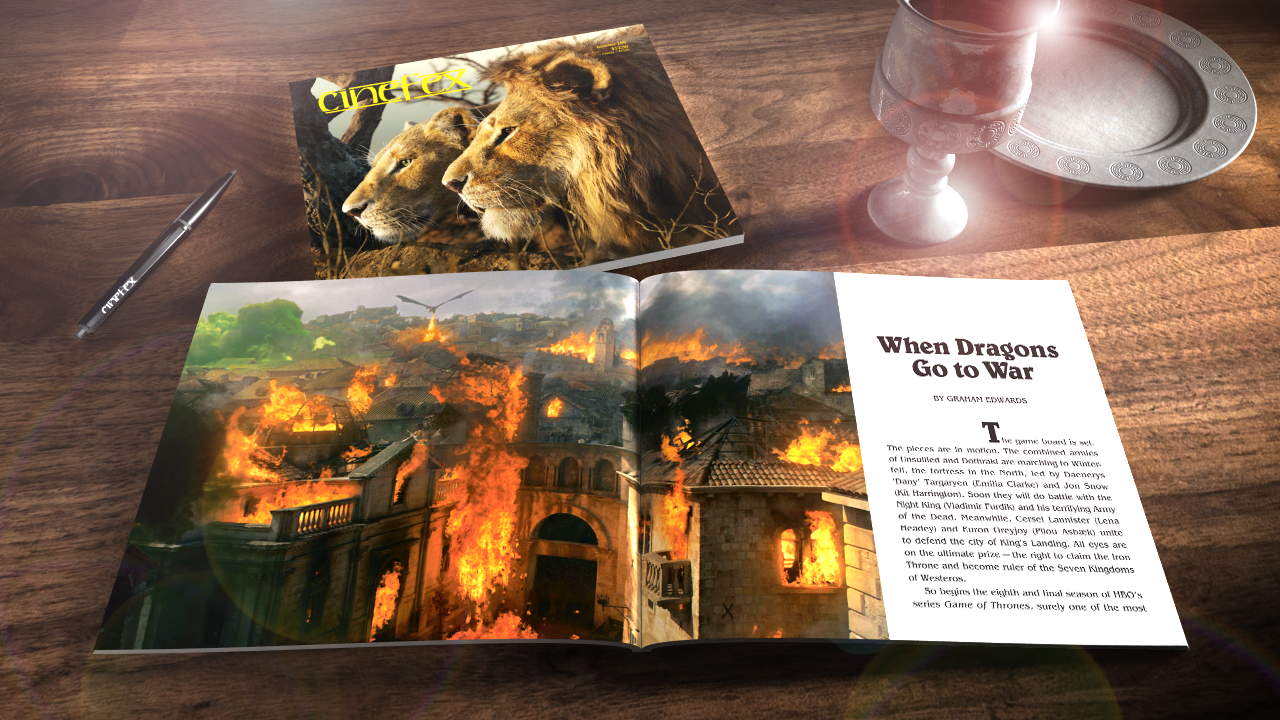
The game board is set. The pieces are in motion. The combined armies of Unsullied and Dothraki are marching to Winterfell, the fortress in the North, led by Daenerys ‘Dany’ Targaryen (Emilia Clarke) and Jon Snow (Kit Harrington). Soon they will do battle with the Night King (Vladimir Furdik) and his terrifying Army of the Dead. Meanwhile, Cersei Lannister (Lena Headey) and Euron Greyjoy (Pilou Asbæk) unite to defend the city of King’s Landing. All eyes are on the ultimate prize — the right to claim the Iron Throne and become ruler of the Seven Kingdoms of Westeros.
So begins the eighth and final season of HBO’s series Game of Thrones, surely one of the most anticipated broadcasts in television history. Throughout the season’s six episodes, producers D.B. Weiss and David Benioff upheld their commitment to ramp up the action from everything that had gone before. “I don’t think any of us fully grasped the magnitude until we saw the outline,” said Game of Thrones visual effects producer Steve Kullback. “The whole season might well have been called ‘Holy Shit!’ It felt solidly like double what we had done in Season 7, in terms of complexity and number of shots. It really blew our hair back.”
Script breakdowns identified the need for no less than 3,150 visual effects shots. Accompanying this unprecedented total was a mandate to deliver the show by April 2019 — a challenging deadline for a team barely catching its breath after Season 7. “Steve and I had a closed-door meeting with Dan and David,” recalled Game of Thrones visual effects supervisor Joe Bauer. “I assumed we’d try to whittle the numbers down, as we’d done many times over the years. But nothing changed. They felt strongly it was their duty to the fans to deliver the most spectacular grand finale they could.” Bauer and Kullback decided to share the load by bringing in a second visual effects supervisor, Stefen Fangmeier. “I picked out the three episodes I absolutely wanted to do — the two battles and the finale — which amounted to about 2,400 shots. That left Stefen with the first, second and fourth episodes. To send three of my babies off to live with another family was really tough, but when I handed it off I really handed it off, and let Stefen do his thing.”
“Dividing the work was an entirely new proposition for Steve and Joe,” Stefen Fangmeier agreed. “But everyone deemed it wise considering the significant expansion of scope. I flew out to Belfast in early August 2017, while Steve, Joe and the team were still in Los Angeles finishing up post on Season 7. So, I was the first visual effects person on the ground with the rest of production, formulating plans on how to achieve this vastly more extensive final season.”
Visual effects shots were divided between multiple vendors, many of them Game of Thrones veterans. Image Engine created the majority of the final dragon animation, notable exceptions being Episode 6’s climactic throne room scene, handled by Pixomondo, and Rhaegal’s death in Episode 4, done by Weta Digital, which delivered over 600 visual effects shots across all episodes and led the work on Episode 3 alongside El Ranchito. Scanline VFX took charge of 600-plus shots, centered on Episodes 5 and 6, while SSVFX, Soho VFX and Important Looking Pirates worked on swathes of shots across the season; Lola VFX contributed digital cosmetic work. Sam Conway returned as special effects supervisor and Barrie Gower continued his role as prosthetics designer, heading up his makeup effects team at BGFX.
The Third Floor created previs for every episode, including initial dragon animation blocking, and devised solutions for virtual production and motion control. Expanding its Game of Thrones previs team from nine artists to 19, The Third Floor broke ground on Season 8 some six weeks before the previous season was complete. Top of the agenda was Episode 3, the 82-minute runtime of which is wholly dedicated to a sustained battle against the Army of the Dead. “We worked with the director, Miguel Sapochnik,” said The Third Floor previs supervisor Michelle Blok, “figuring out how to break up the battle and keep it interesting. We created a kit of animations that we could plug and play — crowd animations, archers, cavalry — then brought in all these chess pieces and populated our battlefield. As elements of the script changed, it was easy to delete or move things, without having to start from scratch.” By the end of Season 8, The Third Floor had delivered previs for over 2,000 shots and techvis for nearly 1,300.
Central to the battle action is the castle of Winterfell, which features prominently in the first four episodes of Season 8. Production designer Deborah Riley extended the established Winterfell set at Toome, Northern Ireland, increasing its fortified appearance with a new gate and battlements. The Third Floor senior real-time technical artist Adam Kiriloff enabled virtual scouting sessions to review the new configuration.
Soho VFX constructed a master Winterfell asset in Autodesk Maya, combining set lidar with previs and art department models. Artists added myriad details such as carts, barrels and cookfires, then loaded the completed model into Side Effects Houdini. “We ran simulations of snow falling and building up on all the surfaces,” explained Soho VFX visual effects supervisor Berj Bannayan. “We masked areas where people had trampled it, or where hot roofs had melted it. If Stefen wanted more snow here or less there, we just reran the sim with different masks. We outputted everything as static geometry caches and included them as part of the final model.”
Stefen Fangmeier entrusted Soho VFX with Winterfell shots across all three of his episodes, including a complex composite near the beginning of Episode 1 in which a boy climbs a tree to watch the armies marching towards Winterfell through the outlying village of Winterstown. Fangmeier and director David Nutter designed the shot after the main shoot had wrapped. “We went back to the location about six weeks after the initial photography,” Stefen Fangmeier related. “We filmed the boy approaching the base of the tree and starting to climb, then used a small portion of a tree on a stage to show him climbing higher.”
Soho VFX combined the elements with two greenscreen plates of soldiers and villagers, blending them into a fully digital environment. The team rebuilt Winterstown from survey lidar and by referencing previously shot scenes. Artists duplicated the greenscreen performers and stretched columns of digital soldiers into the distance. Soho VFX used its Winterfell asset to extend live-action across Episodes 1, 2 and 4, from minimal top-ups to 2½D wides of the military camp outside the walls. The team also augmented shots of the mystical weirwood tree in the Winterfell godswood, topping up the practical set with digital branches and red leaves.
Dany’s dragons Drogon and Rhaegal arrive at Winterfell. While Image Engine shouldered most of the Season 8 dragon animation load, it turned over roughly half its dragon shots as animation caches to other vendors for lighting, rendering and compositing — a new methodology for Season 8. Soho VFX used such caches for shots of the airliner-sized beasts soaring towards the castle; other shots in this sequence were finalized by Image Engine. “We had done almost 100 dragon shots in Season 7,” noted Image Engine visual effects supervisor Thomas Schelesny. “This time we had 370 shots, but some of those shots had three dragons — about 415 dragon performances in total. So it was all about optimizing.”
Jon mounts Rhaegal and embarks on a rollercoaster maiden flight as a dragonrider, with Dany accompanying on Drogon. Seeking a contrast with the brooding battle scenes ahead, Stefen Fangmeier championed the use of beautiful sunlit landscapes. A helicopter shoot captured aerial plates in Iceland, into which Image Engine composited dragons and riders. Snow-covered forests were digitally created, as was a canyon into which Jon and Rhaegal fly. Image Engine built up a picturesque waterfall from separate Iceland plates.
For all its Season 8 dragon shots, Image Engine first created a layout locking down continuity and bringing the previs into a standardized world space. Animators then took performances to a near-complete pre-animation stage. Based on this, production shot any background plates required. “We matchmoved the background plate and snapped the pre-animation scene to the matchmove camera,” said Schelesny. “That was now the new official camera; it worked with the background and the dragon kind of followed it. But only kind of — it was never perfect. So next we redid the animation in that matchmoved environment, again to 95 percent completion.”
Image Engine sent this next iteration to The Third Floor, which used the data to program a dragon buck on a MrMoco motion base operated by motion control supervisor Ian Menzies, and a wire-mounted Spydercam camera rig operated by Todd ‘Hammer’ Semmes and Lawrence Fagan. Building on a methodology established in earlier seasons, The Third Floor virtual production supervisor Kaya Jabar broke down the animation into separate buck and camera movements, scaled and adjusted to fit within the stage. Additional photographer Greg Middleton shot most of the buck footage. “This season we used a Libra Mini head instead of a full head,” Jabar commented. “It’s about a third of the weight, so the camera could reach higher speeds and accelerate faster. Michael Buxton, our Libra tech, had part of the head plate cut off to give it more roll.” For shots of the dragons flying vertically, special effects wedged the motion base at an extreme angle. Flexible though it was, the setup could not always fulfill all the demands of the animation. “I couldn’t necessarily just translate the data across and stick it to the pre-animation overlay. For example, I might have to put things closer and on a wider lens to get more sense of speed. In those cases, I would create separate elements and show them as a rough composite to Joe for approval.”
For certain intimate shots — notably an emotionally charged Episode 5 closeup of Dany sitting astride Drogon as she deliberates on Cersei’s surrender — Jabar operated the dragon buck manually using an encoded tenth-scale replica of the motion base. “On a motion control stage it can be alienating for the director and actors,” reflected Jabar. “Miguel ran that shot as one really long take, directing Emilia, directing me. I timed my breath to an animation of the dragon to get the rhythm.”
Countless battle shots show the dragons breathing fire. The Third Floor virtual production supervisor Casey Schatz revisited a Season 7 technique — shooting one-third-scale practical dragon fire elements using a Spydercam-mounted flamethrower driven by pre-animation files. For key character-driven shots in Season 8, the team took things up a notch by swapping the Spydercam for a more agile Camera Control Bolt Cinebot. “We hit two limits with the original rig,” Jabar observed. “If the fire moved too quickly, it fell apart. And we could only move the Spydercam so fast, anyway. But the Bolt could hit crazy speeds, which meant we could shoot at 72 or 96 frames per second, whereas before we averaged only 30 frames per second.”
Special effects wrangled the flamethrower, which fired pressurized isopropyl alcohol through a nozzle and past an ignitor. A pipe delivered the fuel from a remote tank. Bolt setups required a much shorter pipe than those involving the Spydercam, enabling higher pressures to be reached. Long takes burned up to seven gallons of fuel at a time.
Live-action photography of dragonriders on the buck passed back to Image Engine, where matchmovers snapped the dragon animation and digital camera to the new footage. “There was always significant discontinuity between the motion base and what up to that point we’d treated as nearly complete animation,” stated Thomas Schelesny. “We modified the animation to respect what the motion base was doing, using constraints to attach the dragon’s skin to the matchmove. So now, finally, we had a camera that worked with the background, with the motion base, and with the dragon. That was the whole trick — having this one camera. Only at that point could we take the animation to final.”
Image Engine animation supervisor Jason Snyman managed a team of 17 animators, many new to Game of Thrones. Each recruit spent up to four weeks learning the nuances of dragon performance. “It was very tempting to add an extra flourish, or some kind of wormy tail move,” Schelesny remarked, “something that might look sexy but did not fit the character of the dragon. The animators had to always hold back and stay on character.” Blend shapes gave control over facial expression and hero muscle flexing. “When the dragons are in flight, the animators controlled the billowing of the wing membranes; the rippling on top was a creature effects task. When the dragons have landed, the whole membrane was simulated.” Creature effects managed underlying muscle movement and skin slide.
With all the approved dragon elements now in its possession, Image Engine was ready either to complete shots in-house, or to pass those elements to other vendors. “We projected the live-action elements onto cards in Maya, in the same 3D space with the dragon model,” explained Schelesny. “To our partner vendors we delivered an Alembic cache of the dragon animation, the card of the actor tracked to the dragon’s back, and the card of the fire tracked to the dragon’s mouth. We also provided a body match of the rider so they could cast shadows onto the dragon’s back. We wrote tools to split the cache files and associated QuickTimes into the directory structures and naming conventions our partners needed.”
Gruesomely foreshadowing the impending battle, Episode 1 ends when survivors from the destruction of the Eastwatch Wall find young Ned Umber (Harry Grasby) pinned dead to a wall at Last Hearth, surrounded by a grotesque mandala of dismembered limbs. When Ned awakens as a wight, Beric Dondarrion (Richard Dormer) sets him alight with his burning sword. BGFX manufactured around 40 dummy body parts, plus a silicone likeness mask worn by stunt double Paul Lowe for shots of Ned on fire. Pixomondo composited the burn footage with a greenscreen element of Grasby, and simulated flames spreading through the mandala.
Episode 2 concludes in even more ominous fashion, with a wide shot of the Night King’s vanguard massing near Winterfell, delivered by Weta Digital and paving the way for the following episode, in which the Army of the Dead launches an all-out attack on the castle. Over the course of 55 grueling nights, production shot Episode 3 battle scenes in Northern Ireland on the Winterfell set at Toome, on stages at Titanic Studios, Belfast, and at Magheramorne Quarry, just outside the city. The Third Floor’s Eric Carney was on the ground throughout as additional visual effects supervisor.
Text copyright © Cinefex 2019. Reprinted here with permission.
 Graham Edwards