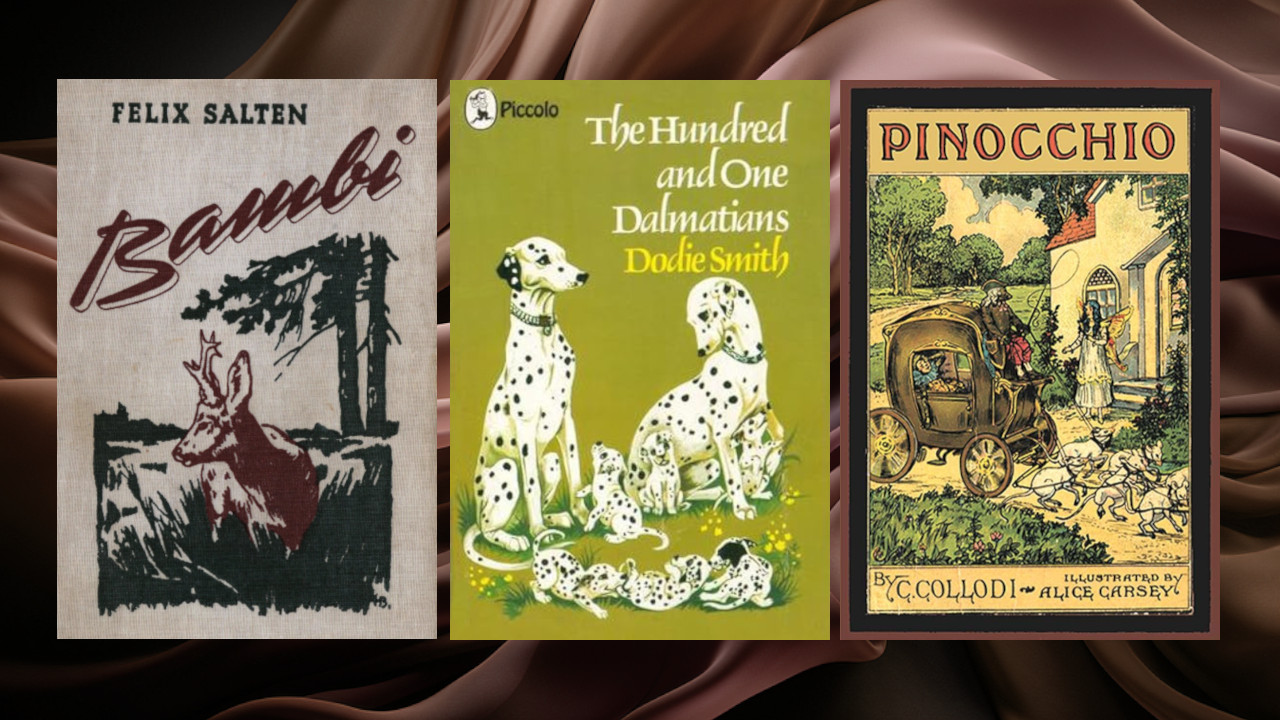
On my bookshelf as a young kid, I had a book called Bambi by Felix Salten, another called The Hundred and One Dalmatians by Dodie Smith and The Adventures of Pinocchio by Carlo Collodi. I suspect my parents bought them for me when the Disney movies came out. However, these were ‘real’ paperback editions, not movie tie-ins. So, from an early age, I was very conscious of how screen adaptations play with the original literary source material.
Thanks to their popularity – not to mention the power of the Disney marketing machine – it’s the animated features that most people think of when they hear the title. That’s a shame. Don’t get me wrong – I love these movies – but they’re just one studio’s interpretation of the texts. And for all the rewards movie success may (or may not) bring to an author, it’s a shame if it comes at the expense of the original work.
Adaptations can lead to some fairly bizarre situations. Philip K Dick famously refused to write a novelisation of Blade Runner and no wonder – why novelise a screenplay adaptation of a book you wrote yourself that was called Do Androids Dream of Electric Sheep? Or take Michael Crichton’s novel The Lost World. He wrote the book concurrently with the movie script, which is a sequel to the movie version of Jurassic Park rather than his original novel. One of the many continuity issues he had to deal with was the tricky problem of resurrecting Ian Malcolm, who dies in Jurassic Park (the book) but not Jurassic Park (the film)! Confused? Let’s not even go into the different iterations of The Hitchhiker’s Guide to the Galaxy (although the mutability of that particular sequence of stories has a charm all its own, and seems entirely appropriate given the rather unreliable reputation of the Guide itself as a definitive source of knowledge).
Is the original always better than the adaptation? Not at all. There are plenty of movies that spin literary flax into cinematic gold. But seek them out all the same, if only to see what you’ve been missing. You might be surprised. Perhaps even horrified, as perhaps by this short extract from Carlo Collodi’s The Adventures of Pinocchio, describing a scene that most assuredly wasn’t in the Disney version:
“(The assassins) tied Pinocchio’s hands behind his shoulders and slipped the noose around his neck. Throwing the rope over the high limb of a giant oak tree, they pulled till the poor Marionette hung far up in space. Satisfied with their work, they sat on the grass waiting for Pinocchio to give his last gasp. But after three hours the Marionette’s eyes were still open, his mouth still shut and his legs kicked harder than ever … The rocking made him seasick and the noose, becoming tighter and tighter, choked him. Little by little a film covered his eyes … He closed his eyes, opened his mouth, stretched out his legs, and hung there, as if he were dead.”

