I’m plotting three novels at once and it’s melting my brain. In a good way, of course. The best way really, because in some ways plotting is the most exciting part about writing fiction. At this stage of the game, anything goes.
To explain, I’m between books in a ghostwriting project that’s taken up most of my year so far (and will continue to occupy me for the first few months of 2010). So I’m taking the opportunity to work up a proposal for a new series of fantasy novels I’ve been planning for a while. Three books to begin with – as for what happens after that, well, it depends whether I get a publisher to bite or not.
Yes, that means I’m plotting books for which I don’t yet have a deal. Trust me, that happens all the time. Which is where the excitement and the brain-melting comes in. Because, much as I’m conscious of market trends and projected page counts and all the conflicting demands of a publishing industry that’s feeling the pinch, there’s nothing more thrilling than planning your next book. So I’m plotting. And plotting. And plotting.
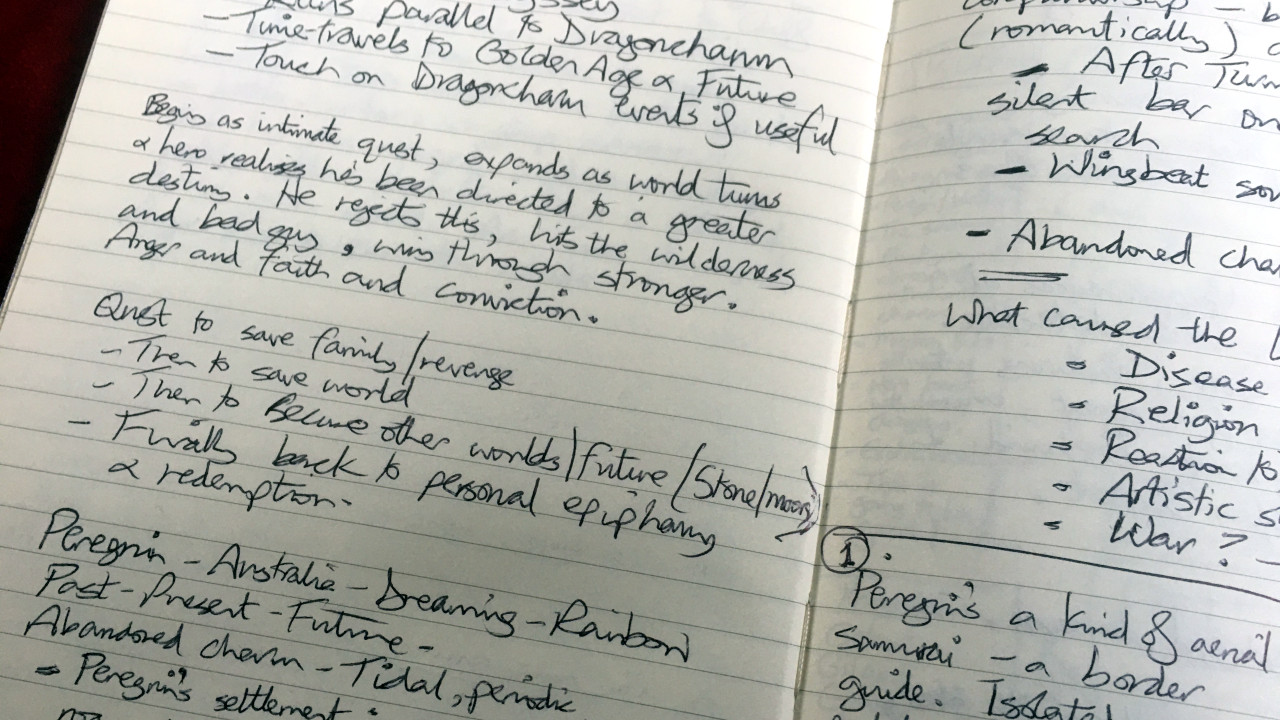
These days I work mostly in a notebook. Sometimes I draw mind-maps and flow-charts but with this project, for some reason, it all wants to come out in words. A lot of the notes I make are conversations with myself, peppered with frustrated outbursts when I can’t get things to hang together. I plot anywhere: on the sofa, in coffee shops, on public transport. I suspect, however, that the real work’s going on in the back of my mind when I’m doing other things. Either that or at three in the morning when my brain just won’t let an idea go.
You have to be careful though. Plotting’s fine up to a point, but plot’s not everything. If you read a book that’s entirely plot-driven, you know it. The characters do things not because they come naturally but because the plot demands it. They act, well, out of character. Too much plot often means too many coincidences. Trails lead neatly to resolutions. Story arcs curve like rainbows towards conveniently placed pots of gold. Everything fits just a little too neatly.
So, even when you’re plotting, it’s a good idea to keep things messy. Or at least leave yourself room to make a decent mess when you come to write the damn thing. It’s vital to look at the action through the eyes of your characters, and to make sure they’re properly motivated at all times. Above all, it has to feel right, which doesn’t necessarily mean it all has to add up.
What’s the end result of all this? Well, I’ll have a single page of background on the series as a whole, plus a single page of synopsis for each of the three novels. I’ll have a character list for the first book, and a detailed chapter breakdown that runs to maybe eight thousand words. Once I’m happy with all that, I’ll write the first five or six chapters of the first book. Then I’ll get some feedback from my agent. Then I’ll know if I’m on the right track.
You must excuse me now. I’ve paused the plotting to eat lunch and write this blog entry. But it occurs to me now that one of my villains isn’t being nearly villainous enough, and I’ve just realised there’s a cracking revenge story to be told in the middle of book three. The plot thickens.
Update
I can now reveal this blog post refers to my preliminary work on a fantasy trilogy called The Peregrine Cycle. So far I’ve taken only one book to completion. It’s called The Dragons of Bloodrock and you can order your copy here.
 Graham Edwards – Author & Journalist