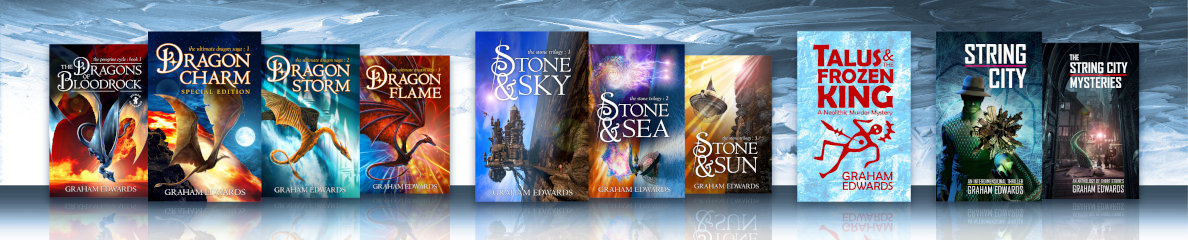

Cinema and literature. Movies and books. It frustrates me how people take for granted certain things in one, but not the other. Take genre. Movie directors – if they so desire – are allowed to tackle a range of genres. In the course of his career, Steven Spielberg has bounced from The Sugarland Express to E.T.: The Extra Terrestrial to Schindler’s List to Saving Private Ryan and far beyond. Danny Boyle has made a career of picking a different genre for every film he makes.
But what about writers?
Let’s pick a few big names. Terry Pratchett? He writes fantasy – the funny kind to be precise. James Patterson goes for crime thrillers. That nice Philippa Gregory does historical. Their names might just as well be genre tags. The fact that they’ve all have had work published outside their respective pigeonholes has no effect on those tags. It’s also irrelevant to my argument. What I’m talking about is not publication history, but the preconceptions and expectations of readers (who generally prefer their favourite authors to stay on the straight, narrow and reassuringly familiar path), and the dictats of publishers, who like to package authors up in commercially convenient ways.
Not that authors don’t stray from time to time. But there are rules. Iain Banks writes socially aware mainstream fiction, but if you want to read some space opera you’ll have to go to his alter ego Iain M Banks. The M makes all the difference. A marketing man might call it a brand extension. Michael Marshall Smith has concocted some splendid science fiction, but when writing about serial killers he goes under his almost-a-pseudonym Michael Marshall. And so on.
So, what’s the problem here? Is it the authors who get stuck in a rut or the readers who put them there? Is it the publishers needing handy and reliable blurb, or the merchants needing books that fit under their equally handy and reliable categories? Is it all, god forbid, driven by focus groups? What about the authors who truly break the mould? Neal Stephenson’s Anathem was undeniably science fiction, but his Baroque Cycle – which resides next to it – would surely be more comfortable on the historical fiction shelf. Stephen King? Horror, of course. Except at least half his novels aren’t.
All this leads naturally to the question of why we categorise books by genre in the first place. Aren’t they all just stories? That’s a whole other debate, for a whole other day.
I honestly don’t know why genre works this way. As a reader, yes, I gravitate to favourite authors in favourite genres. There’s a comfort factor in picking up the latest by your idol and hoping you’ll hit that perfect balance of Reading Something New and Getting What You Expected.
As a writer, however, I like to use my toolbox to make all sorts of different toys. Fantasy, horror, crime, historical, romance or, dare I say it, literary … it’s all the same craft in the end. I guess not every reader likes to experiment, but I’m guessing there are plenty of them out there who do.
Do you?


Genres are like God: if they didn’t exist, we’d have to create them.
It boils down to a theory of economic efficiency. The ultimate consumer wants neatly categorized shelves so their buying experience can be more efficient (read: more pleasant). Retailers who do a better job managing that categorization (read: making the buyer’s experience more pleasant) will generate higher sales/profits. Publishers (or imprints) that help retailers do that (read: making the retailer’s job easier) will likewise generate higher sales/profits. Then we get into the network effects that apply to agents and writers: as they build relationships with imprints/agents/publishers (and their concomitant categorizations) it’s easier for them to sell more of the same along established tracks.
If a writer then tries to break out of that track, there’s risk at every one of those points: their previous publisher might not buy it because it’s outside their sphere, the retailer might not know how to categorize it, the buyer might buy it with a different expectation (and then be disappointed, which comes back to bite the retailer, and the publisher, and ultimately the writer). It takes tremendous luck (and success with ensuing name recognition) to transcend these economic realities.
Chris, I’d agree with all your points. In the end, I think, it comes down to respecting brand loyalty. And it is possible to publish in a range of genres, just as long as you play the pseudonym game. There are plenty of big names who do just that.