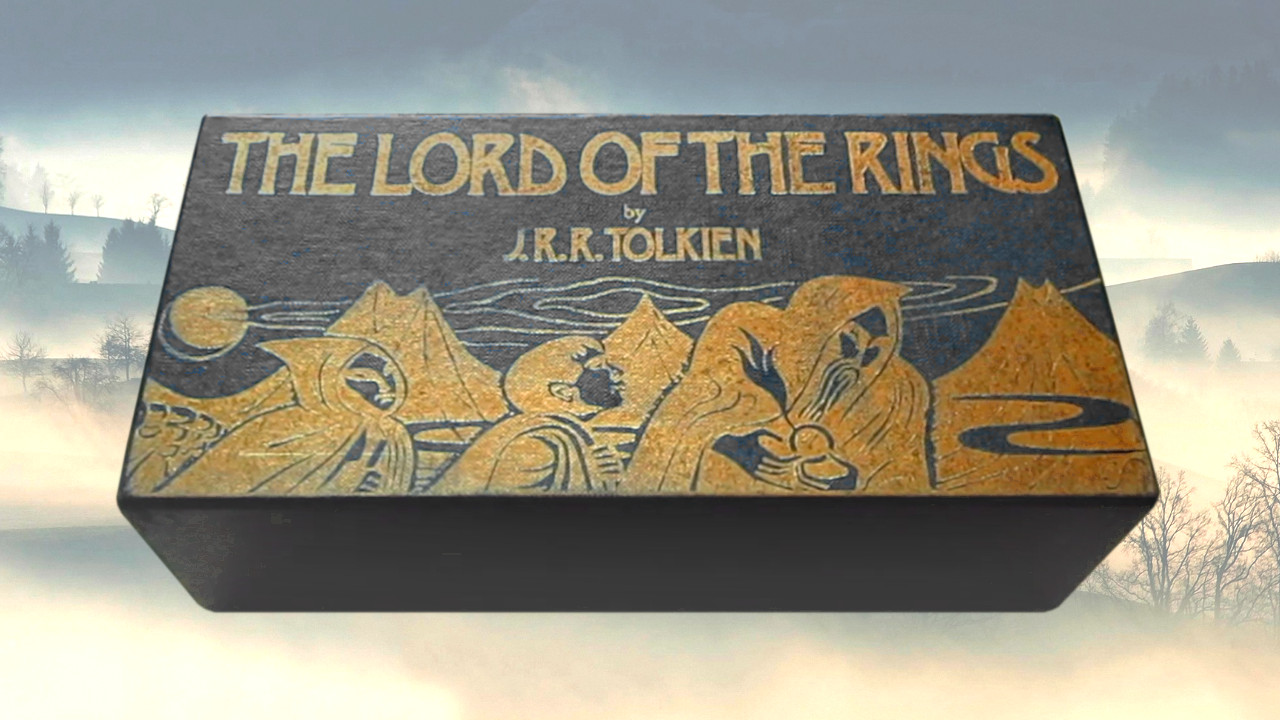
I love my boxed set of The Lord of the Rings. I’m not talking about the Special Edition DVDs of Peter Jackson’s movies (cherished though they are), nor my rather smart hardback of Tolkien’s novel. No, I’m talking about the radio show.
The series was broadcast by the BBC way back in 1981, in 26 weekly episodes of half an hour each (my boxed set repackages this into 13 hour-long audio cassettes – yes, cassettes, it’s that old). The whole story took six months to tell. Sounds like a long time? Trust me, it worked a treat. I was sixteen and mad about it, tuning in avidly to every broadcast, week after week, following Frodo and Sam as they inched their way towards Mordor. The epic timescale of the series matched the epic timescale of the story, and I was with it every step of the way.
In many respects, the BBC radio series paved the way for Peter Jackson’s film trilogy. It proved that the novel actually could be dramatised, something about which Tolkien had always been deeply sceptical. The Lord of the Rings was adapted for radio by Brian Sibley, with writing credits for individual episodes split between Sibley and Michael Bakewell. As I recall, Sibley consulted on the movie scripts, and has written a number of ‘making of’ books about the films, as well as a biography of Jackson. And Jackson apparently gave his cast recordings of Sibley’s radio series as an easy way to bone up on the story.
The screenplays by Peter Jackson, Fran Walsh and Philippa Bowens clearly draw on some of the lesssons Brian Sibley learned while adapting this mammoth work. One of the most obvious is the decision to leave out the early episode with the barrow-wights and Tom Bombadil. For some fans this is a contentious issue – in dramatic terms it’s a no-brainer. While I like the bucolic aside of the Bombadil episode, I don’t like the way decelerates the story just when it’s beginning to get going. Plus, other than equipping the hobbits with some weapons, it adds nothing to the narrative.
There are other, more subtle changes, like the decision to intercut the Frodo/Sam story with those of Gandalf, Aragorn and the other hobbits, rather than follow Tolkien’s technique of following one group for a long period of time then backtracking to catch up with the others. It was Sibley who was first to work all this out – in my opinion he’s the giant on whose shoulders Jackson stood.
In general, the Sibley adaptation is more faithful to the source material than are the films. Arguably, the radio format is what makes this possible. For example, the radio series delivers the ‘proper’ ending in which the hobbits return to the Shire only to discover that Saruman has taken up residence there and is up to his old tricks. There’s no way this sequence would have worked in the films – arguably The Return of the King already has too many endings! On radio, it’s fine.
Again, there are the subtler things, such as the treatment of Frodo’s relationship with Sam Gamgee. Sam might be Frodo’s gardener, but his role has often been likened to that of a batman to an English army officer. In both the novel and the radio scripts, there’s a strong sense of this affectionate master/servant relationship. In the films – despite the ‘master Frodo’ dialogue – the relationship is levelled to become a more straightforward friendship between two hobbits who are rather younger than the characters described in the novel. Ian Holm’s radio-Frodo sounds about the right age to me – older than the movie-Frodo played by Elijah Wood. Holm’s performance for the radio series is astonishing, incidentally. Equally good are Bill Nighy (credited as William) playing Sam and the late great Michael Hordern as Gandalf. There are distinct echoes of Peter Woodthorpe’s radio-Gollum in Andy Serkis’s stellar screen performance.
Brian Sibley came up with innovative solutions for adapting some of the more difficult sequences. Take the Battle of the Pelennor Fields. In the novel, this is rather a short chapter, dwelling mostly on Theoden and Eowyn’s showdown with the Witch-King. By this stage in the proceedings, Tolkien’s prose is getting pretty leaden, with lines like:
‘Still she did not blench: maiden of the Rohirrim, child of kings, slender but as a steel blade, fair yet terrible.’
Jackson made the solid decision to go to town with the visuals and create one of the most spectacular battles ever filmed. Waging war on radio is a much trickier business. Sibley’s solution was to turn it into a song – ‘Theoden’s Last Stand’ – with dramatised vignettes dropped in between the verses. It’s genius: utterly true to Tolkien’s love of epic poetry, lyrical and emotional in its own right, and intrinsically dramatic.
Songs and poems play a big part throughout the production, actually. Stephen Oliver’s music is very English, very beautiful, very evocative of times long gone. If you ever chose to recite Beowulf, this is what you’d play in the background.
You’ve probably gathered by now that I’m a huge fan of the BBC adaptation. It’s true, I love it to bits. I love the films too. We’re really very lucky that such a centrepiece of English literature has been adapted not once but twice, in different media, both times with considerable love and care. If you’ve never listened to the BBC version, I urge you to seek it out. I daresay you can get it on these new-fangled download things by now. Thirteen hours of Tolkien, with some of the best voice performances you’ll ever hear. What’s not to like?
 Graham Edwards