
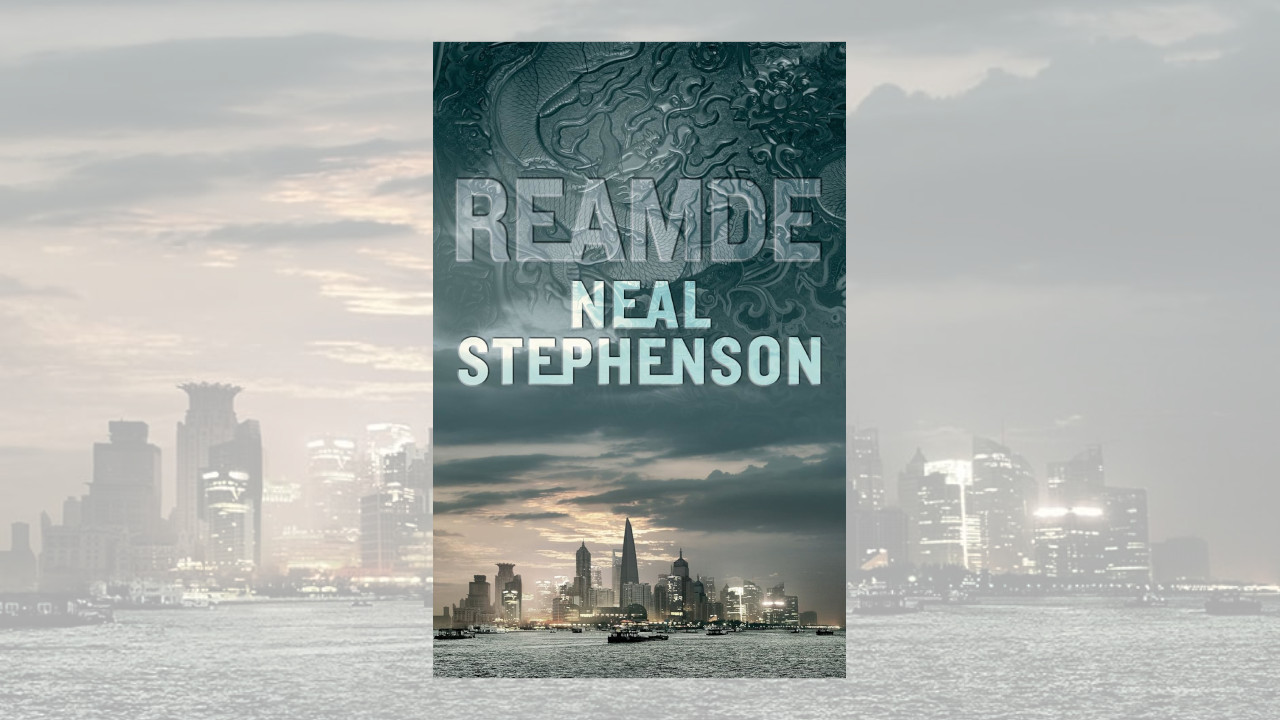
I first stumbled upon Neal Stephenson (not the man himself, you understand) in my local library. I was browsing for something new that I could really get my teeth into, preferably by an author I hadn’t read before, when I chanced on Cryptonomicon. I read the blurb and decided it fitted the bill. I borrowed it, read it, returned it and almost immediately went out and bought my own copy, because I knew this one was a keeper.
Some time later, over the course of one delirious summer, I read all three volumes of Stephenson’s monumental Baroque Cycle back-to-back, the volumes in question being Quicksilver, The Confusion and The System of the World. I’ve since doubled back for Snow Crash, devoured his recent Anathem and now inevitably succumbed to his latest, Reamde.
Stephenson is one of those authors I tell my friends to read. If you’re reading this blog I count you as a friend so, assuming I’m not preaching to the converted, I advise you to check him out. If you’re new to him you could do worse than start with Reamde, as it’s perhaps his most accessible book to date. Confusingly, you’ll probably find it in the science fiction and fantasy section, but this placement is just a legacy from the author’s early cyber-savvy SF novels; Stephenson’s books are actually rather hard to categorise. The Baroque novels are an extended romp through an alternate history of the Enlightenment, while Reamde is best described as a modern-day technothriller.
Where Neal Stephenson is concerned, however, descriptions fall short. Opening one of his books is like turning on a very bright light, like that dazzling LED torch you keep for really close, detailed work. Or putting on a pair of 3D glasses in the cinema and suddenly seeing all those extra dimensions you’ve been missing. Or falling down a rabbit hole and finding a labyrinth of tunnels that lead to places you’d ever imagined. There’s a hyperclarity to Stephenson’s writing, underpinned by the author’s uncanny ability to balance monumental epic scope with intimately human POVs.
I’ve called Reamde a technothriller, and I guess it is. The novel follows the escapades of an unlikely fellowship comprising – amongst others – an American billionaire game developer, a Russian mobster, an English MI6 agent and a Chinese computer hacker. They’re up against a grab-bag of fundamentalist foes, not least the distressingly charismatic psychopathic Welsh jihadist Abdallah Jones. The action springs nimbly from British Columbia to southern China and back again and, thanks to Stephenson’s witty, articulate prose and snappy switches of viewpoint, the pace never drops, despite the novel’s almost extraordinary length. Pace is everything here, really. Roughly one hundred pages in, Stephenson kicks his story into overdrive with what I assumed would be one of his outrageously vivid signature set-pieces. Eight hundred pages later, and nearing the finale, I realised the set-piece hadn’t stopped, that it was, in fact, still running faster than Jack Bauer at full throttle.
In the Stephenson canon, Reamde is a standalone. That’s partly what makes it so accessible. There’s no sign, for instance, of the mysterious Enoch Root, the Wandering Jew character who crops up in several of his novels, despite the fact their time frames are centuries apart. Reamde is not science fiction and there are no parallel realities. All the same, fans of Stephenson (of which I’m one – hadn’t you guessed?) will find a few familiar touchstones. The pursuit of gold (which in this case manifests itself in virtual form within T’rain, the novel’s online computer game), a castle location on a remote island that is at least a kissing cousin of Qwghlm from Cryptonomicon, not to mention quite a lot of gunfire. There’s also humour and an impressive number of sneaky moments that catch you out with entirely unexpected jolts of emotion. All this is strapped to a complex interlocking story that rarely misses a beat.
Although Cryptonomicon remains my personal Stephenson favourite, Reamde is probably my favourite read of this year so far. Given that it’s now the tenth of December, I don’t see that changing. If you’ve read it yourself, tell me what you think. If not, what are you waiting for?
 Graham Edwards