
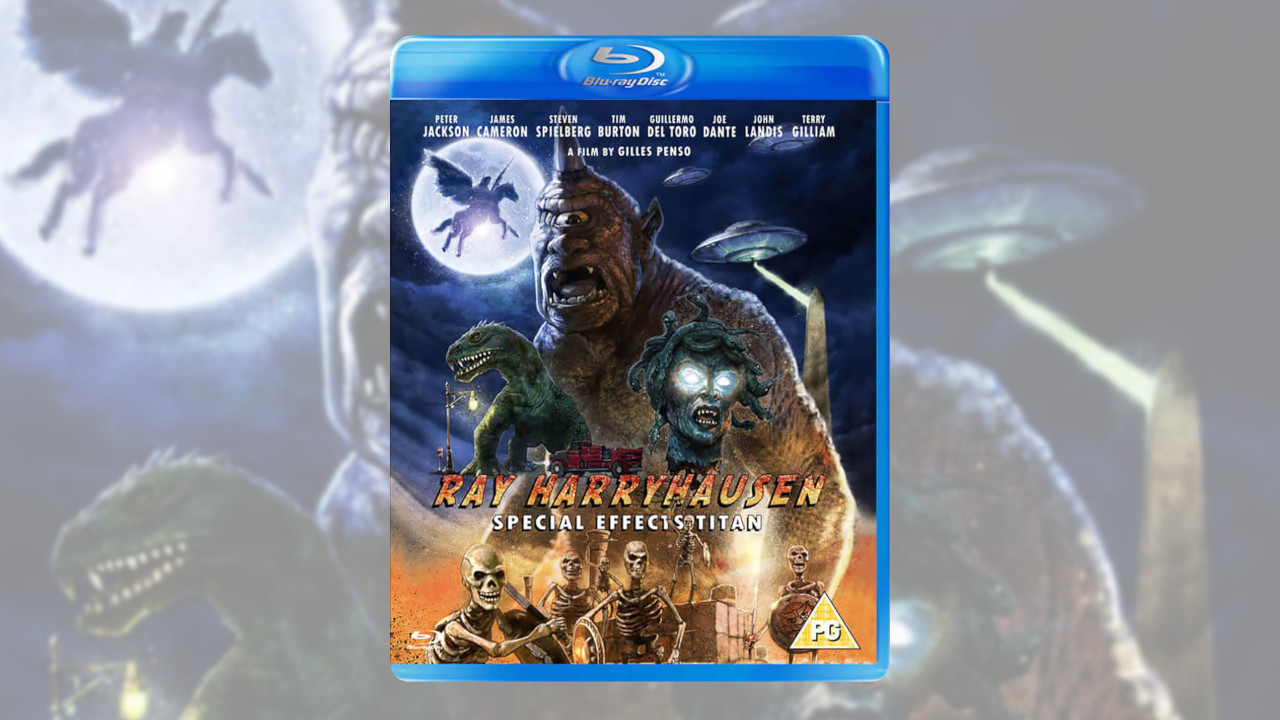
When I reviewed issue #5 of the visual effects journal Cinefex, I had this to say about stop-motion animation legend Ray Harryhausen:
“I’ve always found it astonishing that the man who invented the Dynamation process (whereby models are animated frame-by-frame in front of a screen projecting a previously-shot live-action plate) seemed reluctant to embrace newer technologies that came along later.”
Okay, maybe it’s a tad contentious. In the context of the review I’ll stand by it. Luckily for us all, Harryhausen’s Dynamation process was pure magic. As a kid it certainly worked on me like a spell. Two spells, actually.
The first was the simple joy of watching an adventure film featuring living skeletons, a bronze statue that came to life, a giant cyclops and, if I was lucky, a lady wearing little more than a couple of silk handkerchiefs. This was the magic of story.
The second spell was quite different. The more I watched Harryhausen’s films, the more I realised they obeyed certain rules. For example, if the camera was moving around, you knew you weren’t going to see the monster. However, if the camera locked itself down, usually with a wide lens and a clearly-defined foreground and background, then you knew the monster was coming. This was the magic of technique.
There were other clues that the monster was on its way. Those locked-down shots were often a slightly different colour to the rest. They also looked different. Not exactly fuzzy, but sort of coarse. Sandpapery. At the time, I didn’t know that what I was seeing was a subtle shift in colour balance and contrast, plus an increase in film grain, both caused by the original rear projection plate being rephotographed during the Dynamation process. A bit like when you photocopy a photocopy: you can never quite retain the detail of the original.
I’d noticed a similar shift in picture quality as a kid when watching the old westerns they ran in the evenings. It happened when shots didn’t just switch suddenly from one to the next but somehow melted into each other. This typically happened after a love scene, or any scene that ended with the hero staring broodily into the distance. This sudden change in visual texture, I eventually learned, was a side-effect of film duplication, occurring when an optical printer was used to create a lap-dissolve.
I might not have understood exactly what Ray Harryhausen was doing to put his monsters into the same world as his actors, but I knew he was doing something, and I knew it had something to do with the way the film was made. As with all good conjuring tricks, there was a secret there waiting to be discovered. Knowing this made me want to find out what it was.
Thus, a lifetime’s fascination in visual effects was born.
 Graham Edwards – Author & Journalist
I think I may have to track this down myself! 🙂
Yep, looks good.