
I write in Technicolor.
Perhaps I should explain. Like most writers of my generation, my writing style and sense of narrative have been greatly influenced by cinema. If you asked me to list the stories that have had the greatest influence on me, I’d be as likely to cite George Lucas’s Star Wars as John Steinbeck’s The Grapes of Wrath, or Akira Kurosawa’s Ran as George Orwell’s 1984. For me, fiction blurs past one word after another, and frame by frame, simultaneously.
Some critics get sniffy at the notion of relating the highbrow art of literature to the greasy popcorn pit that is film. Personally, I don’t see the problem. The words we pour out are the blended product of the stimuli we pour in. Much of that input is real life. But real life in the modern world just happens to contain moving pictures: feature films, TV shows, computer games … take your pick. Is it any wonder those pictures leak into our literature?
So, what’s all this got to do with Technicolor? Well, if you’re at all familiar with the two films I mentioned above, you may already have guessed. If not, allow me to elaborate.
Akira Kurosawa was a visionary film director. His early black and white works include the classic The Seven Samurai, but it’s his colour films I want to talk about here, in particular Ran. This loose adaptation of Shakespeare’s King Lear is a visual feast, packed with extraordinary moving tapestries: an immense burning castle; three huge armies marching one upon the next; warring brothers trading blows as their complex rivalry plays itself out to a tragic, bloody end.
Best of all, the film is colour-coded. Each of the three armies carries its own unique banners: bright yellow for the forces led by the brother Taro; vivid blue for Saburo; dazzling red for Jiro. Not only does this help the viewer distinguish between the opposing forces, especially when their movements are shrouded in swirling smoke, it also fills the screen with incredible light and life. Kurosawa’s use of colour is bold and masterful It’s also intrinsic to his storytelling. Without it, Ran would be a lesser achievement.
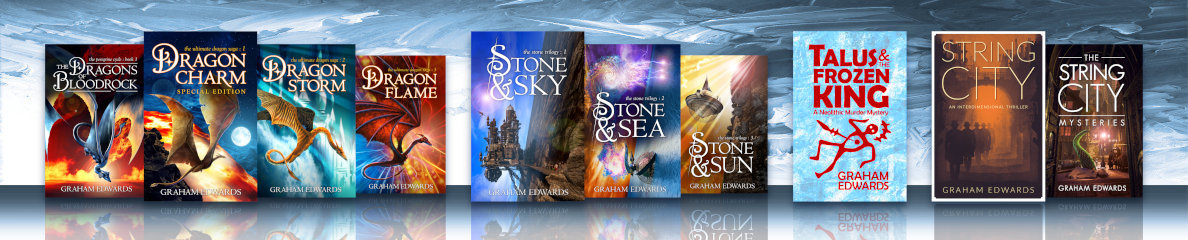
I’ve shamelessly plundered Kurosawa in my writing. When writing about squadrons of dragons battling it out in the skies of my fantasy world, I colour-coded my armies just as the great director taught me. I used the same approach with individual characters. In Dragoncharm, the chief villain is black (the composite of all the colours of magic he’s absorbed throughout his life). His ailing good-guy adversary is black, too (the wasted shade of charcoal). In Dragonstorm, the evil shapeshifting dragon Archan is white, because she sees her body as a blank slate on which any colour may be written. Other dragons in these novels are green, or gold, or tan, sometimes for good reason, other times because that was my whim. One has wings painted in dazzling rainbow hues. Some dragons reflect the world around them with scales of mirrored chrome (I love those guys, because they look cool).
So, to Star Wars. Given how much George Lucas was influenced by Kurosawa, is it any wonder that he uses colour coding in his films, too? What’s that? You hadn’t noticed?
Consider, the way the colour palette develops through the original 1977 film. From the stark white interiors of the rebel blockade runner, we transition swiftly to the hot desert hues of Tatooine. Compare the colourless grey interiors of the Death Star to the funky run-down warmth of the Millennium Falcon. Subsequent films gave us the blue/white ice planet Hoth, the murky green swamps of Dagobah, the glorious orange sunsets of the gas giant Bespin. Cleverly, this shifting palette is designed to inform the drama. All the films in the original trilogy were consciously planned to show a progression of colour through the film, both to keep the eyes of the audience stimulated and, crucially, to help tell the story.
I use this trick myself, imagining in my mind’s eye how a scene might look projected on to a movie screen. I don’t necessarily block the action like a film, but I sure as hell set the scene that way. Weather is always a big deal for me, as is time of day. I like to know where the sun is, whether it’s foggy, if there’s a storm. What will the dawn light do to the faces of my characters? Will the sunrise play well against the previous scene, set as it was in the deep blue of dusk?
In the days before motion pictures, novelists didn’t think like this. For this reason, many people believe the “correct” way to write prose fiction has nothing to do with the movies. I beg to differ. Do I enjoy reading Victorian literature? You bet your boots. Do I also like visiting my local cinema to watch the latest blockbuster? What do you think?
Stories come in many colours. I want to see them all.
 Graham Edwards
I think cinema influencing prose is inevitable, and it’s the writers’ job to be aware of it and, when possible, leverage it. I haven’t thought about the visual aspect of cinema and its relation to writing before – interesting stuff. One thing I have been concerned with is making sure I remain aware of the aspects of point of view that are unique to prose, and not found in visual mediums. I think artists on both sides need to recognize influences on them, but try to make it a net gain within the context of their own medium. Thanks for the post.
I agree, Steven. As much as a novelist can use colour in the ways I’ve described, ultimately the prose is about the words, and the words alone. “She wore a yellow ribbon” may have a pleasing rhythm, but it tells me nothing about who she is, or why she wears such a startling accessory. “Her groping hands clutched the yellow ribbon he’d knotted noose-like about her neck” immediately begins to tell me a story. The ribbon’s colour is iconic – just as it might be were it a movie prop – but only in the context of the words surrounding it does it acquire meaning.