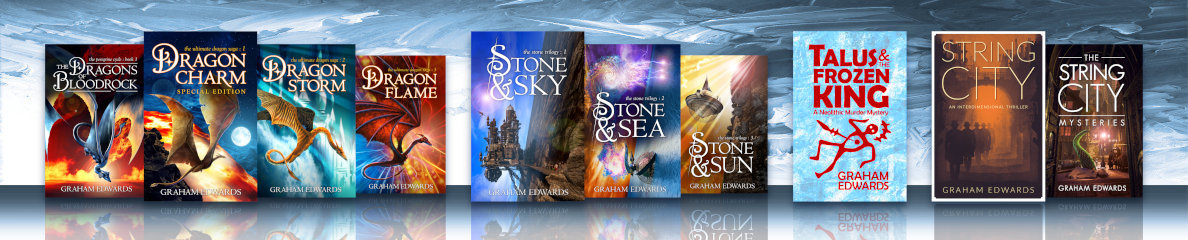

Most people are like cats – they live not just one life, but many. Writers are no exception. Here are a few dramatic moments from my second writing life.
Life 2 – A Long Way Down

One of the ideas I pitched to Voyager Books during my dragon years was a dark fantasy novel about the power of memory. It also contained dinosaurs. As I rode the train to London for what looked set to be my final publishing lunch at Voyager Books, my mind turned back to that old idea. Since I’d become known as the ‘dragon guy’, I wondered what would happen if I swapped the dinosaurs for dragons. I also wondered if I could resurrect some of the ideas from another failed pitch: a partial manuscript I’d long since filed away, called The Wall …
By the time I got off the train, my notebook was full of scribbles. Not long after, as I sat chatting with Jane and Joy in the Voyager office, the dreaded ‘what’s next?’ question finally came up. I launched into my pitch. What did they think about a new fantasy trilogy set on a parallel world – a world that’s actually a vast and infinite wall? As I outlined my ideas, I got quite excited. A considerable amount of arm-waving was involved. I drew diagrams on scraps of HarperCollins stationery. When I finally shut up, Jane and Joy exchanged smiles and I knew that somehow I’d managed to snatch victory from the jaws of defeat.

Writing the first of these new books was an absolute joy. What I’d feared might be a desperate mash-up of old ideas turned out to be something entirely fresh. Although there were dragons in it, the story was mostly about people – a refreshing change for me, given my track record to that point. There were strange environments, even stranger creatures and a peculiar kind of time travel. I couldn’t quite work out if the end result was fantasy or science fiction or something else altogether, and that was just fine. I felt I’d finally hit my stride, and that the writing was wholly mine.
The book had several working titles during its genesis. My favourite was The Skies of Amara. Then Lucas, one of the editorial assistants at Voyager, suggested calling it Stone Over Sky. It wasn’t quite right, but I loved the feel. It didn’t take long after that for me to land on the title it was eventually published under: Stone & Sky.
Stone & Sky was well reviewed, although no comments pleased me more than my editor Joy’s remark that my writing was ‘strange and subtle.’ As with the dragon books, writing the sequels, starting with Stone & Sea, was much harder. Dealing with my father’s death while doing it didn’t help. Halfway through writing Stone & Sun, the final book of the trilogy, I got completely mired and did something I’d never done before, and have never done since: I negotiated an extension on the deadline. Writing the second half of that damn book was only slightly less painful than having your wisdom teeth out (I speak from experience). What made the process more difficult still was the knowledge that sales for the previous two volumes were in the doldrums. It looked like, this time, my days with Voyager really were numbered.

One of the problems was simple economics. Back then, Voyager habitually committed to big print runs for first edition mass market paperbacks – in my case 12,000 copies. That’s one heck of a lot of paper to shift. Unfortunately, if you don’t shift it, your name ends up written in red on the final year accounts … which makes it understandably hard for a commissioning editor to justify further investment in you, however much they might want to (and I have to say that Jane Johnson was never less than totally supportive). In the end, however, any shortfall in sales must come down to the books themselves. People simply weren’t buying my books. The Stone trilogy isn’t easily categorised and, much as I believe it contains some of my best writing to date, I’m equally ready to admit these tales of derring-do in an upturned fantasy realm are a little, well, strange.
My last few exchanges with my friends at Voyager were strained, not through any fault on their part, but because of my failure to accept the reality: my second writing life was over. I should have been happy to have six published novels under my belt. Instead, I was deeply depressed that things had stalled. Looking back, I see how poorly I understood the publishing world back then. I’ve likened getting my first novel Dragoncharm published to winning the lottery, and that’s not a bad analogy. In any event, it was time now to jump off the luck-dragon and start earning my keep.
Time, in fact, to start the next chapter in my writing life. The big question was, what form would it take? It took me a long time to work that one out. When I finally got my head together, I realised the answer was staring me in the face: wipe the slate clean and begin again. I would write a new novel and submit it to literary agents. If the new book was any good, maybe one of them would take me on.
So, that’s what I did. It was exciting. It felt like the beginning of another adventure. For a while there, it had felt like I was falling off that damn world-wall I’d created for myself. After a terrifying period in freefall, it occurred to me that maybe I didn’t have to fall at all. Maybe I could fly.
Next time I’ll tell you about my third writing life, during which I discovered that size isn’t everything.
 Graham Edwards
Reblogged this on Free Speech! and commented:
Interesting perspective.
Reblogged this on Free Speech! and commented:
When the dreamer dies what happens to the dream? Does it to die or lives on through someone else? Reincarnation? Hmm…