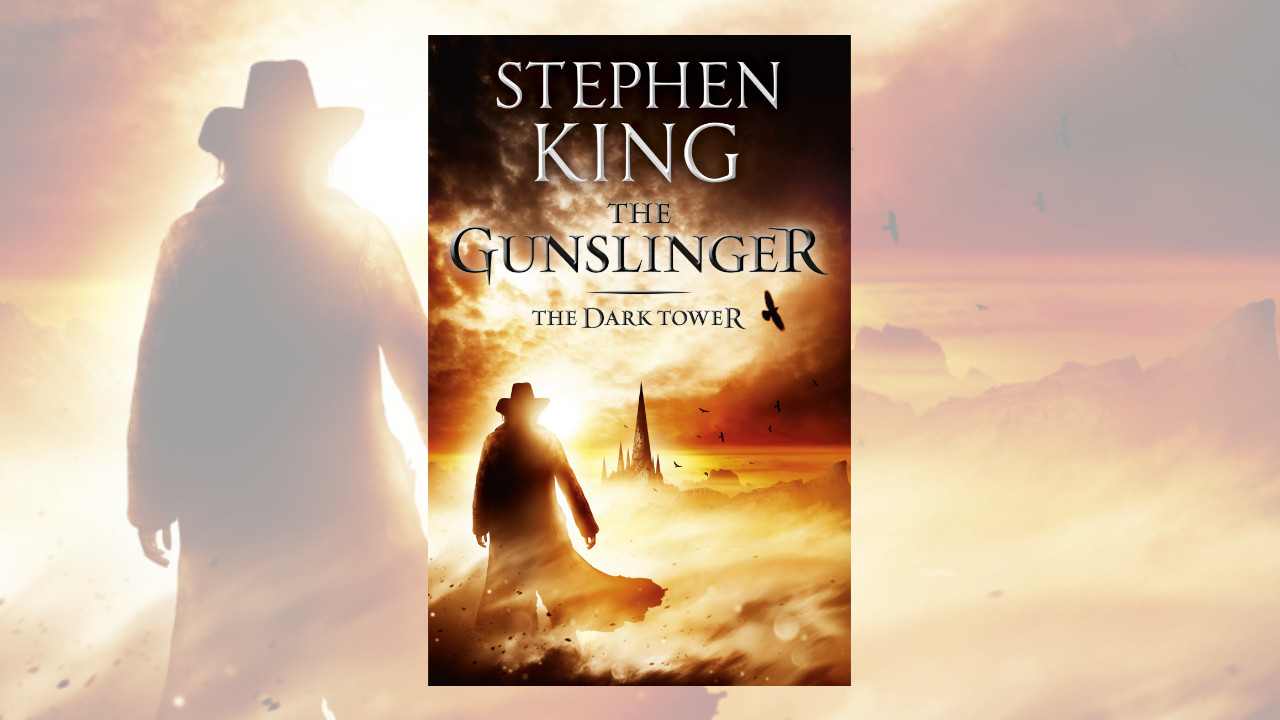
Although it comprises eight books, Stephen King’s Dark Tower series is really one gigantic novel told over many volumes. The first book – The Gunslinger – was first published in novel form in 1982. The final book, The Dark Tower, appeared in 2004. In 2012, King published one additional novel, The Wind Through the Keyhole, which slots into the middle of the series as a kind of interesting aside to the main narrative.
I won’t attempt to summarise the plot of a story that, in total, runs well over 4,000 pages. Suffice it to say this is King’s magnum opus, an epic fantasy yarn that follows the fortunes of Roland, the last gunslinger, in his quest to find the fabled Dark Tower. King has cited JRR Tolkien’s The Lord of the Rings as his primary inspiration. When he started writing the first version of The Gunslinger at the impressionable age of nineteen, he had a head full of hobbits. Just as big in the mix, however, are the spaghetti westerns of Sergio Leone. You don’t have to be a genius to see how closely Roland is modelled after Clint Eastwood’s Man With No Name.
It’s easy to draw parallels with Tolkien. In pursuing his quest, Roland gathers around him a fellowship, or ka-tet, of loyal followers. The landscape through which they journey is iconic and rich in mythology. Monsters abound. Both writers evoke a sense of longing for a lost world. The Lord of the Rings is infused with sadness that the elves are departing and the magic is fading away, while The Dark Tower is set in a world that has already moved on. Tolkien tells us the world is dwindling; King shows us a world where the apocalypse has already happened.
Lurking beneath this shared wistfulness, however, there lies a fundamental difference. Tolkien’s story presents a very English brand of fatalism, a contemplative acceptance that great change is coming, and there is nothing we can do about it. His hero, Frodo Baggins, is brave, resourceful and stoic, but never once does he express hope that the world, or even he himself, might be saved. Frodo’s quest is to defeat the enemy by destroying the enemy’s greatest weapon, whatever the cost. Fate itself cannot be defied. Worlds move on.
King’s response is different. Roland is on a quest not to defeat an enemy but to climb a tower. Initially, his ambition appears to be nothing more than a Don Quixote-ish whim. However, as the story develops, it transpires that Roland is seeking not only redemption for past sins, but the means actually to restore the world. I read this is a suitably American agenda. Change can be effected. Worlds can be saved.
Here’s another key difference. Whereas Tolkien’s Middle Earth represents a sort of alternative prehistory to our own world, Roland’s Mid-World is directly connected to our reality by a number of secret doorways. The action occurs as much in New York City and Maine as it does in a distant fantasy realm; indeed, Roland’s companions are mostly drawn from our world. This provides King with ample opportunity to present amusing culture clashes. It also gives readers the chance to see Mid-World through familiar eyes. Actually, Tolkien performed the same sleight of hand in The Lord of the Rings. He just didn’t tell anyone the hobbits are us.
I first discovered The Dark Tower in 1989, when I stumbled over the Sphere Books UK trade paperback of The Drawing of the Three, the second book in the series. Beside it on the shelf was The Gunslinger. I was already a Stephen King fan, but somehow these books had passed me by. I bought them both, read the first one and found it entertaining. I then read the second and was completely sucked in. King has since made extensive revisions to The Gunslinger, remarking that he always used to apologise for the novel, telling people to stick with the story until it really got going in book two. I think he was a little hard on himself, but there’s no doubt it takes the series a little while to find its feet.
After that, I settled into my role as one of King’s Constant Readers by eagerly anticipating each successive Dark Tower volume. Book three, The Waste Lands, appeared in reasonably short measure, but I had to wait until 1997 for Wizard and Glass. Shortly afterwards, King was involved in a horrific traffic accident that nearly ended his life. Suddenly, I and others were wondering if he would write any more books at all, let alone complete the project he’d been working on for decades. Ultimately, King completed his mammoth task by publishing the final three volumes in rapid succession, betwee 2003 and 2004. The quest was complete.
While I love The Dark Tower, I won’t claim it’s King’s best work. As the series progresses, certain problems set in. In the last three books, there’s a real sense that King is struggling to pull together all the disparate threads and direct them towards a satisfying conclusion. In places it feels overly plotted, even contrived. Then there’s King’s decision not only to bring in characters from some of his other books, but to write himself into the story. Such white-collar metatextual tricks don’t really suit King’s blue-collar style (he himself has expressed regret at putting himself in the book). Personally, I don’t have too much issue with such antics, and I defy anyone not to end up rooting for Father Callahan (from Salem’s Lot) when he finally comes into his own.
My gripes about the later books are nothing when set against the fluid, often funky storytelling of the earlier books, all of which thunder along firing on approximately sixteen cylinders apiece. Nor can I ignore the sublime emotional power of the central book, Wizard and Glass, which winds the clock back to Roland’s youth to relate the terrible events for which he is so desperate to atone. As for the final book’s ultimate conclusion (an ending hated by many of King’s most loyal fans) well, in my opinion, it’s just monumentally good.
Despite the failings of The Dark Tower, the series succeeds thanks to King’s sheer narrative power, his muscle, his instinct, his profound understanding of character, motivation, action and emotion … all these things keep the story firmly on track by main force. I have genuinely fallen in love with Roland’s companions, Eddie, Susannah and Jake. As for Roland himself, I can only paraphrase what King himself says in the afterword to The Drawing of the Three:
The gunslinger haunts me.
 Graham Edwards
Seems like we all get hooked by the lure of the tower – great review.
Thanks, Gregg. I wish you long days and pleasant nights.