Ever since the publication in 1999 of his first novel, Ghostwritten, author David Mitchell has consistently delighted in playing with narrative structure. For example, in his earlier work, Cloud Atlas, no less than six narratives spanning many centuries are nested together like matryoshka dolls.
Like Cloud Atlas, Mitchell’s latest novel, The Bone Clocks, is divided into multiple sections, each with its own narrator. However, unlike Cloud Atlas, its story is ultimately about just one person. Her name is Holly Sykes. She’s an ordinary Gravesend girl with an extraordinary gift, who finds herself caught up in a cosmic battle between the Horologists and the Anchorites, two factions of rarefied amortals who share the ability to cheat death.
I’ve just finished listening to the unabridged Whole Story Audiobooks edition of The Bone Clocks, wonderfully narrated by Jessica Ball, Leon Williams, Colin Mace, Steven Crossley, Laurel Lefkow and Anna Bentinck. Given the audiobook’s total length of nearly 25 hours, it was a mammoth undertaking.
The great thing about audiobooks is they force to you listen to every single word. Where The Bone Clocks is concerned, that can only be a good thing. Mitchell’s prose is rich and witty, his dialogue frothy and articulate, his ideas strong and far-seeing. Yet the whole is imbued with a clarity of diction many so-called literary authors fight shy of. The sound of a pivotal cataclysmic event is described as like “a town being dropped, and everything in it smashing to bits.”After a ride up a mountain, “Holly slides off the chairlift like a gymnast, and I slide off like a sack of hammers.” We are informed that “the soul is on the edge of what’s visible, like a clear glass marble in a jar of water.”
It’s hard not to compare this novel with Cloud Atlas, which I read in the conventional way and which, yes, I do confess to skimming a bit. The Bone Clocks is more accessible than its predecessor, I think. The connections between the different parts are more obvious and, despite the unusual structure, the whole thing follows a more traditional narrative arc.
Some characters from the two books even share the same DNA. Crispin Hershey, the curmudgeonly author of The Bone Clocks, bears more than a passing resemblance to Timothy Cavendish, the irascible vanity publisher of Cloud Atlas. Hershey’s voice is as pithy, plummy and crackling with fireworks as that of his literary predecessor. As performed by Steven Crossley, Hershey is always sympathetic, frequently hysterically funny, yet consistently and disarmingly sad.
The clarity of Mitchell’s storytelling is welcome in a book of this complexity. It also creates one of the novel’s few problems. Some of the exposition, especially the stuff that delves into the actions and motives of the novel’s undying amortals, is so on-the-nose that it sometimes robs the story of mystery.
Similarly, the repetitive strokes of deus ex machina that are wielded by the amortals, and which ultimately stitch Holly Sykes’s entire life together, are sometimes too predictable to be anything more than, well, acts of costumed gods descending on cardboard chariots from a theatrical heaven.
These are minor gripes. If Mitchell’s storytelling machine makes the occasional clunk, it’s only because he’s revving it to the max. The jolts are worth tolerating, not least for those exquisite moments when the gears of his disparate narratives mesh suddenly and seamlessly together, and all the hairs go up on the back of your neck.
Given that this is ultimately the journey of a single, flawed, human soul, could The Bone Clocks have packed more of an emotional punch? Yes, I think it could. In the hands of a fantasy author like, say, Neil Gaiman, might the book’s other-worldly elements have delivered a more heightened sense of wonder? Perhaps.
However, I don’t believe that’s what the author wanted. I believe Mitchell is a skilled enough writer that he delivered exactly the story he intended to tell. Given the extraordinary breadth of the world he creates, and the fundamental ordinariness of the souls who inhabit it, that’s no mean feat. Bottom line? This is an another extraordinary novel from one of the bravest and best writers of his generation, and you need to read it.
My final remark is reserved for the title. While the phrase “bone clocks” gives precious little away, nevertheless it reeks with symbolism. It’s also mysterious. Is this a psychological thriller? A dark fantasy? A lifetime’s memoir? The answer is it’s all those things and more.
By the way, if you’re wondering what a “bone clock” actually is, let me assure you that the meaning of the phrase is revealed during the course of David Mitchell’s epic tale. Not that it’s my place to tell you the secret.
For that, you’ll have to read the book for yourself.
 Graham Edwards
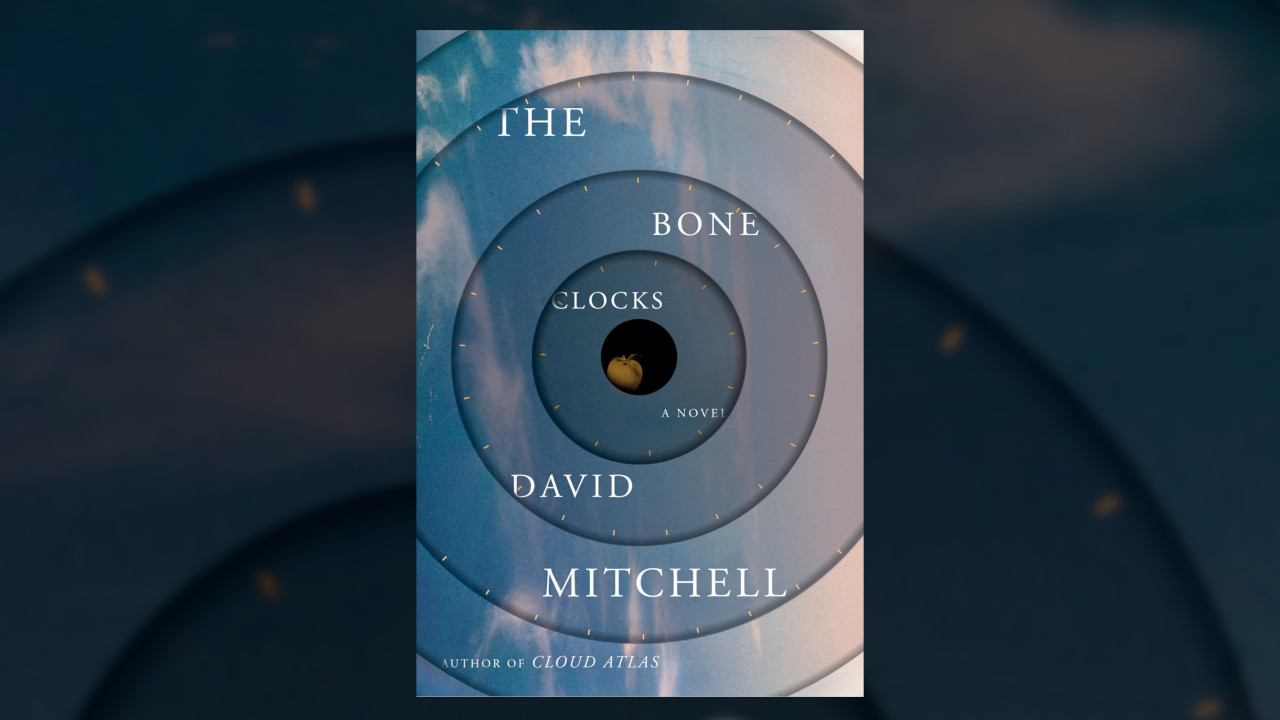
Thanks for the review. I haven’t read it yet, but it’s on my to-read list. I have to add that while I try not to judge a book by it cover, the UK cover is much more inviting the one here in the US. Take a look: http://www.amazon.com/Bone-Clocks-Novel-David-Mitchell/dp/0812976827/ref=sr_1_1?s=books&ie=UTF8&qid=1434979925&sr=1-1&keywords=the+bone+clocks
I agree, Dorothy! I’ll take the UK cover over the US one any day.