
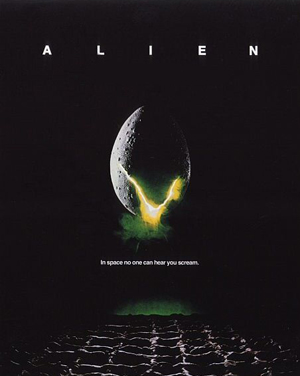
Anyone who knows me will be unsurprised to learn that Ridley Scott’s Alien (1979) is one of my favourite films of all time. So much has been written about this futuristic horror movie, however, that it’s hard to add anything useful to the conversation.
But you probably know that already.
Instead of summarising the plot, I could talk about the groundbreaking art direction. The Nostromo, developed from initial designs by Ron Cobb, is a claustrophobic rabbit warren of angular corridors and metal ladders. Everywhere you look there’s gushing smoke and dripping water. Harsh industrial lamps flare at the camera. Endless grilles shatter the light. At a stroke, Alien redefined the look of the future for decades to come, completing the swing away from the pristine futurism of 2001: A Space Odyssey (1968) that had begun with Star Wars (1977), and taking science fiction cinema into a whole new realm of grit and grime. It’s a look that continues to influence the genre to this day.
But you probably know that too, just as you know that the other big visual treat in Alien is the design of the creature itself. The titular monster was the nightmarish creation of Swiss artist HR Giger. I don’t know about you, but that dang beastie has haunted my dreams for many years. Giger’s glossy biomechanical style is evident not only in the alien itself, but also in the derelict ship and planet exterior. It set the benchmark for every movie monster that came after. But, although Giger’s alien has spawned many imitators, nothing has yet come close to the original.
As I’m sure you’ll agree.
Maybe I should turn my attention elsewhere. I could mention Ridley Scott’s and Derek Vanlint’s restless camerawork, or the subtle and deliberate muffling of parts of the soundtrack, both of which set you squirming in your seat even when little appears to be happening. Then there’s the outstanding composition of almost every single frame in the film. Or the remarkable performances. Sigourney Weaver is magnificent in her career-defining role as Ripley, but let’s not forget Yaphet Kotto and Harry Dean Stanton as the bickering engineers, Tom Skerrit as the world-weary captain and Ian Holm as the science officer who turns out to be not what he seems. Holm in particular is masterful, taking lines that on paper read like the worst B-movie dialogue and delivering them with unpredictable emphasis and a smart cynicism that turns them into something strange and unsettling.
But I know I’m wasting my time, because, like me, you’ve probably watched Alien so many times you can quote the script backwards.
Perhaps I’ll do better sharing my own personal memories from 1979, the year the film came out. The trouble is, I’ve said it all on this blog already. I’ve told you how, long before I ever saw the film, I read both the novelisation by Alan Dean Foster and the excellent The Book of Alien by Paul Scanlon and Michael Gross. By the time I got my dad to sneak me into the cinema (I was fourteen years old and it was an X-Certificate), I knew everything there was to know about Alien, yet still the film blew me away. I’ve told you how I completed my education about the making of the film by reading Giger’s Alien and Cinefex #1, and how one of the highlights of my later teenage years was the day when the film finally became available to buy on VHS home video, and I finally had my very own copy I could watch over and over again.
Instead of telling you all that, I’ll tell you this. Alien won only a handful of technical awards for visual effects, art direction and sound design, yet it is one of those rare films that has not only stood the test of time, but has also firmly established itself in the public consciousness. Having dominated the zeitgeist in its day, it has become a legitimate part of our cultural heritage. In 2002, the US National Film Preservation Board confirmed this by entering it into their registry as a film of ‘cultural, historic or aesthetic significance’. Well, it was a no-brainer, wasn’t it?
I know Alien as well as I know any film, but here’s the clincher: every time I watch it, the damn thing still works on me. There aren’t many films I can say that for. Does it do the same for you?
 Graham Edwards
I was pretty much in the same boat as you Graham – with regards to knowing all about the movie long before it came out. I also read (and still have) The Book Of Alien and also The Alien Movie Novel (with the entire story told in screen-shots from the film). The first image I ever saw was on the front cover of the July ’79 issue of Fantastic Films Magazine – an image of one of the Moebius-designed space suits, with the Japanese-style brass shoulder pads. Fond memories indeed!
I’m not a fanatical collector (unless we’re talking about a certain periodical …) but I do believe I have that issue of Fantastic Films tucked away somewhere!
Blade Runner is my personal favourite, but I do think that in some ways Alien is more timeless than even Blade Runner. Partly I think its down to the evocative score as much as the production design. Or the funereal pace , the gritty, ‘Everyman’ casting. Ah, the whole thing is wonderful. Shame Ridley couldn’t recapture the spark with Prometheus, but I guess times/films have changed.